

Back in 2015, a colleague of mine named Antonio who was working on PVC-O pipes, leaned over and told me something I didn’t fully believe at the time:
💡“This pipe is going to be huge. These oriented PVC products are the future. The diameters will get bigger, the fittings will follow, and one day everyone will want it.”
I nodded politely. Another engineer in love with his niche.
Year after year, that pipe has shown up in more of my projects, more bids, and more conversations across the global water industry.
That’s why I wanted to bring a super interesting case study around those pipes, with the presence of Dolores Herran from Molecor.
I simply love the business model behind it.
That’s the part I think most water professionals, and especially the MBA-minded ones reading this, completely miss.
So let me front-load the value before I tell you the company story that prompted all this.
What “oriented” actually means
Take two pipes, both labeled DN200. One is standard PVC. The other is oriented PVC — PVC-O.
Drop either into an irrigation network or a pumping main and, on paper, they look interchangeable.
❗They are not.
The molecular orientation process realigns the polymer chains, dramatically improving the mechanical properties of the pipe.
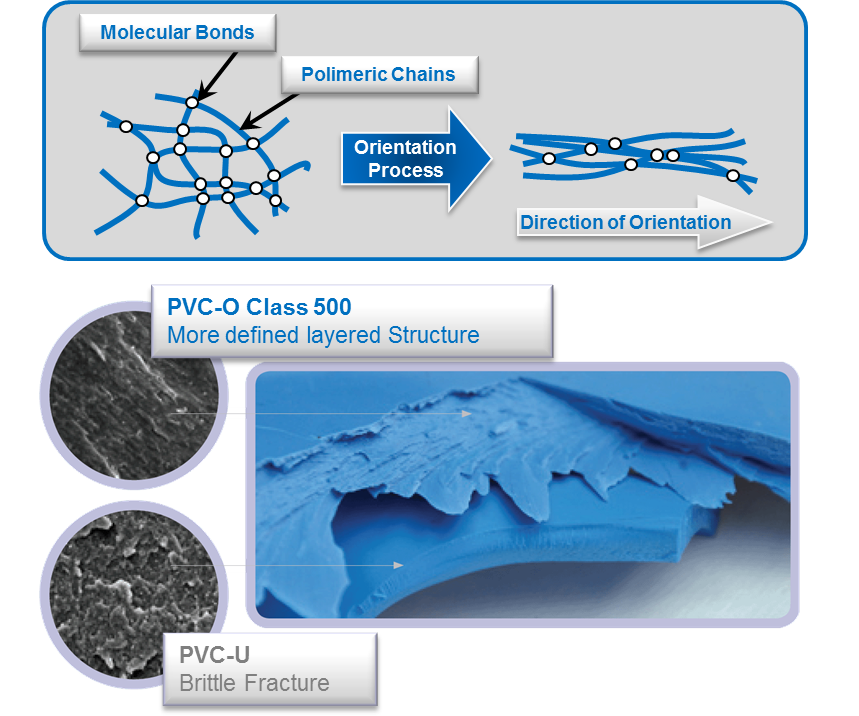
Same chemistry — it’s still PVC, with all the corrosion resistance and chemistry advantages of plastic — but now you can achieve the required pressure rating with a thinner wall.
Think of an aircraft: same job, lighter material, but engineered to be stronger where it counts.
Thinner walls mean three things that compound:
A larger internal diameter for the same external diameter. More free section.
Higher flow capacity. Flow equals velocity times section, so more section means more water moves.
Lower head loss thanks to a smoother, less rugose internal surface — which directly cuts pumping energy.
🚨Here’s the trap I watched countless engineers — myself included, early on — fall into: we forget (most don’t know actually) how to put CAPEX and OPEX on the same table.
A pipe that’s slightly more expensive to buy but saves pumping energy for 20, 30, even 50 years isn’t a cost. It’s a return.
As Dolores Herrán of Molecor put it to me, with the weariness of someone who fights this battle daily:
“CAPEX, CAPEX, CAPEX — and never OPEX.”
She told me about a large-diameter case study where, over 20 years, the energy savings delivered to a water utility roughly equaled the entire cost of the project.
The installer might not care. But the operator absolutely should — and increasingly does, as everyone bets that energy prices only go up.
The real innovation wasn’t the pipe, it was the air
PVC-O wasn’t invented by Molecor. The molecular orientation of pipe was discovered almost by accident in the UK in the late 1970s.
The original method was clumsy and energy-hungry: heat an initial tube with water, pressurize it with water, expand it, then cool it with water inside a mold. It worked — it was running in Britain by the 1980s — but it was inefficient.
✨ Molecor’s founders looked at that and asked a simple engineering question: what if you used air instead of water?
That single substitution became the revolution. Manufacturing the pipe with air rather than water is the core of Molecor’s technology, and it’s why a company founded in 2006 by two friends who met on an Executive MBA at IE Business School could go on to validate a prototype, build a business, and stretch their product range from 90 mm all the way up to currently 1,200 mm in diameter.
It’s also, characteristically, an innovation built entirely from scratch. There was no roadmap. Molecor even had to help write the standards and develop the PVC-O fittings themselves, because the market simply didn’t have them yet.
Why you don’t ship air across an ocean
When I was running bids for water pipeline projects — estimating quantities, requesting quotes, comparing steel against polyethylene, polypropylene, GRP — there was always one truth about pipe procurement: you’re shipping mostly empty volume.
A pipe is air wrapped in a thin wall. Put it in a container and send it from a Spanish factory to a project in Paraguay, and you’re paying to transport air across the planet.
This is exactly why the local player always seemed to win on price. They adjust to the local market equilibrium, and the importer simply can’t compete once freight is loaded in.
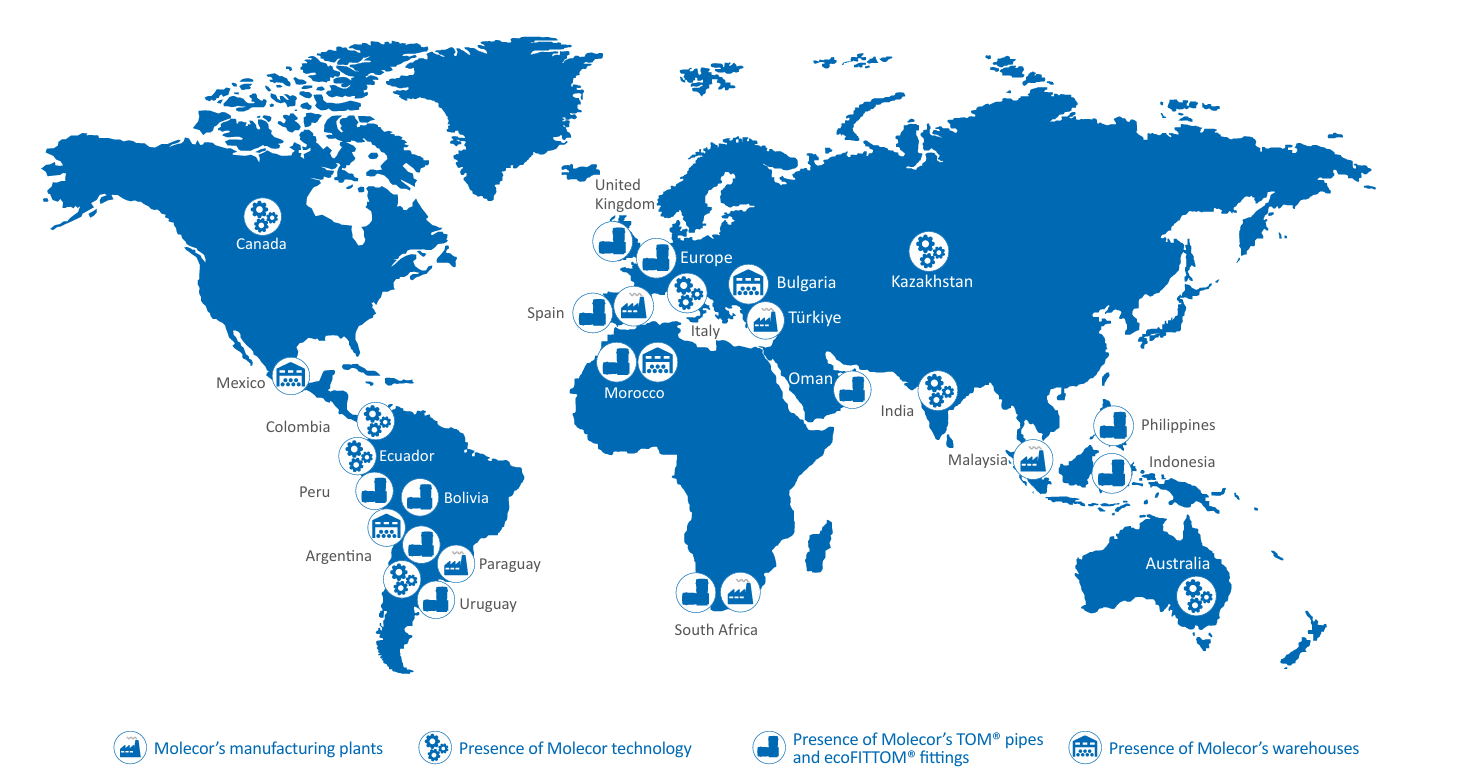
Molecor’s answer to this is elegant: don’t always ship the pipe, ship the technology. Sell the machine that makes the pipe, and let it be built locally.
That’s the dual model. They wear two hats at once: they manufacture the technology and they operate it themselves.
As Dolores explained, being the operator of their own technology is precisely what makes them credible when selling machines to a third party — “I’m the one who builds the machines for myself,” which gives them enormous flexibility.
Win a 300-kilometer project of DN1200 in the Philippines? Ship a production line there.
But the decision of whether to ship pipe or plant a factory is purely a question of volume:
Low volume, opportunistic: ship the pipe, or partner with a local player on a single big project.
Proven volume: stop “transporting air” and establish a local plant (as they did in South Africa, and are now doing in Turkey).
This is the flywheel. Enter a market, prove the product on a trial project, build volume, then localize. Each turn of the wheel funds the next. Dolores said it best when I asked her how Molecor exports:
“There isn’t one way to export. Each market is different. I carry the same product, the advantages are the same — but I have to tell them differently in one market than in another.”
Where this pipe actually wins
A clarification worth making, because PVC-O is not a pipe for everything. The sweet spot is pressurized water transport, roughly 12.5 to 25 bar, in buried trenches, within that 90 mm–1,200 mm range.
Applications? Many. Check out some examples below.
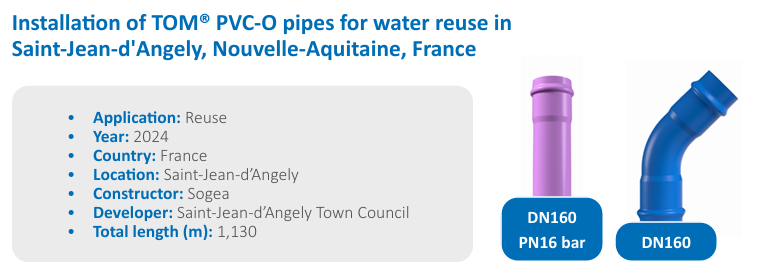
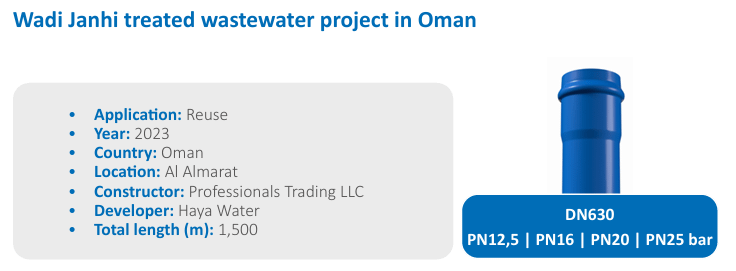
And here’s the strategic detail that took me years in the industry to internalize: by the time a pipe spec lands on your desk in writing, it’s too late to change anything.
🚨If you want PVC-O specified, sometimes you have to go upstream — to the design phase, to the engineering firm — sometimes one or two years before the project materializes. A huge part of their work is getting consultancies to list oriented PVC as an option long before a tender exists.
The Molecor story
Two of the founders, Ignacio Muñoz and José Manuel Romero, met on an Executive MBA at IE in the early 2000s. The idea for Molecor grew out of one of those MBA projects we’ve all had to do. The company was incorporated in 2006 with a single bet: build a technology to manufacture oriented PVC pipe, using air.
Dolores joined in 2007. A structural engineer by training, she’d been calculating building structures when a professor connected her to Ignacio.
She jumped to a six-person startup selling a technology that didn’t even exist yet and, by sheer luck, did so right before the Spanish construction crisis gutted her old sector. They validated the technology that same year.
What followed reads like the flywheel in motion. AENOR product certification in 2009. Spain’s infrastructure market collapsing around 2010–2012, which forced them international — their very first machinery sale went to Australia (”we couldn’t have gone further,” she laughs).
Then a steady, market-by-market grind: a first joint venture in South Africa in 2016 (chosen, pragmatically, because the country already had a standard to anchor to); five years spent developing the standard in India from zero; an acquisition in Malaysia in 2022 to crack Southeast Asia.
Today Molecor has commercial presence in more than 30 countries and owns plants in South Africa, Malaysia, Paraguay and, as we speak, is opening its fifth in Turkey, with inauguration slated for this summer.
The plan from here? Keep widening markets, but shift the emphasis from selling the technology to establishing themselves — owning a piece of the growth rather than just banking a machine sale.
North America, Latin America, and Southeast Asia…, alongside hard-won validation work in the Middle East — trial projects in Oman, certification grinding through Saudi Arabia — where oriented PVC has essentially no presence yet.
When I asked Dolores about going public, she laughed it off:
“Not yet. We’ll see. We still have a long way to go. What motivates me most is that we’re still at the bottom of the growth curve.”
If Molecor were listed, I’ll admit, I’d be tempted. For now, I’ll settle for telling you the story.
If you want to dig into a proper CAPEX vs OPEX lifecycle analysis for water infrastructure, let me know, I’ve been meaning to put together a session on it. And if you’d like an introduction to Dolores or the Molecor team, reach out; the water industry runs on the conversations that happen behind the curtain.


