

There is an interesting through-line in the history of desalination.
For thousands of years, humans made fresh water from the sea by boiling it. The Greeks did it on their ships; even the builders of the pyramids understood the trick.
Then, sometime around the 1980s, we replaced that thermal logic with a membrane and a pump, and the cost of water began its long fall.
Our guest today, Guillem Gilabert-Oriol, explains that we are about to make the same move again — only this time, the prize is not just water.
It is salt, minerals, and a new way of thinking about the sea itself.
Guillem is a doctor in chemical engineering, a researcher who has put close to thirty products into the industry over his career, a university professor, and a board member of the European Desalination Society.
But the most revealing thing he said about himself was not on his CV. It was a philosophy of how innovation actually happens, and a refusal to romanticise the lab.
R&D is a conversation, not a cathedral
Ask most people to picture research and development and they imagine a quiet laboratory, a brilliant mind, a breakthrough.
Guillem’s picture is almost the opposite. The lab matters, yes, but the real work happens outside it, in conversation with customers.
His word for what he is hunting is precise: underserved needs. Not problems someone imagined might exist, but problems a real operator is living with right now.
The danger he describes is the “ivory tower” researcher — the one who decides, alone, that an idea is brilliant, pours years and money into it, and finally delivers something nobody wanted because it solved no real problem.
His antidote is almost embarrassingly simple: get out of the lab, go on the customer visits, listen at conferences, and let the voice of the customer shape the work.
I felt this in my own bones. When I launched The Water MBA in 2023, what I imagined in my living room mattered far less than the feedback the market kept sending back. You iterate toward fit, or you build a monument to your own assumptions.
This matters even more in water because of the rhythm of the industry. Compared to consumer electronics, water is conservative — and rightly so.
It is heavily regulated, it touches human health, and it runs on capital-intensive assets that nobody rebuilds on a whim.
So the clock runs slowly. By Guillem’s reckoning, a marginal improvement — a bit more membrane area, a little less energy, some antifouling character — takes around two years. Something genuinely new takes three to four.
The brine valorisation membrane his company launched this year traces back to an idea floated at a conference in 2022. Four years, idea to product.
And before a single euro goes into development, there is one gate everything must pass through: the business case. No business case, no project.
It is a discipline that protects the researcher from his own enthusiasm.
When I asked whether the industry funds R&D generously enough, his answer was the honest one any researcher gives — we always want more (who doesn’t…!)
But he added the sharper point: it is not only how much you invest, it is how judiciously.
The companies that win are not always the ones spending the most. They are the ones spending most effectively, on the right talent and the right bets.
Biofouling: the only fouling that fights back
If there is one part of this conversation worth pinning to the wall of every operations room, it is Guillem’s explanation of fouling.
I have handed over desalination plants in the Middle East without ever truly understanding it.
After forty minutes with him, I finally do (to my level…).
A fouled membrane is, simply, a dirty membrane, and there are four ways it gets dirty.
Particulate fouling is the microscopic grit — colloids, bacteria, fine matter — and a good pretreatment, ultrafiltration in particular with its roughly twenty-nanometre pores, stops it at the door.
Scaling is what happens when you pull water out and the salts left behind exceed their solubility and begin to precipitate; with good design and antiscalants, and an understanding of induction time, it is well managed.
Organic fouling is the dissolved organic matter — the humic substances a river carries — that lays down a film as you permeate; you see it as a slow, logarithmic climb in energy or normalised flux, and you tame it with a sensible fouling factor in the projections. None of these three keeps a process engineer awake at night.
The fourth one does. Biofouling is biology, and biology adapts. Certain bacteria have spent far longer than humans perfecting the art of finding a solid surface and clinging to it. A reverse osmosis membrane is, from their point of view, paradise: a constant flow delivering a steady supply of food. They eat, they reproduce, they eat again, and within a week or three — depending entirely on the water — they build a gel. The gel is the problem.
It occupies the space the water needs to flow, the pressure drop between feed and concentrate climbs, and eventually the membrane is mechanically deformed and damaged.
Worse, it hides. Bacteria shelter in the feed spacers where chemicals struggle to reach, and unlike ultrafiltration — where a dose of sodium hypochlorite cleans everything, like bleach down a toilet — reverse osmosis cannot tolerate chlorine. It strips the polyamide.
So you are left fighting a living, sheltered, regenerating film with one hand tied behind your back.
A study Guillem cited, analysing around a thousand samples, found that roughly 85% of membrane fouling cases came down to biofouling. It is the dominant headache of the industry.
His framework for thinking about it is the most useful thing I have heard on the subject — the biofouling triangle, modelled on the fire triangle.
A fire needs oxygen, fuel and ignition. Biofouling needs three things too: nutrients, bacteria, and temperature (biological activity gets serious somewhere above 17–19 °C).
I’m a firm believer in the power of books. Much of my personal and professional growth has come from reading. So, if this subject resonates with you in any way, I highly recommend having Guillem’s book on your desk. It is already in our database for water books. You’ll find the link for purchase at the end of this publication.


Now ask where you can realistically intervene.
Temperature? You will not cool an ocean’s worth of feedwater; the energy cost is absurd.
Bacteria? Put ultrafiltration upstream and you stop them entering — but everything downstream is not sterile, and a single survivor is enough to start a colony. Biocides only buy a delay before the bacteria shelter and rebound.
That leaves the third leg: nutrients. Strip out the assimilable carbon, nitrogen and phosphate that every living thing needs, and you starve the problem at its root.
The technology to do this exists — nutrient-limiting pretreatments that grow a benign bacterial layer to consume the food before it reaches the membranes.
So why is it not everywhere? Economics.
Guillem put the cost trajectory in stark terms: in the 1980s, desalinated water cost around two dollars a cubic metre, which inflation would put near thirteen dollars today. The plants now being built deliver at thirty-five to forty cents.
When water is that cheap, any added investment needs an exceptional business case to survive.
The hope is that nutrient-removal technology keeps getting cheaper until, finally, prevention beats cleaning on the spreadsheet.
Until then, the reality on the ground is what I see in the plants I commission: cleaning-in-place systems, chemical cycles, and a constant negotiation with the inevitable.
He added a point I have watched play out and never named properly:
A plant is designed for a sweet spot, with the pretreatment that keeps fouling at bay. Then the end user asks for ten percent more water.
You push the flux a little, then a little more, and the squeeze tightens until the pretreatment can no longer keep up — and by then there is no floor space left to retrofit the technology that would have helped.
A chicken-and-egg problem built into the economics of success.
Innovation in membranes: two speeds at once
When I asked Guillem how the future of water treatment looks, he gave me the most clarifying mental model of the whole conversation: innovation runs at two velocities.
The first is incremental and familiar. Elements that use a little less energy, deliver slightly better quality, or grow selective toward particular ions.
You can see this speed by reading the membranes themselves: the standard reverse osmosis element went from 370 square feet of active area in the 1990s, to 400 in the 2000s, to 440 today.
Small, steady, compounding gains — the everyday craft of the industry.
The second velocity is slow and rare and decisive. Every twenty or thirty years a genuinely disruptive innovation arrives and resets the baseline.
Thermal desalination dominated until the 1980s; then reverse osmosis took over and has held the field since. Something will eventually displace it too.
The discipline, as a researcher, is to keep harvesting the incremental gains while staying honest about the fact that you cannot schedule the revolution.
Brine valorisation: water as a chemical feedstock
Guillem’s framing surprised me. I expected hype.
Instead he reached for the technology readiness scale — where one is an idea and nine is full industrial deployment — and placed brine valorisation at TRL9. Not coming. Here.
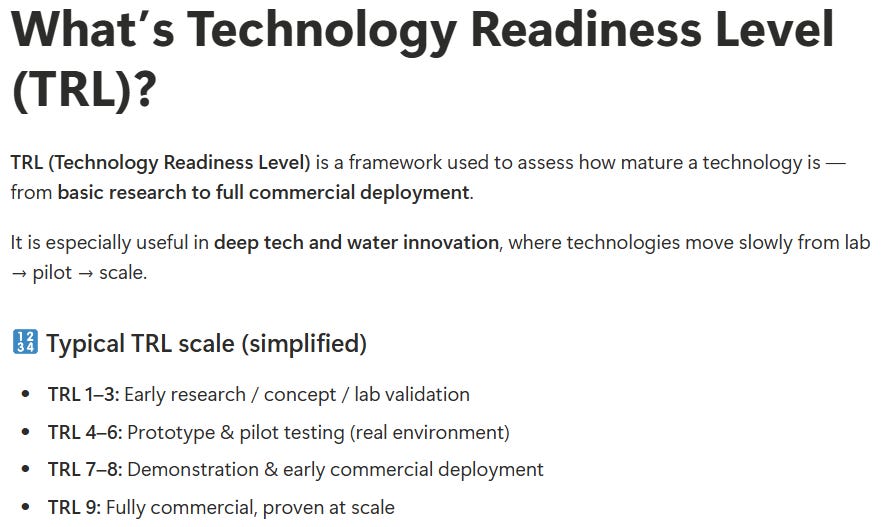
“I have to admit that I wasn’t aware of what TRL (Technology Readiness Level) meant until a few months ago. During a conversation in our networking chat, several founders mentioned that their startups were at TRL 4, TRL 5, and so on.
So, here’s a brief summary: TRLs provide a scale to measure the maturity of a technology, ranging from TRL 1, where the concept is still an idea or basic principle, to TRL 9, where the technology has been fully proven in real-world conditions and successfully commercialized
In water tech specifically, I guess that moving from TRL 6 → 8 is often the hardest jump (real-world hydraulics, regulation, O&M complexity), but we’ll explore this further with a specific episode in the near future.
His proof is the Maven project in Indonesia. The island had a sodium chloride problem.
The OARO project aims to produce 220,000 tons of salt and 25,000 m³ of desalinated water daily.
Osmotically Assisted Reverse Osmosis (OARO explained → Standard membranes can concentrate brine up to 85,000 ppm at 80 bar, while OARO can achieve up to 250,000 ppm at 70 bar.
Salt is not a humble commodity; it is a keystone of the chemical industry, because you electrolyse it to make chlorine gas, and chlorine gas underpins the whole world of PVC and plastics.
Indonesia was importing it from New Zealand and Australia at around 130 dollars a tonne, exposed to logistics and the price shocks of a turbulent world.
So they built a brine valorisation plant. It produces salt at thirty to forty dollars a tonne — an eighty percent reduction — and, crucially, it produces fresh water at the same time.
By valorising the brine, recovery jumped from around 43% to 85%. They doubled the water and decoupled the salt from global logistics in a single move.
Then Guillem told me about a customer call that genuinely shifted how I think. The customer wanted a new desalination plant, but said something I had never heard from an end user: the fresh water matters, but we do not care that much — what we really want is the sodium chloride, because we already have buyers for it.
Read that twice.
Here is a desalination project where water is the by-product and salt is the point. That is the inversion at the heart of all this.
We are beginning to see seawater not as a source of water but as a chemical feedstock with a known, fixable cost driven mostly by energy — exactly the kind of certainty a chemical business craves.
And the engineering logic is beautifully familiar. Just as desalination replaced the thermal evaporator with a membrane and a pump, brine valorisation replaces the evaporation pond — the centuries-old Mediterranean practice of flooding land with seawater and harvesting the salt a year later, ruining the soil in the process — with membranes.
It is standard desalination, reconfigured. (Guillem also left me with a piece of etymology I cannot shake — salario, salary, comes from salt, because Roman wages were once paid in it. The value was always there. We are only rediscovering it.)
There are real obstacles, and he was clear-eyed about them. Water companies know how to produce and sell water; they do not know how to produce and sell chemicals.
Bridging that gap will force some companies to reinvent themselves and others to bring in entirely new downstream players.
But the demand is real, the example is built, and his forecast is concrete: within three to five years, the projects now on the drawing board will be executed and running.
Ultrafiltration: the right answer that is not always chosen
UF was invented around the same era as reverse osmosis, in the 1970s, but it sat quietly until the early 1990s, when a chlorine-resistant outbreak in Milwaukee — pathogens that ordinary filters and disinfection had failed to stop — made the case undeniable.
Put an ultrafiltration barrier in place, with its tight pores, and those microorganisms simply cannot pass. Adoption climbed exponentially, and as a standalone treatment UF keeps leading the way.
As a pretreatment for desalination, though, the picture is more political than technical. Well-designed ultrafiltration lowers both capex and opex and reduces the total cost of water.
Yet Guillem still sees conventional sand filters pushed in its place — sometimes because the plant builder has its own technology it knows intimately, sometimes because the land is government-owned and effectively free, which quietly erases UF’s footprint advantage from the calculation.
I have watched the same story in a brackish plant in Málaga, where the operator was convinced the plant wanted ultrafiltration, but the business model handed down to him left no room to install it.
The best technical answer and the chosen answer are not always the same, and the gap between them is usually written in the business case, not the engineering report.
What the membrane knows
If I had to compress this conversation into a single idea, it would be this: water innovation advances by recognising when an old job can be done a new way.
We replaced boiling with membranes and watched the cost of water collapse.
We are now replacing evaporation ponds with membranes and learning to read the brine not as waste but as wealth.
The hardest enemy, biofouling, will not be beaten by force but by starving it of nutrients once the economics finally allow.
And the whole enterprise only works because researchers like Guillem refuse to stay in the lab — because they treat innovation as a conversation with the people who actually run the plants.
I am already looking forward to the next chapter of this, in Marrakech, where so much of the agenda points exactly here, to fouling, and to brine.
The sea has been trying to tell us something for a long time. We are finally building the instruments to listen.
Euromed 2026
Guillem and I will be attending EuroMed in a couple of weeks.
It will be my first time there, and based on the agenda and the feedback I received from the 2025 edition, it seems like a very worthwhile event to attend (despite Porto being remembered for the famous power blackout!).
If you’re attending, feel free to drop us a message—or simply come and say hello in person. We’ll both be speaking during the event. Guillem’s sessions will undoubtedly be the most valuable ones.
As for me, I’m not particularly comfortable speaking to large audiences, but I’ll do my best to make my 15 minutes worthwhile. My goal is simple: that everyone listening walks away having learned at least one new thing.

Guillem Gilabert-Oriol joined the Water MBA in his personal capacity, and we would like to sincerely thank him for the immense value and insights he shared with our community.
His book on biofouling is well worth the read for anyone, expert or not, who wants to understand the enemy properly. 298 pages of pure value → Purchase Biofouling and Organic Fouling: in Reverse Osmosis Membrane Elements
Connect with Guillem through LinkedIn.


