
Today I do not bring any amazing guest, sorry for that.
Last week I stood in front of around 30 people at EuroMed 2026, the congress organised by the European Desalination Society, and I had about twenty minutes to say something that mattered (at least to me).
For the many of you who weren’t in the room, I share again in video and writing.
EuroMed was a good congress precisely because the conversations were more practical than theoretical. The presentations felt like professionals comparing scars rather than reciting slides.
That is exactly the kind of event I think our sector needs more of, and it’s the same instinct that has driven everything I’ve tried to build over the last three years.
So rather than let the talk evaporate the moment I left the stage, I wanted to turn it into something the whole community can reuse.
A few anecdotes from the event...
By the way, I have to confess this was probably the event where I received the most unexpected positive feedback about The Water MBA.
I remember three years ago walking around conferences trying to approach people: “Hey, I’d love to chat...” and making the first move every time.
This event was completely different. Funnily enough, every time I crossed the exhibition hall from one side to the other, someone stopped me for a conversation. It made me realise that attending events has become far more enjoyable and productive than it used to be.
One conversation really stayed with me. Someone told me:
“I’m here because I saw your post saying you were attending. I came with my wife and our little kid. We’ve had a really tough year and a half, especially my wife, and she needed a change of scenery. We thought this event would be a great opportunity.”
I replied that I was simply happy if I had contributed, even in a small way, to making his wife happy—because when she’s happy, everyone at home is happier too. 😊
It reminded me that, beyond our professional ambitions and technical discussions, we can also have a positive impact on people’s personal lives.
Another funny moment (actually happened twice!). Someone introduced me to a group:
“This is Ramon Rubio. Do you know him?”
The first reaction was:
“No idea... from Company X?”
Then the person introducing me asked:
“Really? You don’t know The Water MBA?”
And suddenly it clicked:
“Ahhh... you’re the LinkedIn guy!”
“Oh... The Water MBA guy!”
I spent quite a bit of time explaining that this is no longer about me, or simply about creating content on social media.
Today, The Water MBA is an ecosystem. It brings together hundreds of water professionals who freely engage in our networking community chat, read our articles, watch our videos, and contribute to the discussions.
Social media is simply the front door, it helps more people discover the community and join what we’ve built together.
The problem I opened with
My starting point was a single observation: the sector moves faster than our knowledge.
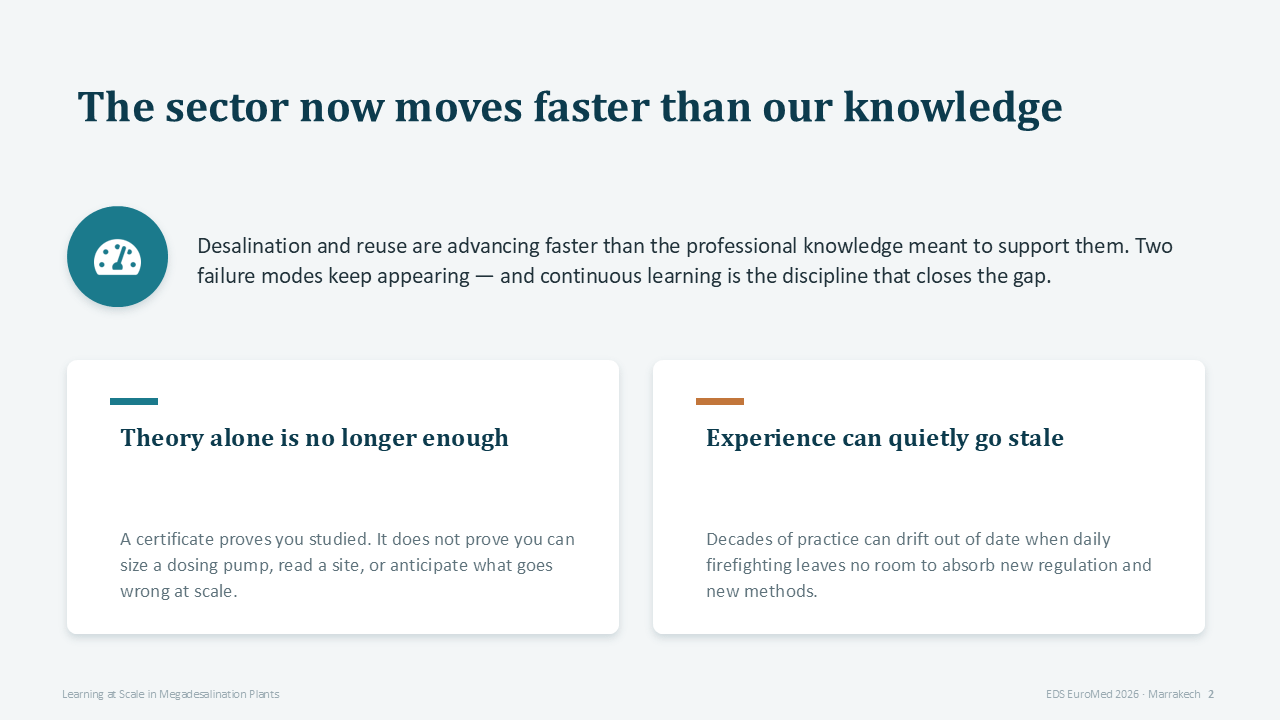
A few years ago I began noticing two things drifting apart.
On one side, theory and the available offer of training and education — abundant, but overwhelmingly academic.
On the other, practice — where the real work happens and where almost nobody writes anything down.
The gap between them was widening, and the reason is structural. You finish a degree, you carry that theory into your career, and for a long time the assumption was that it would carry you all the way to retirement.
That assumption is dead. Things now move fast enough that if you stop updating yourself, you quietly slip into the second line of professionals — still employed, still experienced, but no longer where the opportunities are.
To make this concrete, I shared three real experiences that first revealed what I now call the knowledge gap.
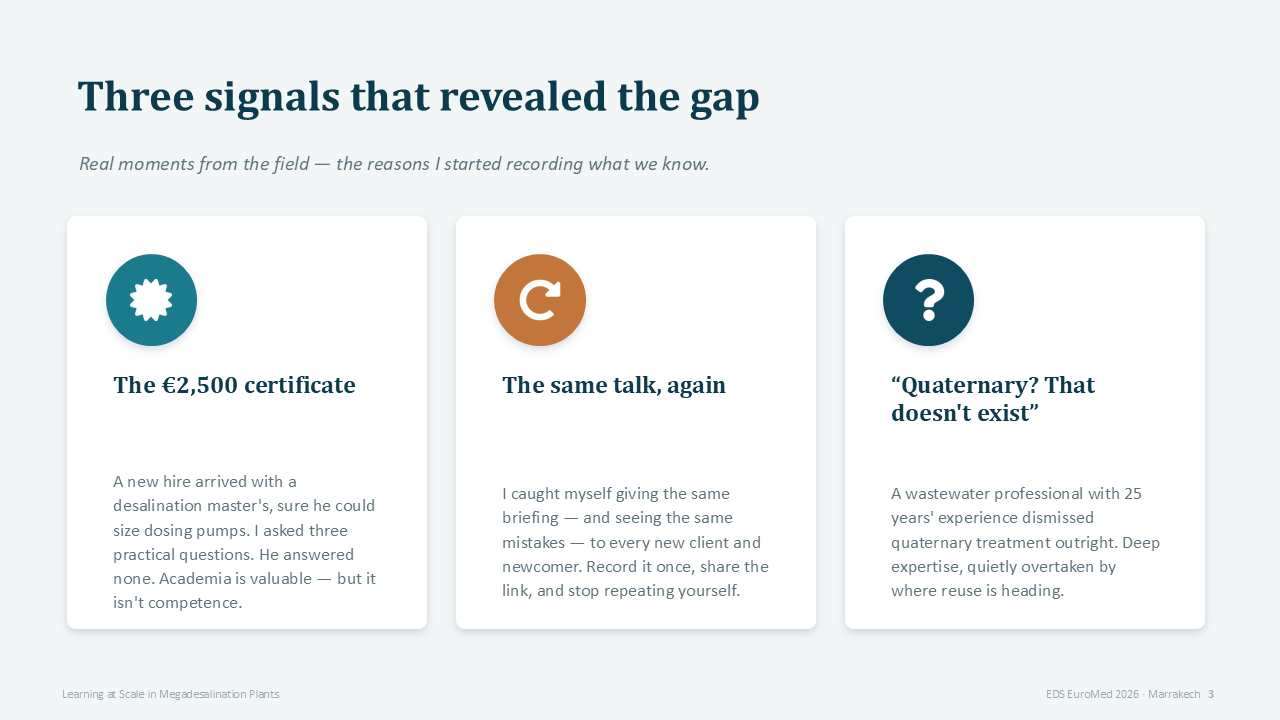
The first was a colleague who approached me proud of a certificate — around three thousand euros — that declared him a “master” in desalination.
I wasn’t interested in testing whether he had the certificate; I wanted to know what was behind it. After two or three genuine questions, just the kind of thing a project throws at you, he couldn’t develop the context or hold the thread.
The certificate was real but the mastery wasn’t.
The second was about me.
I kept finding myself repeating the same explanations, again and again, to new clients, new partners, new professionals — the same handful of points that every project needed.
That repetition was a signal. If I was saying the same thing on a loop, the knowledge clearly wasn’t reaching people any other way.
The third was a very good engineer with twenty-five years behind him.
We were talking about water reuse and the newer European framework, and he told me, in effect, that treatment stops at tertiary — that quaternary “didn’t exist” as far as he knew.
A strong professional, suddenly unable to hold a conversation about what the market is now demanding. Not through any fault of character, simply because continuous learning hadn’t been part of the deal.
Those three moments are an example of why The Water MBA exists. I wanted an ecosystem where we learn and share knowledge together, at scale and internationally — even trying to connect a fragmented demand with a fragmented supply, and building content that can be reused for years rather than delivered once and forgotten.
🌟 What one person learns the hard way becomes something the whole community can reuse. That sentence is more or less the entire thesis.
The lessons I chose to share
With the purpose established, I moved into a handful of lessons drawn from mega-scale desalination — some basic, some less so, all of them things we’ve argued about privately in the community.
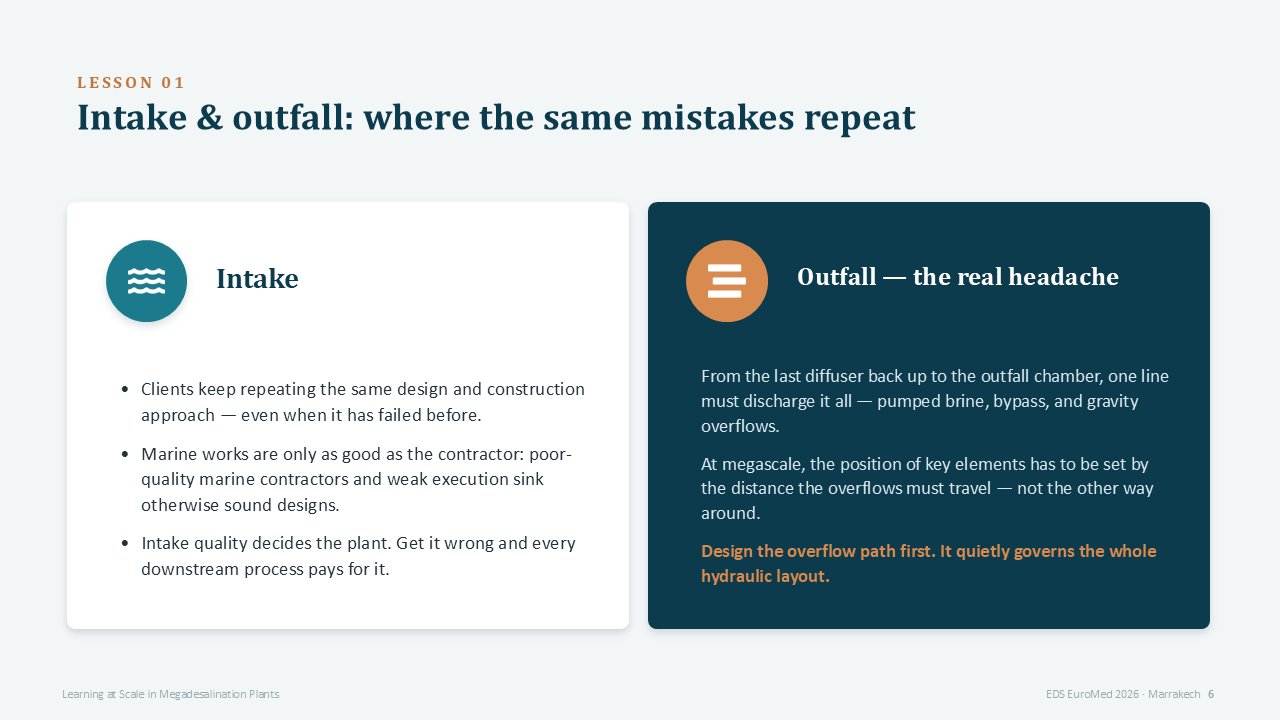
The outfall is where the mistakes live.
Intake and outfall together are probably one of the single topic that has generated the most engagement across three years, it became the origin of a whole course and brought many serious professionals into the community.
But of the two, the outfall is the real headache.
The intake has its challenges, yes, but the outfall is where I see people cut corners most often, especially because it isn’t only about the plant’s pumped lines.
Gravity lines, overflows, the piezometric line — these have to be discharged, usually through the outfall, and a badly designed one doesn’t announce itself politely.
⚠️The problems surface during operation. Sometimes at commissioning, but sometimes only after handover, in a specific scenario, years later. That delayed feedback is exactly what makes it dangerous.
No power, no water.
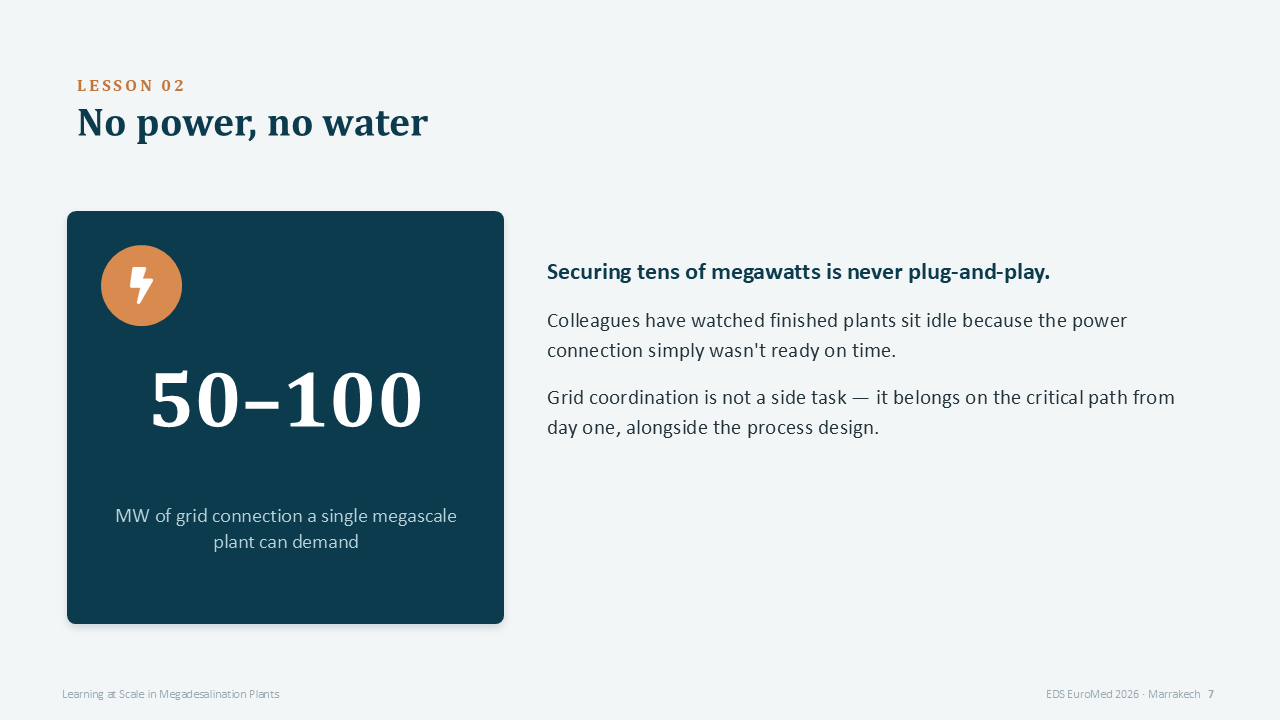
We talk casually about deploying desalination across the world, but at mega scale it stops being a water conversation and becomes a power conversation.
When a client tells me they want a very large plant in some location and I ask about the power arrangement — and the answer is “that has to be discussed” — I know the project isn’t mature.
A mega-scale plant can’t simply plug into a neighbourhood grid; it usually arrives alongside its own power infrastructure development.
I have friends whose projects were ready to commission at full stage and couldn’t, not because of anything on the water side, but because the power section wasn’t there. The plant waited on the megawatts.
The UK flip-flop — and the opportunity inside it.
This was my favourite, and the room felt it.
Next year’s EDS Congress lands in Liverpool, so I asked the audience the obvious question:
How on earth are we holding a desalination congress in the UK, of all places?
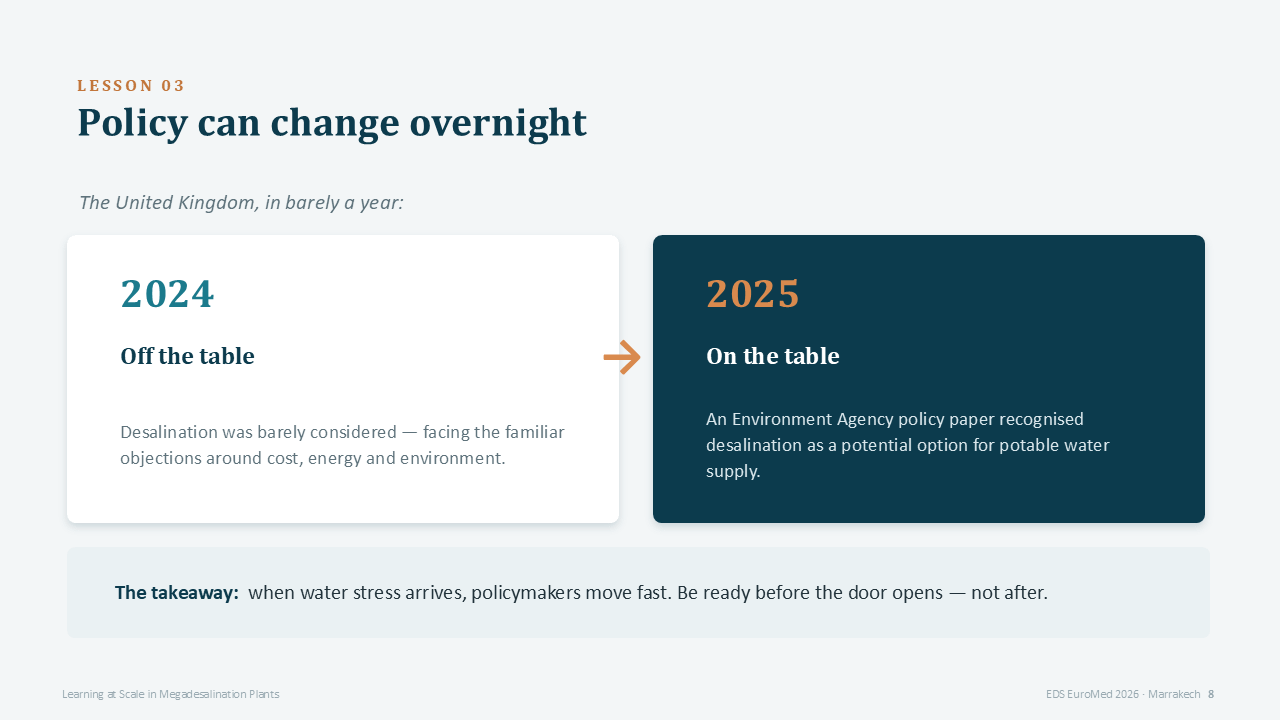
For years the UK line was that desalination was too costly, too energy-hungry, not environmentally friendly. Then the framing shifted.
Water stress and integrated water management have become serious enough that desalination is now appearing in UK investment thinking, with entities like Anglian Water in the picture.
One paper, one policy signal, and a settled opinion reverses.
For water professionals — including those of us with years in the MiddEast — this is a genuine opening.
⚡Some of the people best trained by the most water-stressed region on earth may find their next opportunity in one of the rainiest countries in Europe.
I’ve already sat in recruitment conversations with UK consultancies who have a desalination pipeline behind their general water needs.
You cannot over-specify your way to a good plant.
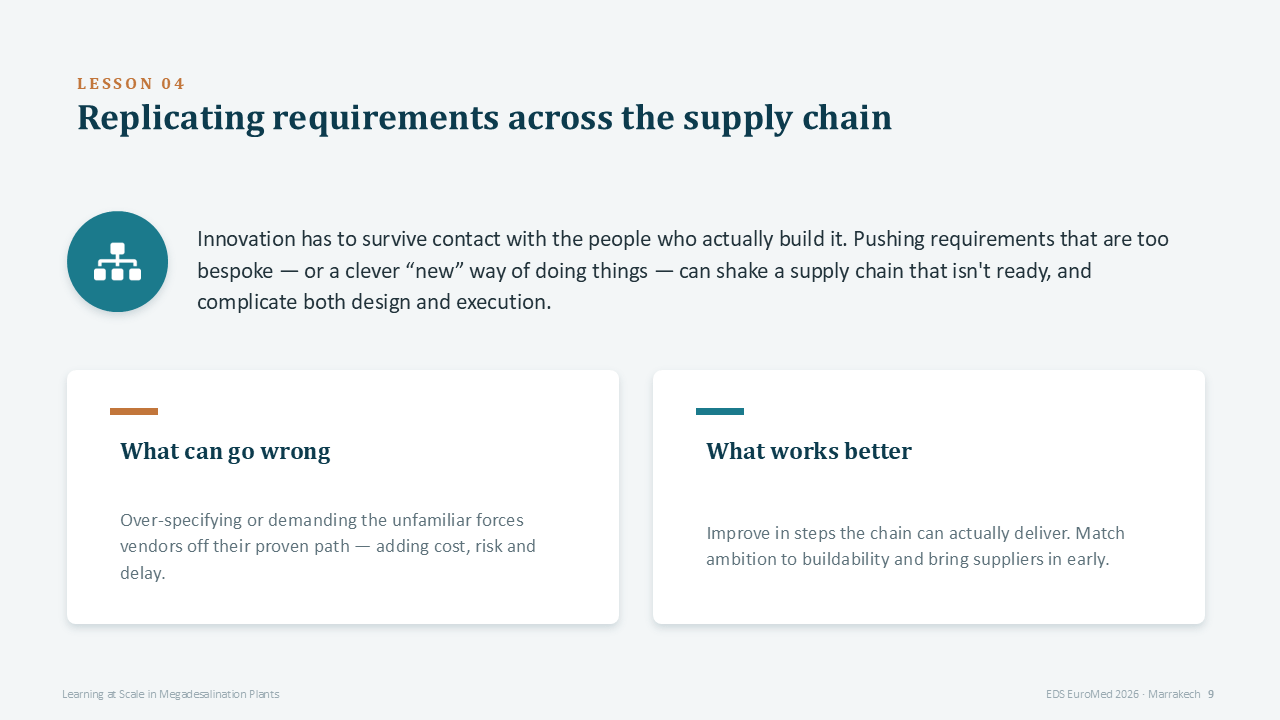
A large desalination project sits on a long supply chain: end user, offtaker, developer, contractor, subcontractor, vendors, material suppliers — all wrapped in the geopolitics of logistics, materials and price.
Clients sometimes try to over-specify, demanding a “state of the art” plant in terms that the supply chain simply cannot consolidate at a reasonable capex or a reasonable schedule.
It’s a fair ambition, but it isn’t a one-sided business. Everyone in that chain needs everyone else for the infrastructure to happen at all.
Continuous improvement, step by step, beats a specification nobody can actually deliver.
Morocco and Egypt are the ones to watch.
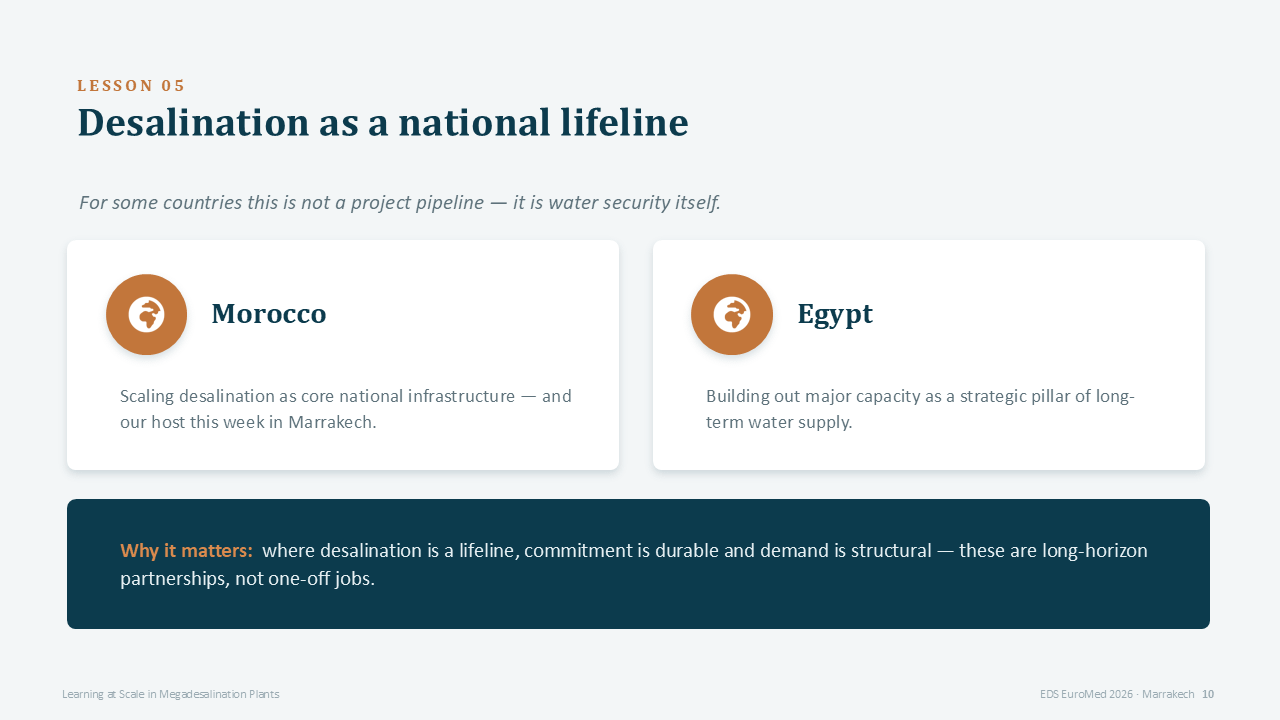
Desalination is becoming strategically central in specific countries, and we feel it directly: a high inflow of members from Morocco and Egypt asking to go deeper.
That’s why some of our Tuesday editions lean into desalination — there’s a clean match between what people need and what we can supply.
Egypt’s pipeline in particular is large enough that manufacturers and technology suppliers are opening their own factories and offices there to stay competitive.
These two countries will offer opportunities at every level of the chain in the coming years.
Financing eight hundred million is not financing eighty.
Funding a mega-scale plant is different from funding a modest one — capacities that push capex toward five hundred million or a billion dollars change the entire structure of the deal.
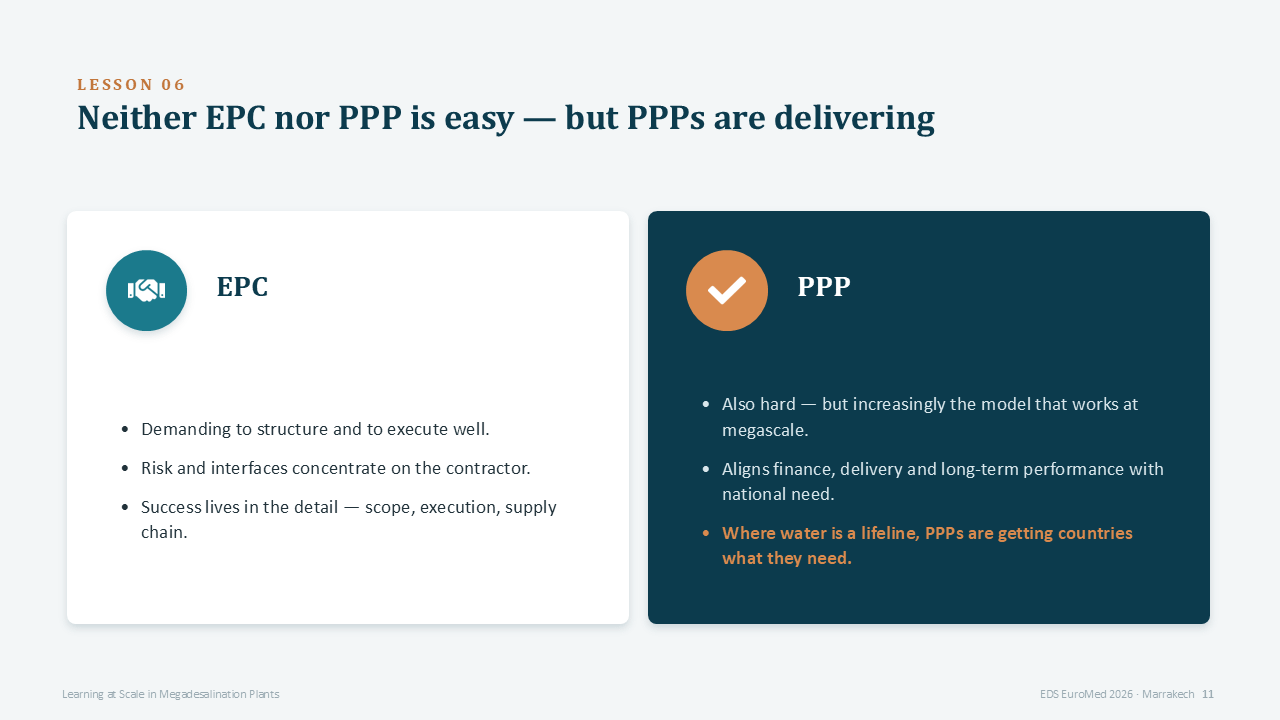
The public–private framework becomes central, and the community is hungry to understand how PPPs actually work: the bottlenecks, the characteristics, the lessons learned.
It isn’t a perfect solution, but in the current environment it’s the vehicle many countries are reaching for to close the investment gap, with private capital carrying the funding of infrastructure the public side can’t finance alone.
The lesson under all the lessons
It’s a real gap, and it deserves the attention.
Whether you’re reading this or watching the recording: we learn something new every single day, and the day that stops is the day you fall behind.
That’s the whole reason this community exists, and I hope it’s a reason to keep pushing.
I closed in Marrakech the way I’ll close here — by encouraging people to join us, to be surrounded by colleagues who want to be the best at what they do and to keep improving while, ideally, enjoying the process.
In the end we’re human. We like to shake hands and stand shoulder to shoulder, and we also like to collaborate across borders.
That combination is the best vehicle I’ve been able to build for water professionals around the world.
The feedback in the room was warm to be honest, and I left more convinced than before that this ecosystem will matter more, not less, in the years ahead.
Twenty minutes on a stage in Marrakech, and the takeaway was almost embarrassingly simple: keep learning, or get left behind.


