
One of my favourite episodes of the last three years. If what Ravid shares isn’t MBA-level, then what is? I learned a huge deal in just one hour.
Internationally, the statement is clear: water tariffs often do not generate enough revenue to cover all the necessary costs, keeping pace with increasing regulations and requirements, investing in infrastructure renewal for this highly capital-intensive sector addressing ageing assets, and, in some cases like the UK, providing returns for stakeholders and investors.
However, there are also existing models where the water business is financially sustainable. And this is exactly what we will explore today.
I think it is a good moment to publish in our new website the conversation we had with Ravid Levy time ago.
I saw he’s been in India recently taking an active part in Thermax Limited corporate event titled 'Odyssey Beyond 1000', in Pune India.
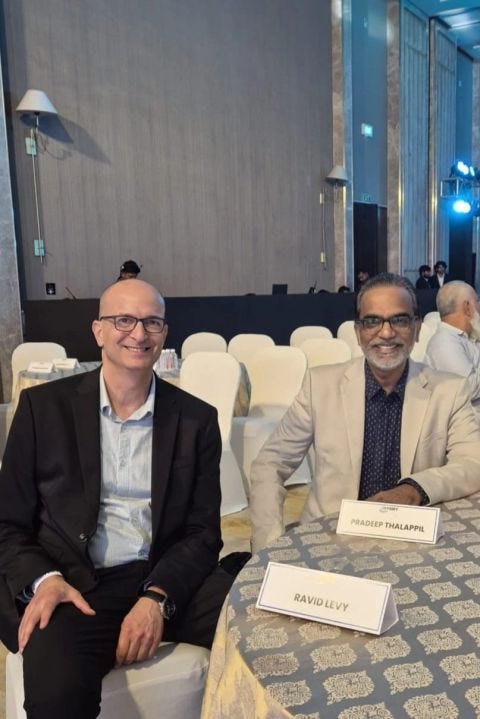
A funny anecdote the first time I came across Thermax time ago.
To be honest, I had never heard of the company before.
During our very first meeting, they shared a presentation along with their organizational chart. What was actually a relatively small subcontracted package within a much larger project, they had assigned around 27 people to the job, each with a clearly defined role and responsibility.
They had almost as many people working on that single package as we had across the entire project team on our side. I remember thinking, “Wow... I’m basically here with one or two colleagues coordinating this, and on the other side there are 27 people in the meeting.”
The engineering capacity and scale that companies in countries like India can mobilize...demographics, talent availability, and geopolitics shape the global engineering industry…
As I was saying, Ravid presented 4 upcoming global trends and opportunities shaping industrial water tech in the coming years:
🚀 Hyperscaled datacenters (not only cooling water, but also power & semicon fabs)
I see interesting moves around this…I'll explore this in more detail and share my thoughts.
♻️ Circular resource recovery (both from desal brines and organic waste streams)
🔬 Micropollutants (mainly, but not only PFAS. With integrated separation, destruction and monitoring)
🖥️ Digitization of water systems (leveraging AI, big data and iOT for realtime optimization and towards autonomous operation)
He also published some days ago an extremely interesting reflection about AI and Data Centers, read carefully and reflect on it.
How long will the datacenter water hype last?
Everybody's talking about how thirsty is AI. They usually mean how much fresh water is needed to cool the chips that process the data that makes the AI we all use and love (or hate, or fear or admire)
First let's separate facts from fiction regarding datacent'rs water thirst:
According to a Global Water Intelligence (GWI) and Xylem report that was published earlier this year, only a small part of the water used by the AI industry is for cooling datacenters directly (<5%, don't let the "billion liters" or "trillion gallons" figures confuse you). The majority is indirectly used to produce power (>50%) and to make the semiconductors (>40%).In carbon terms we would have called it Scope 1 vs. Scope 2/3 water use.
Overall, datacenters is still a minor water user compared to less hyped industries like food&bev, mining, oil&gas, , power etc. Not mentioning agriculture, but it is growing much faster than all the others.
So the huge public and professional focus on datacenter's water cooling may be missing the real impact of AI on the water cycle, which mostly happens way beyond their fence.
Obviously, this doesn't mean water use for cooling is negligable, but here lies the question I openned with:
There is huge incentive for AI hyperscalers to reduce direct water use, both to mitigate their direct impact, but mainly to get 'lisence to operate' from public, regulators and politicians (i.e to un-NIMBY their projects).
And when these giants have incentive they also have the resources to invest in development and scaleup of low, or no-water cooling technologies. And they already do:
Air cooling, direct-to-chip, under-water, floating, space... they will do whatever it takes to keep booming, and if water (or power) is limiting, they will buy their way out.
The AI companies are doing it in a pace the water industry can hardley comprehend. We're used to technologies that scale based on regulatory incentives limited by usual infrustructure and investment constrains (i.e very slow). Suddeny, we need to cope with space travel speed and resources that dwarf the entire watertech industry.
So there is a window of opprtunity for water tech to solve a real bottleneck for the fastest and richest industry in history.
But not forever. Sooner than later, there will be alternatives that will make direct water use in datacenters redundant, or less limiting altogether. This change happens as we speak.
So if you're targeting water solutions for the AI industry, do it FAST
AI fast, not water fast
I met Ravid Levy for the first time last year in Amsterdam. Five minutes, maybe, in the corridors of Aquatech, the kind of quick hallway exchange that a congress makes possible and that you promise yourself to continue one day.
Five years running an Australian subsidiary during the Millennium Drought, and now a decade coordinating Israel’s national water innovation community, a government-backed non-profit whose whole job is to connect the dots across the country’s water ecosystem.
If you wanted one person to explain how a country actually works as a water system, you’d struggle to find better.
We many think this is a technology story: drip irrigation, desalination, reuse percentages that make the rest of us wince.
But listening to Ravid, the real lesson is institutional and economic. A country that built a set of rules that made the invention inevitable, and, crucially, that made it pay.
The island principle
Start with geography, because everything else is built on top of it. Israel sits on the semi-arid eastern edge of the Mediterranean, half of it desert, the rest not much wetter for most of the year.
What we now politely call “climate change” was simply the baseline here from the beginning, a climate you cannot count on.
Then add the geopolitics. As Ravid puts it, Israel is effectively an island.
Israel has to plan as if it were surrounded by ocean: rely on your own resources, because you cannot import water at any meaningful scale.
Two facts — a hostile climate and no external lifeline — force a single conclusion. Water is a strictly limited, strategically vital, domestically-sourced resource.
The answer was the Water Law, drafted in the early 1950s and still in force after many updates.
Its founding principle is deceptively radical: all water in the country is public domain.
Underground, above ground, clean, dirty, even seawater, none of it is private.
If you own land above an aquifer, the land is yours and the water beneath it is not. You need a licence, and you pay, to extract it.
Every drop carries a price tag, and something or someone must pay it.
You cannot price, allocate, or plan a resource you don’t fully control.
The closed box
By law, the Israeli water sector is a closed economic system.
All the revenue generated within it stays within it, and those revenues are the only resources available for the sector’s development, investment, and maintenance — national, municipal, all of it.
This is totally different to many countries as we all know.
Which means one thing above all: water must pay for itself. Tariffs are engineered to reflect the true cost of service and the cost of future infrastructure.
The sector is not subsidised from outside, and it cannot over-invest beyond what water prices can support.
Now hold that up against Spain. Here tariffs routinely fail to cover operating costs, let alone the reinvestment the networks need.
The gap is filled, or more often not filled, by political cycles and competing budget priorities.
The result is chronic under-recovery and deferred investment, dressed up as affordability.
A stable, ring-fenced financial base that lets the water system plan and build on its own terms.
The trade-off is honesty…wait wait…, is this word understood by most of politics nowadays??
If water has to fund itself, the price has to tell the truth.
That’s an uncomfortable proposition politically, and it’s exactly why so few countries do it.
One grid, and a plan that runs to 2075
Being small helps. Moving water is a problem of topography and distance, and a small country can afford a solution that a continental one cannot: a single national grid.
Something like 80–90% of the population, plus most agriculture and industry, is connected to one network run by a national water company that answers to the government.
The payoff is operational flexibility.
Drought in the north’s natural resources run thin, so the system leans harder on desalination and groundwater elsewhere and shifts water south-to-north across the same grid.
In wetter years the balance flows the other way.
Supply follows demand around the country instead of being trapped where it happens to fall.
And that grid is managed against a plan that is almost absurdly long-term.
The Israel Water Authority already has a complete strategic plan out to 2050, and a preliminary one to 2075, modelling different scenarios for rainfall, population, and economic growth, and pre-positioning the solutions to meet them.
When your resource is scarce and your box is closed, you’re forced to think in decades.
Scarcity, it turns out, is a discipline.
Reuse: a strategic choice, not a by-product
Around 90% of all domestic wastewater in Israel is reused.
And roughly 50% of the water used in Israeli agriculture comes from reuse.
Reuse in Israel goes almost entirely to agriculture — not to potable supply, not to industry.
A strategic choice, and the entire regulatory, technical, and management apparatus for wastewater is bent toward it.
There are two grids, and they never touch: a national blue grid for drinking water and an almost-national purple grid for reuse.
Within the purple grid, quality varies by region and by plant, and so does price.
Higher-quality effluent costs the farmer more but unlocks more sensitive crops and irrigation methods; lower grades are cheaper but come with tighter rules on how they can be applied.
It’s a matrix: treatment quality, soil condition, crop selection, and irrigation method all negotiated across both sides of the pipeline, and priced accordingly.
There is no single “cost of reused water.”
Why agriculture, and why does it work? Partly, again, geography.
Ravid tells a story about arriving in Melbourne and asking why treated wastewater was being discharged to the ocean instead of reused.
The answer: do you know how far the farms are?
In Australia — and much of the US — the distance between cities and major agriculture may kill the economics in some cases.
In Israel the fields sit close to the cities, so treating effluent near the population and piping it to nearby farms makes sense.
Distance is a hidden variable in every reuse business case.
The waste and the resource are the same object, viewed from two ends.
Desalination, and the paradox of water that’s too clean
Then there’s the sea.
Roughly 70% of Israel’s drinking-water mix is desalinated — higher in some places, lower in others — with total production around 700 million cubic metres a year and rising toward a billion.
Strip that out and you lose something like 20–30% of national use.
That’s the equivalent of two days a week without water, which is the actual reality in some neighbouring countries that haven’t built this capacity.
Climate resilience in a dry region starts with water resilience, and desalination makes supply climate-independent.
Combine desal, reuse, natural resources, efficiency, and non-revenue-water reduction and you are close to being climate-independent for water.
We’re selling independence from the sky.
But Ravid is refreshingly unromantic about the downsides, and one of them is genuinely counterintuitive: desalinated water can be too clean.
Double-pass RO strips almost everything, which is wonderful for keeping PFAS and micro-pollutants out of the network, the risk profile of a heavily-desalinated supply is lower than most.
The flip side is minerals. Calcium and alkalinity are added back per health regulation; magnesium is not regulated, so in desal-heavy areas it runs low.
I’m going to write something separate on the magnesium question, because I suspect it’s a quiet issue in a lot of desal-dependent systems and nobody’s talking about it.
The innovator’s paradox
I asked Ravid what’s left. If Israel has more or less solved independence, resilience, reuse, and desalination, what do you do for an encore?
His answer is that this is precisely the reason his innovation organisation exists: how do you keep a train running fast when your own urgency has largely been managed away?
He frames it as three circles.
The local circle is far from empty, brine valorisation (Israel desalinates a lot, so it produces a lot of brine that is currently benign waste rather than a resource), sludge and resource recovery, PFAS and micro-pollutants in specific groundwater pockets, and above all decarbonisation: the water sector accounts for 8–10% of national power consumption. That’s an enormous carbon footprint hiding inside the resilience story.
The regional circle is about exporting hard-won knowledge to neighbours with acute water stress, where geopolitics complicates but doesn’t erase real opportunity.
And the global circle is the big one: Israel has spent fifty years managing exactly the pressures — heat, scarcity, population — that climate change is now handing to everyone else. Which makes the country something like a beta site, or a preview, of the water future much of the world is walking into.
Two kinds of water, two kinds of money
Ravid splits water innovation into two sub-sectors.
There is physical, “wet” innovation — anything that touches the water itself: treatment, desalination, membranes, the physical assets.
A litre of water will always weigh a kilogram; it’s incompressible, it can’t be digitised, it has to be moved from A to B by physics.
So this side is inherently slower, more infrastructure-bound, more public.
Expecting it to accelerate and exit like fintech is, in his word, naïve — and funding it with the same impatient venture money is a category error.
And then there is the digital side — the data embedded in that physical asset. That can and must move as fast as any other digital industry. It should be funded like one and judged like one.
The mistake we make is applying a single yardstick, a single funding model, and a single set of exit expectations to both, simply because it all sits under the “water” label.
His candidate for the most exciting frontier sits right on the seam between the two: water-quality monitoring.
For a century, quality analysis has meant lab-based standard methods — accurate, authoritative, and almost impossible to miniaturise or automate cheaply.
So online quality measurement got deployed only where you absolutely had to.
Meanwhile we’ve cheerfully installed three million remote-reading water meters across Israel (100% AMR mandated by next year) because they’re cheap and reliable.
Now imagine a quality sensor as cheap and reliable as that meter — for PFAS, bacteria, heavy metals, or just pH and conductivity — deployed at the same density.
Ravid calls it the democratisation of water-quality measurement: real-time visibility into pipes, rivers, and beaches we currently just assume are safe, and a flood of data that opens entirely new AI and analytics markets on top.
The regulators may take a while to accept it but the technology is arriving anyway.
Plumbers with a degree
Spain — like much of Europe — faces a silver tsunami: a generation retiring in the next five to ten years and too little talent behind them. Everyone’s studying code haha.
Ravid’s optimism here is contrarian. AI, he thinks, will help — but not the way we assume.
The professions most exposed to automation are the office ones; the professions that touch physical assets are the hardest to replace with a robot.
And water, remember, is always a physical asset.
The factories, the data centres, the agriculture, they all keep needing this resource.
So water is, in his phrase, a very safe stock: it’s not hyping, it’s not booming, it will never die.
A key quotes
On necessity as the engine
“The oldest cliché in this business, or any business, is that need is the mother of all invention. If you have a specific ongoing challenge, you either meet it or you stay behind.”
On planning as an island
“We cannot rely on resources coming from outside the borders. This is how we must organize our water system — as if it’s an island in the ocean.”
On water as public domain
“All water within the country — underground, above ground, dirty, clean, even seawater — is a public domain. It belongs to the public. There is no private water in Israel.”
“Every drop of water has a price tag, and someone, something, needs to pay for that. There is no free water.”
On the closed economy
“All the revenues remain within the water sector, and these are the only resources that by law are available for its development. Water must pay for itself.”
On long-term planning
“The Water Authority already has a complete strategic plan for the whole sector until 2050 — and in fact a preliminary plan till 2075.”
On efficiency
“It’s very, very foolish to waste the little water you have through leaking pipes.”
On the reuse strategy
“Almost 90% of all domestic wastewater is being reused — and we must say, to agriculture. That’s the strategic choice Israel took.”
On why geography decides reuse
“I asked in Melbourne why they discharge treated wastewater to the ocean instead of reusing it. The answer was: ‘Do you know where the agriculture is?’”
On desalinated water quality
“It’s the cleanest water you can get. However, sometimes it’s too clean, if you like.”
On resilience
“Climate resilience and climate adaptation in a dry area starts with water resilience.”
On Israel as a preview
“Israel is kind of a beta site — almost a preview of what other major areas in the world are now, or will be, facing. It’s a bit like back to the future.”
On physical vs. digital water
“A liter of water will always weigh one kilogram, whatever we do. It’s incompressible. It cannot be digitized. It must be transferred from A to B according to physics.”
On measurement
“Some people call it the democratization of water-quality measurement. Until now, the ability to test was only in the hands of those who had to do it or could afford it.”
On the sector as a safe bet
“It’s not hyping, it’s not booming, it’s not exiting in billions — but it will never die.”
On the profession
“We used to say we’re just plumbers with a degree. But a plumber with a degree might actually become a very attractive thing for people who think forward.”


