
Today is a great day. For the first time, The Water MBA hosted a session with more than one guest, and all three were not invited speakers from outside but official members of our own community.
They came from the Pacific side of the world, from Chile: Ignacio Rodríguez, Juan José Crocco and Carlos Rubilar Camurri.
I have spent a long time bringing people onto the podcast, and I will keep doing it.
Brilliant people, willing to share live experience as it happens.
If so many of them are already among us, why not start there?
This panel was the first answer to that question.
There will be more so that you can get to know each other and so that members take an active role in how we learn together.
📢 This essay is sponsored by… The Water MBA.
AI and Intelligent Operations in the Water Industry
Our new AI course starts on October. This first cohort gets 5 live sessions with Sandro Hansen and me. Future editions will be on-demand only.
399 €. Then the price goes up.
Get to know the members
Ignacio Rodríguez is a lawyer by training who came from the power sector and founded Desala, a company focused on the early-stage development of seawater desalination and the trunk transport of desalinated water.
He has been there since day one. His projects serve mining, but also farmers and rural drinking water systems, which makes his work deeply multi-sector.
Juan José Crocco, also a lawyer and Ignacio’s university classmate, has dedicated his entire career to water.
He served as Secretary General of the Confederación de Canalistas de Chile, the association of the country’s canal users, and as Deputy Director of the Dirección General de Aguas (DGA) during President Piñera’s second government, where he handled the Water Code reform and its parliamentary debate.
Today he works as a strategic water consultant and helped create One Water, an alliance of companies pursuing more integrated solutions, because, as he put it, water is a multi-systemic problem and a lawyer alone only ever sees part of it.
Carlos Rubilar Camurri also knows the DGA from the inside, and today he is one of the most active voices in Chile explaining water to the public, in the media and on social networks.
Three different angles: the developer, the regulator turned strategist, and the communicator.
A market that almost nobody else has
Some time ago, Ignacio shared in our networking group that he was looking for a partner for Aguas Petorca, a project he originally founded as Desala Petorca and which is now controlled by the Chilean power company Colbún.
When I opened the PDF, I did not fully understand the business model: a developer building a desalination plant and a transmission line, and then serving many different clients along the way.
Ignacio explained a very interesting point.
In most of the world, desalinated water is municipal, regulated water.
The plants in southern Spain were financed with public capex and serve human consumption and irrigation under regulated tariffs.
In Israel, a state entity fixes the tariff under a BOT model, you build your financial model, calculate your return, and invest.
Chile has something different: a market of what he called free clients.
Miners, farmers, rural sanitation services, real estate, green hydrogen... Each pays according to the value water creates for their own activity.
“Every user has their own willingness to pay, depending on the return that water produces for them.”
A copper mine extracts far more value from each cubic metre than a vegetable grower.
Structured properly, those different willingness-to-pay levels can share one piece of infrastructure.
Ignacio went further and said he suspects Chile may be the only country in the world where geography, regulation and economics line up to make this possible, largely because copper mining sits relatively close to the coast.
He also described how the model evolved.
Mines first built desalination plants inside their own capex and carried all the risk.
Then they realised water was not their business and began tendering dedicated plants, which in some cases produced absurd situations: two plants close to each other, with two pipelines, for two different mining companies that could have shared one system.
Now the more advanced miners understand that shared infrastructure brings two benefits: social licence, because the water reaches communities along the route, and a lower tariff for themselves, because more users are amortising the same capex and opex.
Then came this line:
“The future is that desalinated water will end up being a commodity.”
His reasoning is that environmental permits and project finance tenors typically run around 30 years, but a desalination plant physically lasts much longer.
Once the anchor client has paid for the asset, operators will be able to sell water to many more users, more cheaply, while keeping or even improving their return.
The hard part is getting these assets born. After that, they can grow.
Reservoirs designed for rivers that no longer exist
Before I hit record, we were talking about the Punilla reservoir, I visited Chile in 2015 while tendering for this beautiful project, but it seems there has been little progress since then.
It was the kind of project every civil engineer dreams of being part of.
I remember how challenging the social acceptance was among the local community, particularly around the idea of creating a pool in their natural habitat.
Juan José brought up the Las Palmas reservoir, which is effectively stalled because the river flow it was designed for no longer exists.
The tendered works were oversized for the real hydrology, and according to him that was known from day one.
Had it been designed from the start to store half the volume, it would already be built, and it would have captured the water from the recent floods.
And that brings us to the paradox of this year. Chile has been hit by an extreme El Niño, which Carlos called, with some humour, “El Niño Godzilla,” with historic rainfall across much of the country.
Petorca, a basin that became internationally emblematic of drought, now sits next to regions under flood alerts.
Carlos summed up the lesson:
“We lack the water policies and the infrastructure to deal with surplus, and to make use of those resources.”
Save this quote:
We discovered during the drought that we lacked infrastructure for scarcity. Now we are discovering we lack it for abundance.
What is missing, in his view, is planning built around climate resilience: the capacity to adapt to long periods of very little water and sudden periods of too much.
Juan José’s idea: imagine a reservoir that could also receive desalinated water during the months when nature provides nothing.
Desalination and storage stop being competing solutions and become parts of the same system.
Permits
When I worked in Chile, what struck me most were the timelines.
Feasibility, environmental studies, tenders, everything took a very long time.
So I asked Ignacio, as a developer, where exactly it hurts.
The science of permits... Ignacio believes the country has, in his words, hit bottom in uncertainty and slowness, and that things can only improve from here.
It is not simple, because there are many administrative interdependencies and many agencies with water competences.
But he sees concrete hope in the new sectoral permits law, which allows processing times for critical infrastructure to be cut by up to half.
Desalination plants and reservoirs involve many permits processed by the DGA and the Dirección de Obras Hidráulicas, and one in particular, the obra hidráulica mayor (major hydraulic works) permit, is feared by everyone for being long, expensive and engineering-heavy.
Juan José offered the view from the other side of the desk. Delays were always present, and a project slightly out of the ordinary, such as conveying desalinated water, could land you in a very grey zone with no idea how long it would take.
But he was clear that this was a problem of institutional design, not of civil servants’ attitude.
The DGA has a very marginal budget within the Ministry of Public Works, which reflects a country that for a long time simply had enough water.
Regulating after the fact
The most provocative moment of the conversation.
Juan José acknowledged that the new desalination law still leaves many grey areas, for example how desalinated water relates to water rights once it enters a water users’ organisation that distributes the resource.
And then he said something that goes against the instinct of many of us:
“I am in favour of it not being regulated, because that allows agreements between private parties that can be far better solutions than what the State could reach in a reasonable time.”
His argument is historical. Chile’s canal users’ organisations extracted and conveyed water, and private capital built much of the country’s canal infrastructure to bring water from the Andes to where it was needed.
All of that happened about a hundred years before a law regulated those organisations.
Chile’s water framework, he says, has always been reactive. So don’t wait for perfectly clear institutional guidelines. Start making agreements, between the desalination plant and the irrigators, for example, and execute.
Coming from someone who wrote reforms to the Water Code, that carries weight.
And it echoes what we have been saying at The Water MBA for a while: the gap is not only one of investment. It is often a gap of knowledge and coordination between people who could already be doing business with each other.
The Antofagasta paradox
Carlos brought the conversation back to people.
Desalination is still a largely unknown world for most citizens, who often keep only the negative headlines without checking whether they are true.
His example of Antofagasta, supplied 100% by desalinated water, has the highest per-capita bottled water consumption in Chile.
The water is safe. The trust is not there. That is a communication problem, and no technology solves it on its own.
He also asked us to leave behind what he called trench politics, the habit of setting human consumption, environmental conservation and productive use against each other, when water itself can reconcile all three.
And he pointed to the coming regulations for the desalination law and the sectoral permits law as moments that must be explained well to the public.
Two practical ideas from Carlos:
First, small-scale desalination: we picture large plants like the ones Desala develops, but there are many smaller needs that could be served perfectly well with smaller units.
Second, smaller reservoirs located not at the head of the basins but in lateral valleys, which are easier to permit, more likely to actually fill, and useful in years of surplus to store water and later recharge aquifers.
The magic wand
Before Ignacio had to leave for another meeting, I asked him what he would change if he were President of the Republic.
His answer: make Chile a country open to water technology.
Israel, China and the Gulf are launching technologies quickly, and many of them are not present in Chile. His example was atmospheric water.
With all the coastal fog Chile receives, the famous camanchaca, he believes some coastal communities’ drinking water problems could be addressed quickly. His criticism was sharp and fair:
“This democratic exercise has flooded us with diagnosis, and sometimes we are diagnosing things we haven’t even tried.”
So: incentives to pilot, expedited permits, and readiness to regulate whatever works. Regulate based on technological penetration, not diagnose in a way that scares everyone away.
Juan José, describing himself as the liberal he is, agreed that the Chilean framework already allows exactly what Ignacio proposes; it just isn’t clear.
His decree would be different: put all the dispersed information held by different State agencies onto one public, reliable platform (the water MBA?😂), so that anyone can work out, for example, how much someone would pay for a cubic metre of desalinated water delivered at 5,000 metres above sea level.
Resources available, priorities defined (ecosystems, human consumption, production), and clear rules of the game.
Carlos closed the same loop.
He dreams of a public-private project that creates a single database where each user contributes information according to their profile and extracts what they need, with artificial intelligence helping to detect and correct errors in data that is often outdated, inaccurate or hard to access.
The obstacle, he admits, is incentive: why would a private company contribute its data? But without good data, he warned, communicating anything is just selling smoke.
Why this matters for us
The information exists, but it is scattered, and its value depends on how it is structured, communicated and made accessible.
That is exactly why I told them about the platform we are opening for our community in October.
It is obviously not a national database, but the question is the same: how do we build the skeleton so that knowledge is organised, available to everyone, and grows over the coming years?
There will be a specific page on Chile explaining how the country’s water sector works and reflecting many of the issues discussed today.
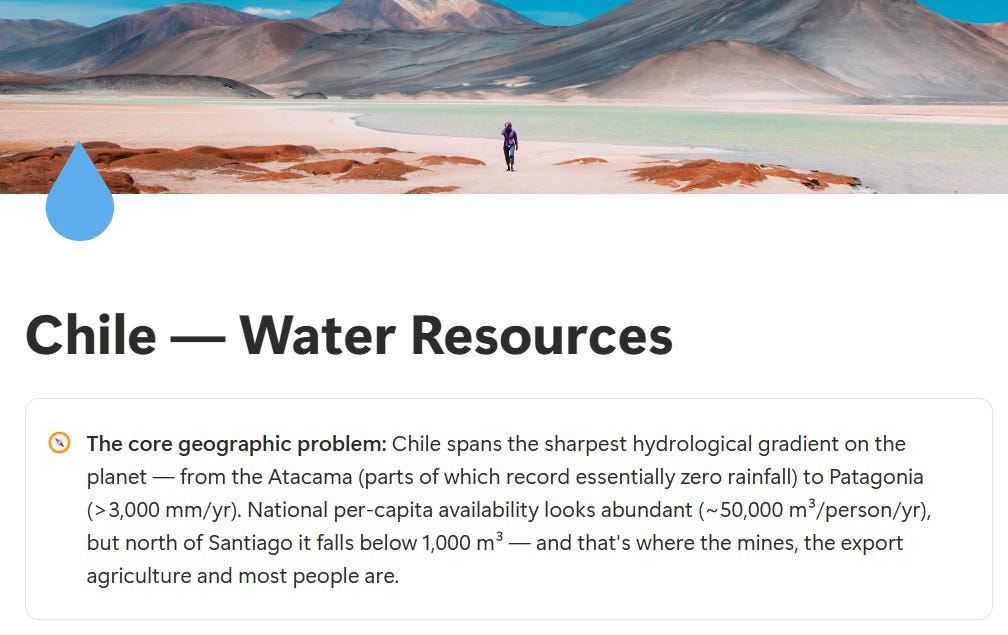
Chile, by the way, is the fifth country by number of members in The Water MBA.
This panel was a first step.
The idea is simple: members who are active in the group and as subscribers should also have the chance to have a voice and share their views, so that we can find each other.
Our sector keeps looking for top minds on international stages, and we will keep bringing them.
But many are already here, reading the same essays and answering in the same group.
So why not start among us?
Thank you, Ignacio, Juan José and Carlos for your continuous support to our community.
A key quotes you can navigate quickly
On the free-client market
“Every user has their own willingness to pay, depending on the return that water produces for them.”
— Ignacio Rodríguez (08:00)“Chile is probably the only country in the world with the geographic, regulatory and economic characteristics that make this kind of project possible.”
— Ignacio Rodríguez (09:00)
On mining as the market’s engine
“The mining companies realised that water is not part of their business.”
— Ignacio Rodríguez (28:30)“Chile has seen absurd cases: two desalination plants very close to each other, for two different mining companies, where the infrastructure could perfectly well have been shared.”
— Ignacio Rodríguez (29:00)
On the long life of the asset
“The future is that desalinated water will become a commodity.”
— Ignacio Rodríguez (30:50)
On infrastructure designed for a hydrology that no longer exists
“The works that were tendered were oversized: the flow it was designed for no longer exists today.”
— Juan José Crocco (12:20)“Imagine the reservoir built and able to receive desalinated water in the periods when you have no availability.”
— Juan José Crocco (14:04)
On drought and surplus
“We lack the water policies and the infrastructure to handle water surplus and make use of those resources.”
— Carlos Rubilar Camurri (16:00)“We have to plan within a framework of climate resilience: knowing how to adapt to a lot of water or very little.”
— Carlos Rubilar Camurri (17:32)
On permisología
“Permisología is a half-invented word, but it’s not a simple matter: there are many administrative interdependencies and many agencies with water competences.”
— Ignacio Rodríguez (20:00)
On regulating after the fact
“I’m in favour of what isn’t regulated, because it allows private agreements that can be far better solutions than anything the State could deliver in a reasonable time.”
— Juan José Crocco (24:10)“Chile’s regulatory framework is reactive.”
— Juan José Crocco (26:00)
On water as a multi-systemic problem
“Water is a multi-systemic problem; facing it only as a lawyer would only ever give me a partial solution.”
— Juan José Crocco (03:00)
On public perception and trust
“Antofagasta is supplied 100% by desalinated water and has the highest per-capita bottled water consumption in Chile.”
— Carlos Rubilar Camurri (33:00)“We have to leave behind this trench politics that puts human consumption, environmental conservation and productive use at opposite ends.”
— Carlos Rubilar Camurri (33:40)
On scale
“We picture the big plants, but there are also smaller needs that could be served by small-scale desalination.”
— Carlos Rubilar Camurri (35:00)
On diagnosis versus piloting
“This democratic exercise has flooded us with diagnosis, and sometimes we’re diagnosing things we haven’t even tried.”
— Ignacio Rodríguez (38:50)
On data as infrastructure
“I’d put all that information on a public, available, reliable platform that lets you work out what someone would pay for a cubic metre of desalinated water delivered at 5,000 metres above sea level.”
— Juan José Crocco (42:40)“You can communicate anything, but if it isn’t grounded in correct, up-to-date data, in the end you’re selling smoke.”
— Carlos Rubilar Camurri (46:00)


