

A warning before we start. This edition may cost me a few unsubscribes. I accept that.
The Water MBA was never meant to repeat the headlines we already read every week. It is meant to be real exercise for your brain.
We are here to transform ourselves, and that means listening to insights that go beyond the typical narratives, even when they make us uncomfortable. If you leave today, I hope you leave with more context than you arrived with.
That is why it felt so refreshing to open LinkedIn a few weeks ago and find a post from Chris Fellows.
He said that life is short, that he is no longer under pressure to keep his mouth shut, and that he was going to start saying the things that usually stay unsaid.
Then came a series of ten personal perspectives on some of the hottest topics in our sector.
I followed it like a Netflix series. I activated notifications so I would not miss the next episode.
And once I had read them all, I knew I wanted to discuss them further, with him and with you.
So here it is. Raw and real talk on the picks I chose for the podcast.
For each of the ten reflections you will find what Chris said, whether we took it into the episode, what we discussed, and one or two questions to keep you thinking.
At the end, as usual, the best quotes by topic with the approximate minute.
Today’s publication is sponsored by the The Water MBA
Interested in reaching a global community of water professionals while supporting the growth of The Water MBA?
We have this space reserved for you. If you’d like to explore sponsorship opportunities and become part of our journey, get in touch at info@thewatermba.com.
Who is Chris Fellows
Chris was born in 1970 in Tucson, Arizona, in the middle of the desert. He was raised to take short showers and to hate golf courses.
At twelve his family moved to Townsville, in tropical North Queensland, where one year he measured 600 mm of rain in a single day at his house.
He wanted to be a physicist, “downgraded” to chemistry, and ended up with a PhD in polymer chemistry.
His first water problem came through the sugar industry: scale in multiple effect evaporators very similar to those in thermal desalination.
That led to a postdoc at the University of Sydney on scale inhibitors and flocculation, and then a permanent post at the University of New England.
One phone call out of the blue took him into desalination research. Another took him to Saudi Arabia, to the research arm of what was the Saline Water Conversion Corporation, now the Saudi Water Authority, arguably the largest producer of desalinated water in the world.
The plan was one year. It became seven.
I first heard his name when Christos Karishadis, visiting our community, thanked him for renaming “brine mining” as “brine valorization”.
One year ago, in Valencia
Exactly one year ago, I almost missed a flight to Valencia, to a conference on desalination and nuclear power (I already talked about that in previous publications).
I made it, checked into the hotel, exhausted, and went down to the hotel restaurant. Fully booked. No space.
Fuck. Now I had to go out and find something.
Then someone shouted my name across the room. It was Christos. He had a table. “Have dinner with us.” Hell yeah.
He was sitting with Chris, and he introduced us. We talked, and mostly, I listened. The next day I watched Chris on stage, and he was as sharp explaining complex matters to a full room as he had been over dinner.
This is the kind of serendipity in life that I love. A fully booked restaurant turned into knowing a great professional.
One year later, here you have the chance to listen to someone really worth listening to, and to connect with him directly on LinkedIn to keep the conversation going.
The ten reflections
I took eight of the ten into the episode.
There is a role for thermal desalination · 09:30–12:00
Academic effort wasted on solar-driven desalination · 12:15–17:00
Academic effort wasted on exotic 2D materials · 17:05–20:10
Seawater desalination brine is not a problem · 20:10–25:50
Zero Liquid Discharge makes zero sense for seawater · 25:50–27:50
Microplastics and nanoplastics are not a problem · 28:20–32:20
Untapped potential in rainwater harvesting · 36:40–41:40
PFAS “forever chemicals” are not a problem · 32:20–36:40
Agriculture is the elephant in the room · Not in the pod
Can the clouds give us more water? · Not in the pod
1. There is a role for thermal desalination
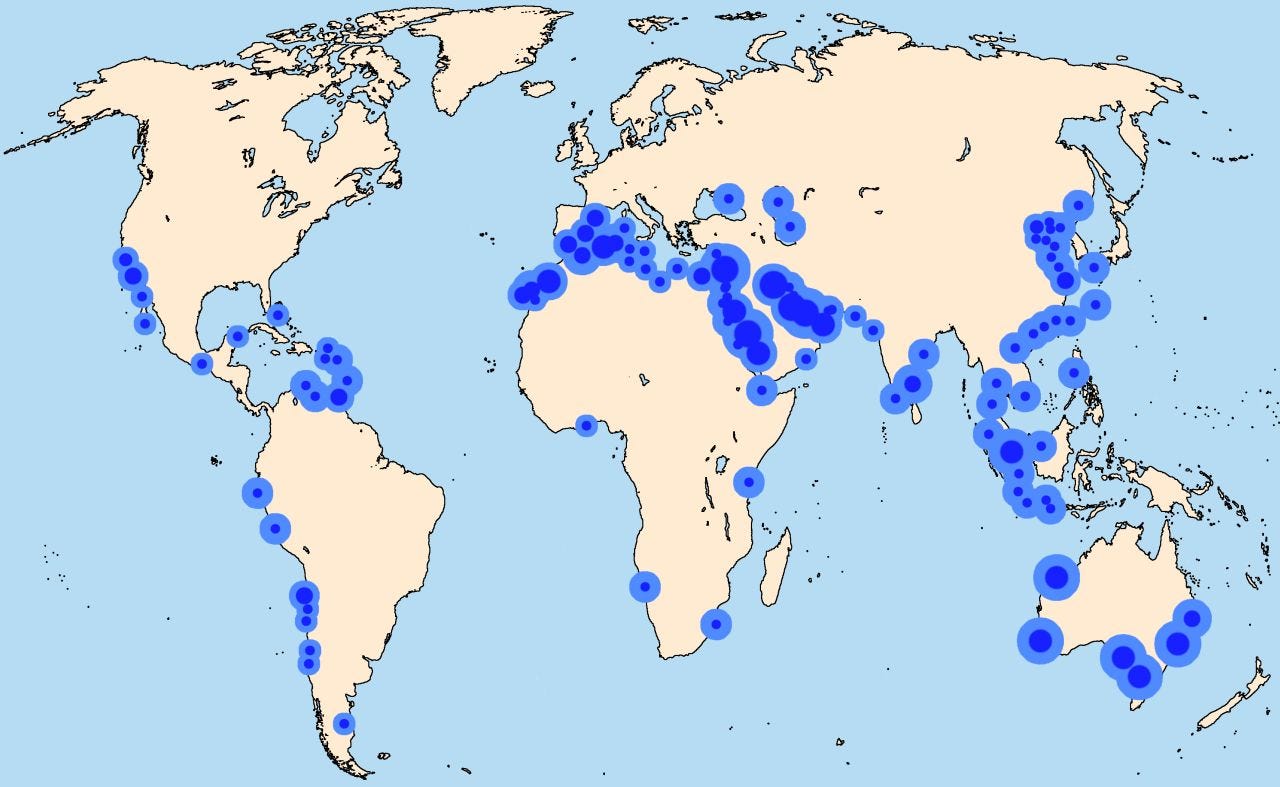
In his post, Chris made a point that sounds almost heretical today: RO wins on specific energy consumption, but there is no fundamental physical reason for that.
Right now it is simply cheaper to recover pressure than to recover heat of condensation. And energy is not the only factor in the cost of water, just as cost is not the only factor in choosing a technology.
His proposal is to keep roughly 30% of capacity as thermal, because it is more robust under “pathological conditions”: no steady stream of replacement membranes, bad intake water from algal blooms or oil spills, sanctions or crises cutting access to expertise.
Thermal research should be kept alive too.
I pushed back with my own experience.
When I started my career, some contracts in the GCC was about replacing end-of-life thermal plants with RO, sometimes terminating offtakes early because the numbers were so much better.
Chris answered with what he lived during COVID in Saudi Arabia: membranes could not be replaced on schedule, and the kingdom-wide water quality data they were collecting showed it.
For him, the number one priority for water supply is not cost but security.
Questions for you.
How would you price water security in a tender, when the cheapest kWh/m³ always wins the evaluation?
Is a thermal reserve the right hedge, or can strategic membrane stocks and dual sourcing do the same job?
2. Academic effort wasted on solar-driven desalination
Here Chris was blunt. By his estimate, around 90% of what is published in journals with “desalination” in the title has no relevance to real desalination.
Solar stills and “interfacial photothermal” desalination are his main targets.
If you want to desalinate seawater with the sun, photovoltaics driving RO is by far the best route, and for very small systems, simple and robust beats clever.
A clarification I also made in the pod: this is not about the PV plant plus RO projects we share every week in our WhatsApp group.
It is about using sunlight directly to evaporate water.
I asked Chris where this disconnect comes from, and he said he only saw it clearly after a few months working in industry. These papers ignore a century of thermal desalination learning, starting with recovering the heat of condensation.
Then he told me an anecdote. He reviewed one of these papers, accepted the science and rejected the sustainability claims.
It was published with the claims intact. His letter to the journal, signed by his desalination colleagues, was declined.
So, with Dr. Mustakim, they wrote a full review article taking the field apart.
He closed with Linus Pauling: to have good ideas, have lots of ideas and throw the bad ones away.
Questions for you.
Who should police exaggerated claims: reviewers, journals, or the agencies funding the work?
What would it take for industry to hand academia a clear list of the problems we actually need solved?
3. Academic effort wasted on exotic 2D materials
I have to confess I had never heard of “exotic materials” before reading this post, so I asked Chris directly.
He started with the one we all know: graphene, the wonder material that is still very hard to scale into anything useful.
Molybdenum disulfide and other 2D materials belong to the same family, and they are a fast track to prestigious journals. Show near-perfect ion rejection and ten times the flux of commercial membranes, and you can get into Nature.
The problem, as he explained, is that flux barely moves the cost of water.
Most of the energy goes into overcoming the osmotic difference, not into pushing water through the membrane.
Higher flux also means more concentration polarisation and faster fouling, and every membrane compacts and fouls back to ordinary performance within months.
Turning any of these materials into a membrane that fits an existing plant needs a lot of development, for a marginal benefit that disappears almost immediately.
His plea: keep working on them, but “stop tugging heartstrings” by claiming to solve water supply.
Questions for you.
What membrane improvement would really change an EPC bid: fouling resistance, chlorine tolerance, lifetime, price?
Should grant applications claiming water impact be asked to show a credible path to a real plant?
4. Seawater desalination brine is not a problem
This is the one where I agree with Chris the most.
He calls it “a hill I am prepared to die on”.
Modern outfalls use diffusers and discharge into fast-moving water. Studies find effects within 50 to 500 m, measured in hectares, not square kilometres, and those areas host different life, not necessarily less.
Follow best practice, yes. Spend hundreds of millions to eliminate every impact, no.
And avoid words like “toxic”, which some campaigns use to block desalination where it could relieve real pressure on aquifers and rivers.
I asked him why brine is such a hot topic at every conference.
Chris first drew a line: inland desalination is a different story, with evaporation ponds or deep aquifers to deal with. At sea, the dilution ratio is enormous.
Part of the problem, he said, is the word itself. In English, brine sounds like pickles, smelly and coloured.
In reality it is concentrated seawater with ppm-level additives, and every plant sends divers to check its outfall.
I shared a project I bid on next to a coral reef.
Microtunnelling avoided trenching a corridor of about 200 m of seabed, and we went deeper for dilution. More expensive, but the lesson for me is that construction often hurts more than the brine itself.
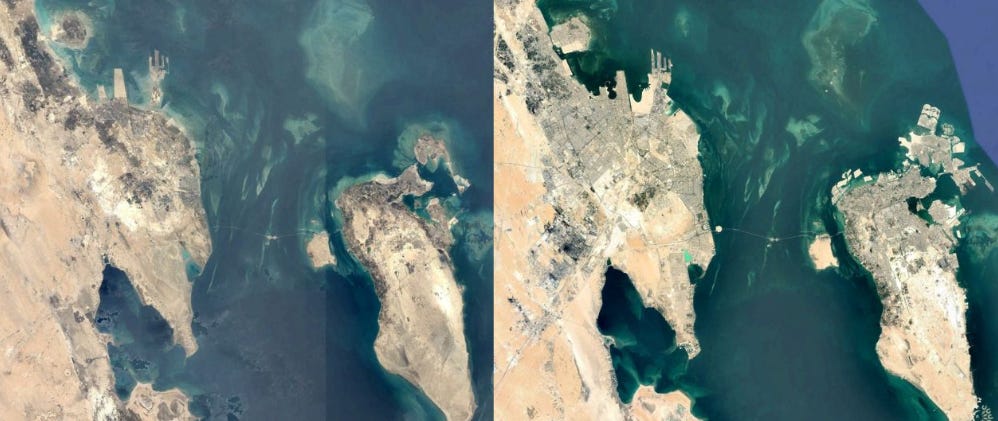
Chris complemented it with the images from his post: Google Earth views of the Gulf coast around Qatif, Dammam and Bahrain, thirty years apart, where dredging and land reclamation have turned seagrass and reef shallows into land.
Next to that, brine is a footnote.
Questions for you.
If construction is the bigger impact, should EIAs give more weight to construction methods than to plume modelling?
Are we over-engineering outfalls to buy public trust, and is that money well spent?
5. Zero Liquid Discharge makes zero sense for seawater
Brine leads naturally to brine valorization. Christos had already told our community that ZLD makes little sense and that minimal liquid discharge is a better focus, so I asked Chris whether he shared that view.
He did, with one nuance: at an inland mine site, ZLD can make sense. For seawater, it simply swaps an easily managed liquid waste for a very difficult solid one: dust, truck movements, groundwater risk, land take.
Then he did the market maths.
Early adopters could ship salt north as de-icing salt, but that market saturates quickly.
Even with free separation, sodium chloride is cheap everywhere, and transport kills the margin.
Applied across the board, we would have more salt than anyone could use, far from the markets that want it, in warehouses or in desert piles.
He supports valorization for strategic and economic reasons, but it will only ever absorb a small fraction of brine and should not be sold with environmental arguments.
ZLD, he jokes, means mountains of unsaleable salt, perhaps good for skiing.
Questions for you.
Which two or three brine products have an honest business case at scale, and where?
Should tenders stop scoring ZLD as an environmental plus for seawater plants?
6. Microplastics and nanoplastics are not a problem
When I asked Chris about microplastics and PFAS, he put them under the same umbrella as brine: many people want to be Erin Brockovich.
Find an environmental problem, find a villain, make them stop, be the hero.
And discovering a big problem is an easy way to secure research funding for life.
He was careful to say he accuses no one of acting in bad faith. It is just the temptation.
As a polymer chemist (”maybe that makes me the enemy”), his argument is chemical.
“Plastic” is not a chemically defined class, just shorthand for synthetic polymer, and nothing makes synthetic polymers hazardous and natural ones innocent.
Polymers are unreactive because the reactivity of their building blocks is used up, and their molecules are too big to cross cell membranes easily.
His classic example: styrene is a carcinogen, polystyrene is the cup you drink hot coffee from.
We evolved surrounded by indigestible polymers, from cellulose and keratin to the humic substances in surface water.
He tells his students they can eat as much polymer as they like, then adds that this is not medical advice.
In his post he goes further on treatment.
Macroplastics are a real problem for wildlife and landscapes, but micro- and nanoplastics behave like TOC and suspended solids. Sand filters retain them, sweep flocculation captures them. No novel treatment challenge.
A note from me: I am not a chemist, and this is Chris’s position. Many researchers see the health question as open, and it is an active field.
Questions for you.
If conventional filtration already retains them, what exactly are utilities being asked to pay for?
What evidence would it take to change your mind, in either direction?
7. Untapped potential in rainwater harvesting
That dinner in Valencia when Chris told me he harvests rain at home. I had finally found someone who actually does it, so of course I asked him how.
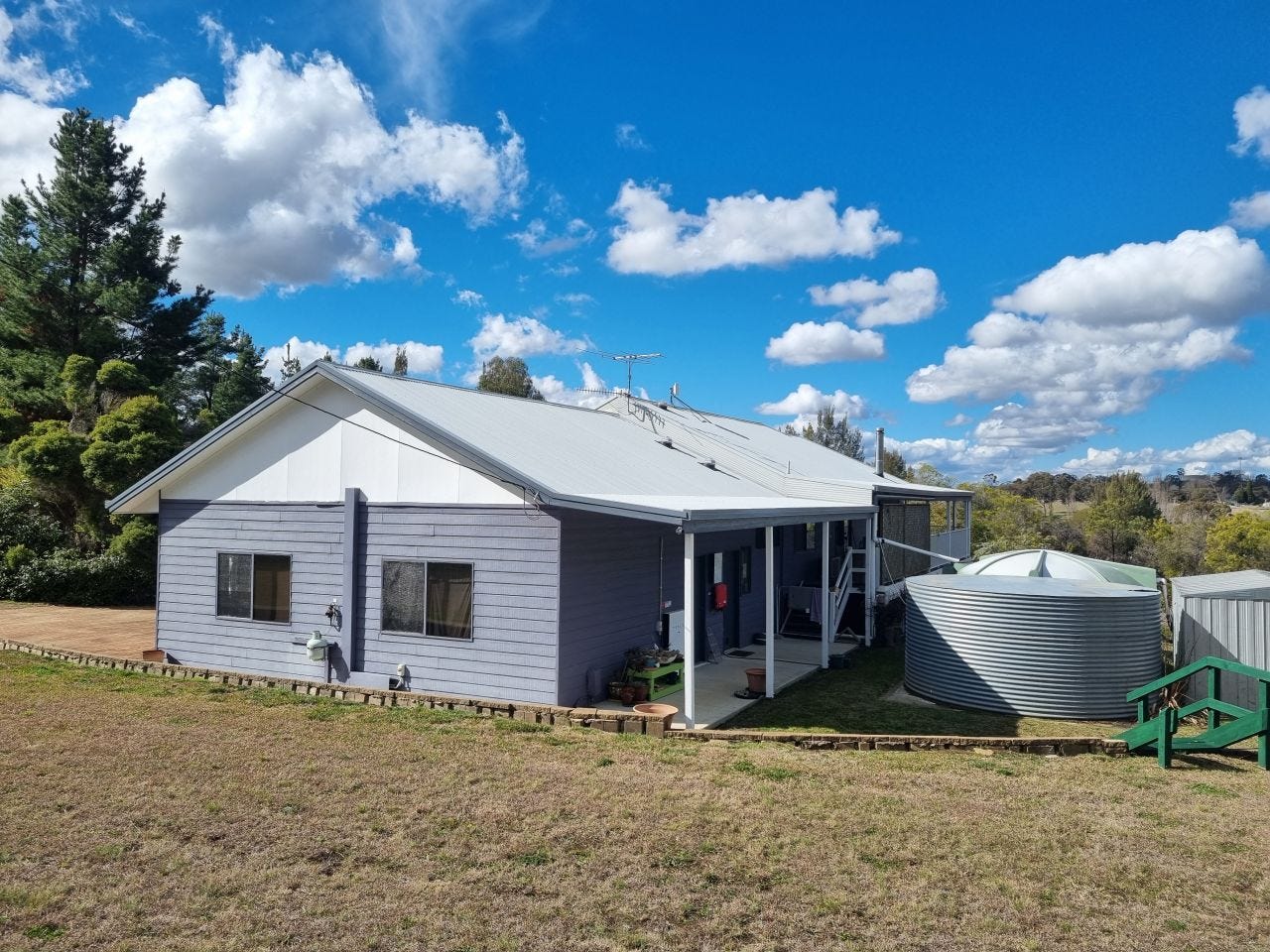
He lives only 1.5 km outside town, but there is no municipal network, so he and all his neighbours collect rain.
Two 20,000 L tanks off the side of the house, about 800 mm of rain a year, negligible OPEX and a CAPEX that was a small part of the house price.
Five adults lived there during COVID.
A few times they had to buy water, mostly when teenagers at home took long showers.
His in-laws down the hill, with the larger storage now required for new homes, have never run out.
I asked whether it was only for showers. No: it is for everything, drinking included, with just a filter for solids.
Nobody inspects the system, unlike septic tanks, and he has never heard of anyone getting sick.
His explanation: without interconnections, contamination has nowhere to spread.
In his post he adds an irony: when people buy chlorinated water in droughts, THMs and haloacetic acids probably spike because of the organic matter in the tanks.
He is honest about the limits. For a dense area like the City of Sydney, 237,000 people on about 26 km², you would need to capture around 40% of the rain to match his household use.
But most of Western Europe gets more rain than he does, and the UK or France declare droughts a few months after heavy rain ran off urban infrastructure.
For local communities, this is a simple solution that we in the water business should take more seriously.
Questions for you.
Why do we not require storage tanks in new buildings, as his local council does?
How should a regulator treat a self-supplied roof compared with a networked supply?
8. PFAS “forever chemicals” are not a problem
On PFAS, Chris was less absolute in the pod than in his post. He admitted he knew little about them until a full-day workshop in Birmingham a few years ago.
PFAS are “forever” because we designed them to be unreactive, which is also why they bioaccumulate.
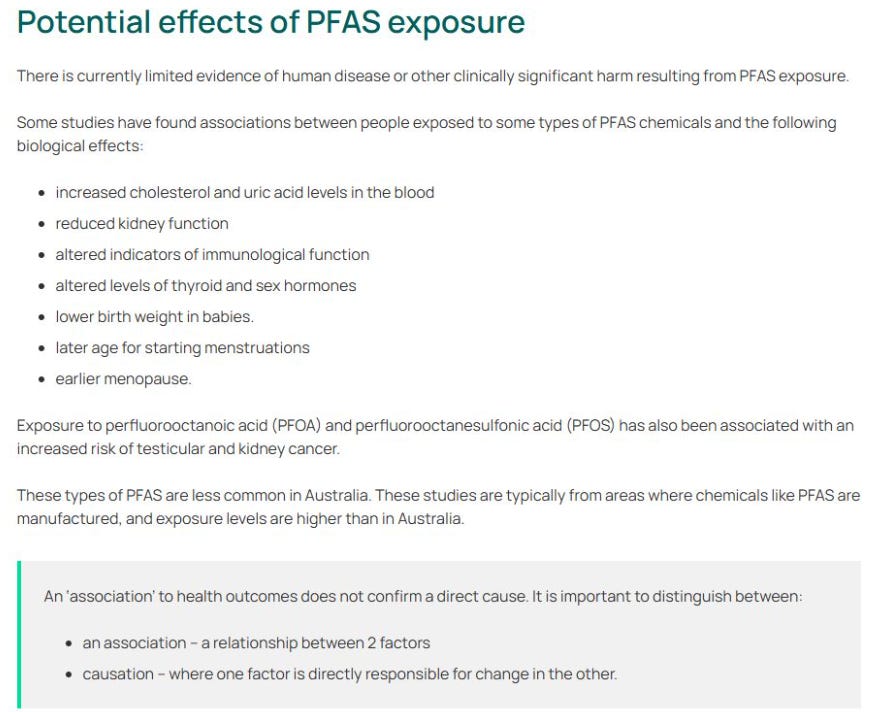
Some studies show negative effects, especially for shorter chains, and drinking firefighting foam is a bad idea.
But compared with real chemical threats like DDT, chromium or tobacco, he finds the epidemiological evidence weak, with no clear syndrome attached.
His hypothesis: PFAS may be markers of other, more dangerous contaminants in the same waste streams, from landfills, factories or air bases.
In the post he adds a provocation: nature is trying to kill us, and his cauliflower surely holds thousands of untested toxic compounds at ppb levels.
His core point is economic: the regulated levels determine the cost.
Hotspots near landfills and air bases should be cleaned up, but spending tens or hundreds of billions to remove nanoquantities worldwide is, in his view, a terrible misallocation.
He argues US limits should be at least a hundred times higher, and that most exposure comes from food and cosmetics, not drinking water.
I shared what I had just read about polluter-pays in Europe, with cosmetics and pharma pushed to contribute, and asked whether tariffs will rise anyway.
And I mentioned Dark Waters: in our business, narrative and communication move as much as data.
Again, a fair note: regulators on both sides of the Atlantic and many toxicologists hold a different view, which is why limits keep tightening. This is Chris’s dissent, argued in the open.
Questions for you.
If the limit sets the bill, who should set the threshold, and on what evidence?
Does polluter-pays change the debate, or simply move the cost to another bill?
9. Agriculture is the elephant in the room
In his post, Chris says seawater desalination today is in good shape: high quality, low cost, low impact, able to supply cities 300 km inland.
He even says lack of political will is the only real reason Los Angeles and Phoenix are not fully supplied this way.
What desalination cannot do is supply agriculture competitively. Even with zero production cost, pumping water inland makes it far too expensive, and most of the world’s water goes to farming.
The opportunity is high-value crops in greenhouses near the coast, like California’s strawberries.
Places like Andalucía, Israel and Saudi Arabia could produce as much or more with desalinated water, but only with big changes in what is grown and where.
Whole regions dependent on groundwater, like Al-Jawf, would have to shut down. And for China, Sudan or Kansas, no desalination breakthrough will ever be enough.
Questions for you.
Are we ready to talk openly about what we grow and where we grow it?
What desalinated water price would make coastal greenhouse agriculture viable at scale?
10. Can the clouds give us more water?
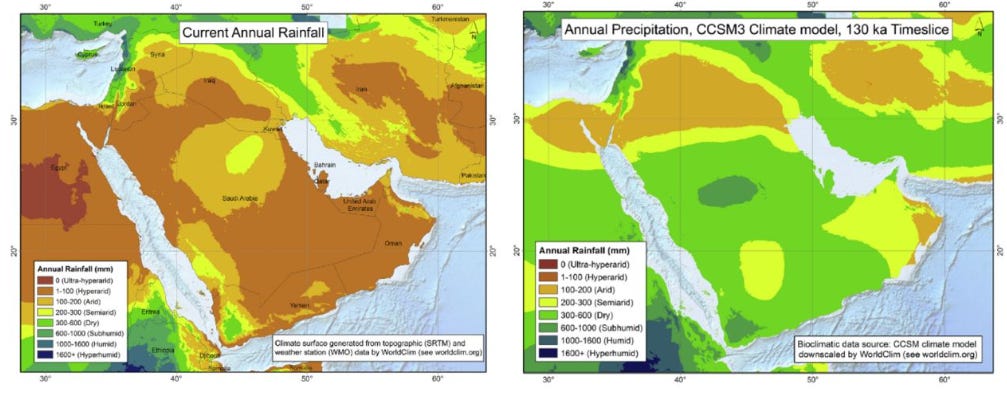
If agriculture needs cheap water and the ocean cannot provide it, Chris asks whether the clouds can provide more.
He points to past interglacial periods about 2 °C warmer: a warmer atmosphere holds more water, and central Australia, Arabia and the Sahara greened.
From that record he concludes that ice caps would not drown the coasts, there would be no runaway feedback, deserts would shrink rather than get hotter, and polar species would only lose range.
Questions for you.
If Chris were right, what would change in how we plan water infrastructure?
If he were wrong, what would it cost us to plan as though he were right?
Dialogue over monologue
You do not have to agree with Chris. I do not agree with all of it either.
But I agree with how he does it: name the claim, show the reasoning, and accept that you might be wrong in public.
Our sector needs more of that. We cannot be lazy with narratives just because they are comfortable or well funded.
Chris said it himself at the end of the episode: despite his lecturing habits, he finds dialogue more interesting than monologue, and he wants to hear back from you.
He is now part of our community. Write to him on LinkedIn, reply to this email, or bring your disagreement to the WhatsApp group.
Pick one of the questions above and tell me where you stand.
Quotes from the episode
Lightly edited from the recording for readability. Minutes are approximate.
Background
“I was raised to take short showers and to hate golf courses.” — Chris, 01:30
“I went into university intending to be a physicist, but I didn’t work hard enough at my maths, so I had to downgrade to a chemist.” — Chris, 02:20
“It was basically just applying first-year chemistry to real-world problems, which was very exciting.” — Chris, 06:40
Thermal desalination
“The number one priority for water supply isn’t cost. It is the safety and security of the water that’s supplied.” — Chris, 09:55
“Thermal is much more forgiving.” — Chris, 10:55
“There are benefits in having a single integrated water and power plant that you can defend against a drone swarm.” — Chris, 11:00
Academia vs industry
“Coming out of academia, you really start to see the disconnect between what academia is doing and what industry needs.” — Chris, 12:25
“The best way to desalinate seawater with sunlight is to use photovoltaics to generate electricity to drive reverse osmosis.” — Chris, 13:15
“I think we do too many rounds of review nowadays.” — Chris, 15:05
“The way to have good ideas is to have lots of ideas and throw the bad ones away.” (quoting Linus Pauling) — Chris, 16:50
2D materials
“The marginal benefit is very tiny, and you would lose it almost immediately, because nothing stays the same.” — Chris, 19:20
Brine
“Brine is something you have pickled vegetables in. We know brine is not like that. It’s just seawater, more concentrated.” — Chris, 22:15
“No plant wants to damage the environment it is operating in.” — Chris, 23:00
“For me, the construction part is more impactful than the real brine dilution.” — Ramón, 25:05
“The impact of brine is absolutely dwarfed by the impact of dredging and land reclamation.” — Chris, 25:35
Zero Liquid Discharge
“You’re spending an awful lot of money to replace an easily soluble liquid waste problem with a very, very difficult solid waste problem.” — Chris, 26:50
“We would have more salt than anyone could use, and it would be far away from the markets that want it.” — Chris, 27:20
Narratives
“A lot of people basically want to be Erin Brockovich.” — Chris, 28:35
Microplastics
“You can eat as much polymer as you like. That’s not actual medical advice.” — Chris, 31:10
“Plastics aren’t a chemically defined class.” — Chris, 32:15
PFAS
“Compared to the epidemiological evidence for real chemical threats, it’s very weak.” — Chris, 33:50
“These PFAS might be there as a marker for something else that’s happened in the past.” — Chris, 34:50
“The regulated levels are what determine the cost.” — Chris, 35:10
“In the water business, narrative and communication are super important.” — Ramón, 36:40
Rainwater harvesting
“Just what’s falling on our house is sufficient to keep us going.” — Chris, 38:30
“It’s not a sacrifice at all.” — Chris, 38:50
“I think we could go a long way by just capturing the water that’s falling and running off our houses.” — Chris, 39:20
“We’re quite paranoid about problems, but we have never done anything to the water falling on our house.” — Chris, 39:50
Dialogue
“We cannot be very tolerant with the bad ideas or the wrong messages.” — Ramón, 42:10
“I really think dialogue is more interesting than monologue.” — Chris, 42:25


