

Today, Sunday, 18 October, Spain’s Valencian Community is bracing for an extreme rainfall event, with the highest-level red weather alert issued for parts of the region.
Forecasts warn of rainfall exceeding 200 litres per square metre in 12 hours, potentially reaching 300 litres in 24 hours in the worst-affected areas.
Such volumes could trigger flash floods, overwhelm urban drainage systems and cause dangerous rises in rivers and ravines.
On 28 and 29 October I will be in Madrid for the Iberoamerican Young Water Professionals conference.
The last edition I attended was two years ago, in Bilbao.
I remember that event for a reason that had nothing to do with the agenda.
While we were in the sessions, the DANA hit Valencia.
Phones started buzzing in the room, and by the next morning the numbers were unthinkable: more than 220 people dead.
Two years later, I am going back to the same conference.
So I asked myself a simple question:
what has actually been done since? And what has happened with floods in the rest of the world in those two years?
The short answer is the title of this essay. Floods will never disappear.
They will come back to Valencia, to Texas, to Pakistan and to places that today think they are safe.
The only real question is how ready we are when they do.
To close the essay I am recovering a conversation I recorded with Oliver, co-founder of Aggeres, a Belgian company that builds flood barriers.
Flood protection technology was already flagged then as one of the fastest-growing segments of climate adaptation and resilience.
Two years of headlines have only made that case stronger.
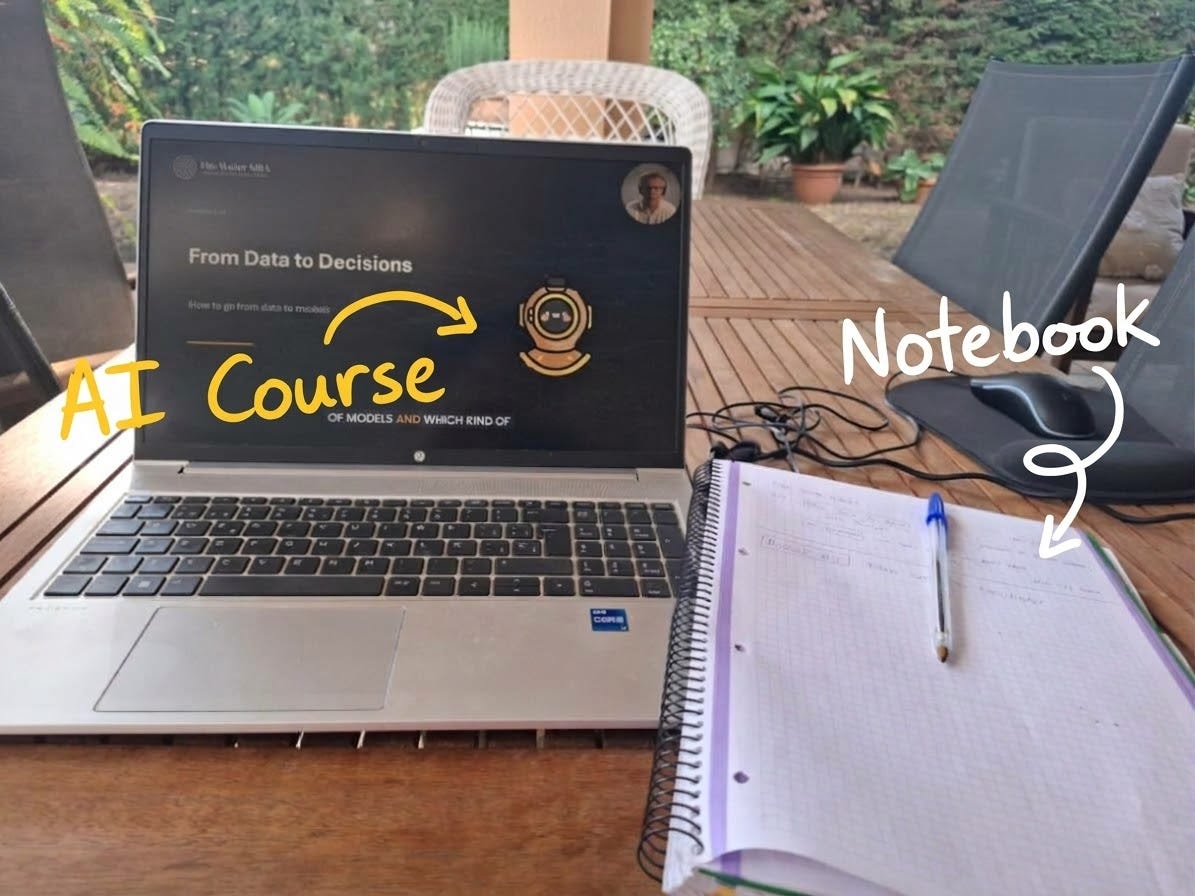
🤝 Sponsored by The Water MBA: AI and Intelligent Operations in the Water Industry
This week we kicked off Modules 0 and 1. You can join anytime: the course is available in our academy, so you can start at your own pace.
A few seats are still free in the end, the page shows how many seats would get the early-bird discount. So don’t tell me I didn’t warn you!

👉 Join the first cohort, or write to info@thewatermba.com
My personal advice: in any of our courses, the thinking is what matters most. I recommend pen and paper. You’ll see the difference at the end, because writing by hand helps you connect the dots.
Valencia, two years on: mostly repair, the big works still on paper
Two years after 29 October 2024, almost all the money executed in Valencia has gone to repairing damage.
The structural works that would change the risk may be partially designed, tendered or authorised, but not built.
Three messages from the news, checked
In the days after the disaster, three messages dominated the conversation. Each has some truth, and each is incomplete.
1. “We need more hydraulic infrastructure. Lack of investment is killing people.”
Largely true, with a nuance.
The Barranco del Poyo had been studied since the 1980s. A 2009 CHJ flood plan for the basin worth €221 million was never executed for lack of funding.
The diversion of the Poyo to the new Turia channel was drafted in 2006, got its environmental approval in January 2012, and let it expire in 2018 without a single shovel.
The Poyo carried about 2,282 m³/s at 18:55, against a warning threshold of 150 m³/s.
The dean of the Valencian civil engineers told the Senate that the planned works would have laminated the peak and reduced the damage, not prevented the flood.
Infrastructure reduces risk. It never brings it to zero.
2. “The floods came because the rivers were not clean.”
Mostly false. Reeds and sediment matter for ordinary floods.
At fifteen times the warning threshold, a clean channel and a dirty one both overflow.
3. “The alarm systems did not work.”
True, and this is where most lives were lost.
The ES-Alert reached phones at 20:11.
In Paiporta the first 112 call about the Poyo overflowing came at 18:32, and 192 of the 228 deaths counted happened in municipalities along the Poyo.
The Horteta ravine, a tributary that sent water into Torrent and Paiporta, had no flow gauge at all.
What has actually been done
The Confederación Hidrográfica del Júcar leads the state works. Its first two years look like this:
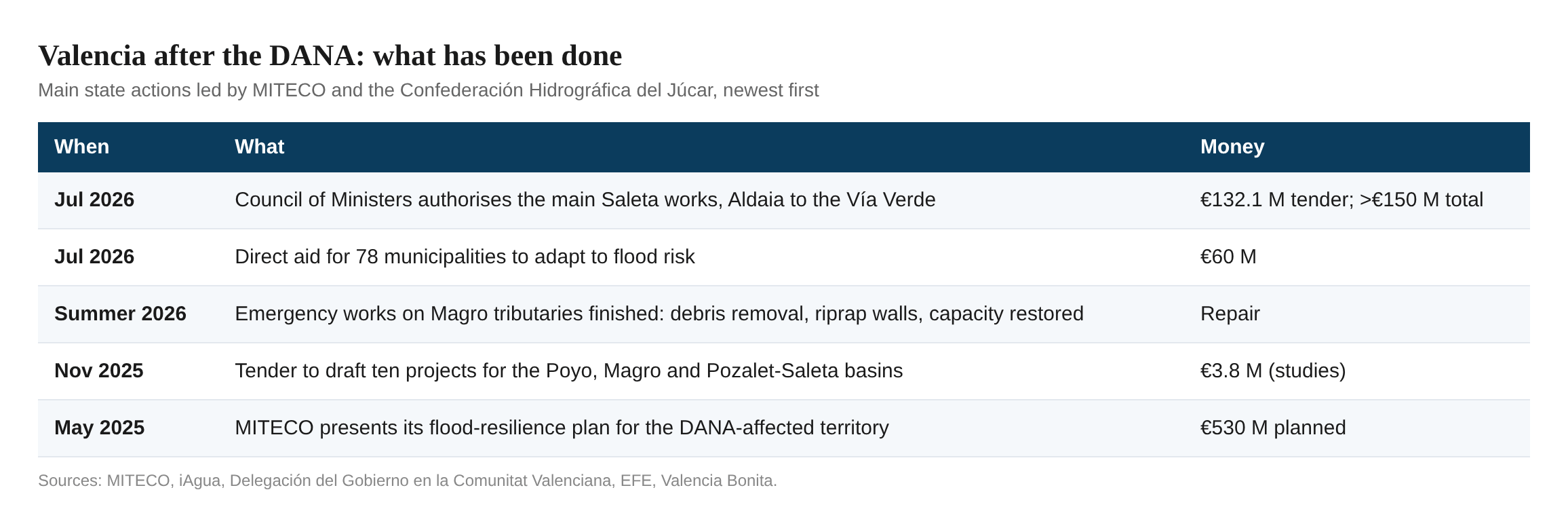
What did they study?
The ten projects, now with Typsa-Gecival and Aquatec-Granell, use the real behaviour of the water on 29 October as the design reference.
They combine controlled storage zones to shave the flood peak, widening of the Poyo from Torrent to l’Albufera, more room for the Magro in Algemesí, flood parks in urban areas, and removing the barrier effect of the V-30 and the railway.
The first proposals are due this autumn, followed by public consultation. The Valencian Government says the definitive Poyo works will not start before 2030.
Let’s be honest: acting on physical infrastructure has become very, very slow, especially in places like Europe. Very slow.
You can have a list of 200 actions that would improve the situation.
But there is no magic wand that turns a list into concrete.
Studies, environmental approvals, expropriations, tenders and construction take years, even under emergency.
Meanwhile, the next DANA does not wait: on 1 October 2026 Valencia’s universities suspended classes again under a red rain warning.
One line of the MITECO plan deserves attention: €60 million to adapt buildings with raised accesses, watertight doors and barriers. That is the scale where protection can arrive in months, not decades. I will come back to it.
Meanwhile, the world kept flooding
In the two years since Valencia, at least eleven major floods have killed several thousand people on every inhabited continent. While Spain was still drafting projects, the rest of the world kept writing new headlines.
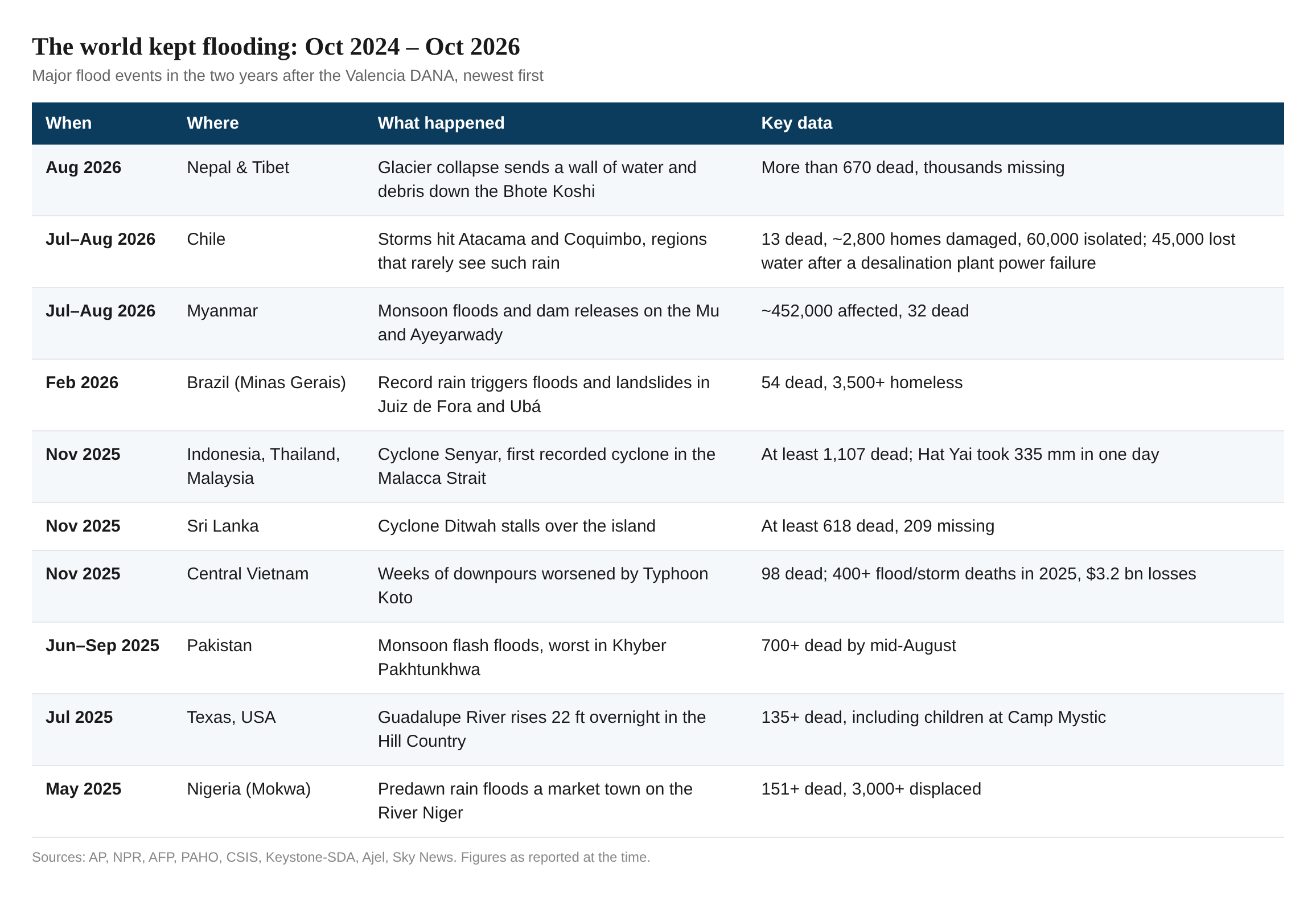
Three patterns repeat.
First, speed: in Texas, Paiporta and Nepal, people had minutes, not hours.
Second, surprise: the Atacama desert, a cyclone where cyclones do not form, a rainfall record in Hat Yai.
Third, the same sentence in every language. In Mokwa, the local chairman said the flood-control works were long overdue. In Valencia, the Poyo plan had been waiting since 2009.
The Chile row is worth a second look. During the same weather system, an electrical failure at a desalination plant left 45,000 customers in Antofagasta without drinking water.
Flood barriers: protection you can build this year
Big hydraulic works take decades.
Flood barriers can protect a building, a garage or a riverfront in months.
That is why I wanted to bring back my conversation with Oliver, co-founder of Aggeres.
How Aggeres started
In 2010, Belgium suffered severe floods.
Oliver, a civil construction professional from Antwerp, watched people on the news wading through water with sandbags to protect homes that were already flooded.
His reaction was simple:
why are we still using medieval solutions?
He and his brother found almost no professional flood-protection suppliers in the Benelux, only a few in Germany and the UK.
They ran a market survey, started as distributors of other products, and soon moved to designing and manufacturing their own.
It is a path I see often in water entrepreneurship: you first learn the problem by selling someone else’s solution, then you build yours.
What a flood barrier is
A flood barrier closes the gaps through which water enters: doors, garage ramps, low walls, a riverside promenade.
The point is to protect without living behind a permanent concrete wall.
As Oliver says, cities were built next to rivers for a reason.
A city cannot turn its back on its river.
The main types
Manual demountable barriers. Custom panels placed in doors and garage entrances. Cheap and effective, but someone must be there to install them before the water arrives.
Watertight garage doors. Sealed every time they are closed and strong enough to hold a set water depth. No action needed on the day.
Sliding and pop-up gates. For larger openings, chosen to fit each building and budget.
Self-closing flood barriers. Fully passive. The water itself raises the barrier. More on this below.
One warning from Oliver: protecting doors is not enough.
If your building has low drains or toilets, water will come back up through the sewer.
Most of his clients would rather have water through the door than through the toilet. Backflow protection is part of the job.
The self-closing barrier: one moving part
The design principle is keep it simple.
A narrow, long basin is built into the ground. Inside it hangs a composite wall of glass fibre filled with polyurethane, so it floats.
The basin is connected to the water source: the river, the sewer, a drainage canal, or several of them for redundancy.
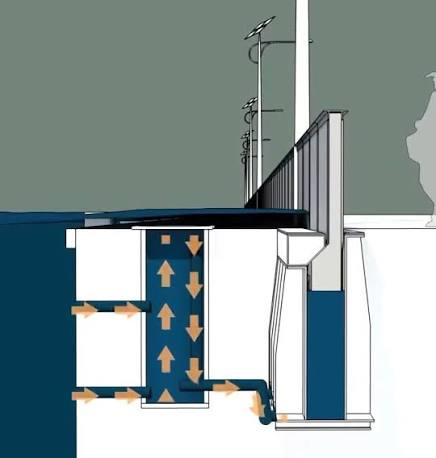
In normal conditions the basin is dry and cars drive over it.
When the water reaches a critical level, it overflows into the basin, the wall floats up and locks itself into place.
Heights go from 30 cm to 3 m, and lengths from a 3 m garage exit to hundreds of metres of riverfront.
No electricity, no hydraulics, no button to press, no person who must arrive in time. That is the whole argument.
A barrier that sleeps for five years has to work the one night it is needed.
The biggest example is in Antwerp, under Belgium’s Sigma Plan against flooding from the Scheldt.
Raising the quay embankments by another metre would have put a concrete wall about 2.25 m high between the historic centre and the river.
Instead, the Flemish water authority chose an 842 m self-closing wall of 1.5 m in several sections, plus a 2 m high, 170 m long barrier.
When we recorded, the engineering phase was almost finished and construction was due to start in phases.
The ROI paradox: zero return or recovered in four hours
The hardest part of flood protection may be deciding to pay for something before you know if you will ever use it.
A simple thought experiment
Imagine you have $1 million to invest. Like any investor, you want a return, some proof that the decision was right.
So you put the $1 million into flood barriers.
Then the expected flood never comes during the whole lifetime of the asset.
Return: zero.
On paper, a bad decision.
Next time, you will look for something else to invest in.
Now change one detail.
You install the barriers, and the next day the flood arrives.
The barrier rises, and the garage, the cars, the basement and the shop below street level stay dry.
You avoid several million dollars of damage.
Return?
Recovered and multiplied in 24 hours.
Same investment, same barrier, same quality.
The only difference is a date you could not know in advance.
Oliver’s four-hour return
This is not theory. In 2015, Aggeres installed a self-closing barrier at the exit of a public underground car park, with level -2 holding 200 cars.
They finished on the day of delivery and went home.
Near midnight, Oliver’s phone lit up: water in the activation chamber.
He thought it was a false alarm, until the thunderstorm passed over his own house.
He drove to the site and found the barrier up, holding the water back.
Without it, he says, 200 cars would have been floating against the ceiling.
The car park’s CEO called him the next day and told him it was his best investment ever. He had never seen a return in four hours.
Think like an insurer, not like an investor
The mistake is to judge protection like an investment. It works like insurance.
Nobody asks for the ROI of the fire insurance on their house after a year without fire.
Oliver uses the same comparison with burglar alarms: you install one hoping it never rings.
The numbers support that view.
A flood with a 1% chance per year sounds rare. Over a 30-year asset life, the chance of seeing at least one is about 26%.
P = 1 - (1 - 0.01)^{30}Roughly one in four. Few investors would ignore a one-in-four risk of losing a car park full of vehicles.
The insurance logic is also where the market is moving.
In Belgium and the Netherlands, Aggeres works with insurers so that a certified installation lowers the premium, much as alarms and smoke detectors do.
Belgium already makes new building permits in flood-prone zones conditional on autonomous protection for underground car parks and low-lying buildings.
Oliver’s view is that this should be European regulation, because floods do not stop at borders.
The real barrier is human
About 90% of Aggeres’ domestic clients had already been flooded before they called.
Oliver has quotes that sit unanswered for two, three or four years.
Then the phone rings: I was flooded yesterday and I want it today. What a classic!
On the public side the barrier is different but just as human.
Engineers prefer embankments and concrete walls they can calculate, and they distrust a composite wall that floats.
Politicians prefer works they can inaugurate to protection that is invisible until the night it works.
This is not unique to floods.
In any business, decisions with an uncertain payoff get postponed: maintenance, cybersecurity, redundancy, training.
We are wired to reward visible returns and to discount rare events.
That is why the cost of not deciding is always paid later, and usually by someone else.
In Valencia, it was paid on 29 October 2024.
Floods will never disappear. Our exposure can.
We cannot stop the rain. We can decide how much of it reaches people, and how fast we react when it does.
That means working on four layers at the same time, not waiting for the biggest one.
Large infrastructure. Necessary, and slow. Studying is not building.
Warning and response. The fastest layer to fix and the one that failed most in Valencia. Automatic alerts, emergency plans that reflect today’s territory, and a population that knows what to do. I think that China is a worldwide leader in this regard.
Space for water. Oliver called it Waterland 2.0. The Low Countries have drained their land since the Middle Ages, and now they face record droughts and floods in the same year. Flanders even talks about desalination while it floods every winter. Keep water where it falls, store it, and release it when needed?
Protection at building scale. Barriers, watertight doors, backflow valves, self-closing walls. It is the only layer that can be in place before next autumn.
In two weeks I will be in Madrid with young water professionals from Spain and Latin America.
Many of them will spend their careers in countries that appear in the table above.
My message to them will be simple: do not wait for the perfect project. Floods will come back.
The question is whether we will have built anything by then.
Key quotes
On founding Aggeres
“We saw people wading through water carrying sandbags, trying to protect their already flooded homes. Why are we still using medieval solutions to protect our houses?” (~02:00)
“Initially, we were a distribution company for other solutions already on the market, quickly transforming into a production company, creating and building our own solutions.” (~03:40)
On living in a delta
“We’re living in a delta, probably the most engineered delta in the world, with land reclamation and high embankments protecting ourselves from the rivers.” (~06:50)
“Once you start building higher embankments, it gets more difficult when it rains to get the water behind the embankments into the river.” (~07:30)
On cities and rivers
“Usually the river is the reason a city exists. But as a city, you can’t turn your back to the river.” (~08:30)
“How can you provide the highest level of protection from the river without it becoming a barrier?” (~09:10)
On reliability
“If you put in a barrier system that protects you from flooding, you need to be 100% sure that it will operate once you need it.” (~09:40)
“The main idea is: keep it simple. The fewer moving components, the more secure you are that it will operate once you need it.” (~20:30)
“Eliminate the need for a person pushing a button, electricity, hydraulics, pneumatics, anything that may rust and get locked once you need it, and you make a system which is very reliable.” (~23:30)
On the sewer nobody thinks about
“You’d rather let water run into your house through the doors than have it flow back through the toilet.” (~12:00)
On return on investment
“About 90% of our domestic clients had already experienced flooding.” (~15:40)
“Two, three, four years later, they call and say: can we have it executed, because I was flooded yesterday and I want it today.” (~16:00)
“The return on investment can be 10 or 20 years, depending on when you get flooded. But once the first flood happens, the return is immediate.” (~16:30)
“It would have been 200 cars floating against the ceiling. So the return on investment was four hours after the installation.” (~18:20)
“The CEO called me and said: you’re my best investment ever. I never got a return on investment of four hours.” (~18:40)
On why people don’t buy
“The engineers prefer large embankments and concrete walls that they can calculate.” (~29:15)
“People might protect themselves and never see a flood, and that leaves you with the question: was the investment worthwhile?” (~29:40)
“It’s the same as installing an alarm in your house. If you never get a burglar, why did you install it?” (~30:00)
On insurance and regulation
“People are increasingly unable to get insured because their houses flood too often.” (~30:55)
“Floods don’t stop at borders. Climate doesn’t stop at borders.” (~32:25)
On Antwerp
“Antwerp and the river are connected. They are one.” (~26:00)
“You would have a 2.25-metre concrete wall just in front of your nose. That’s not on any political agenda.” (~26:30)
On the Gulf
“If you had told me in 2010 that the UAE would become a market…” (~34:35)
“You cannot keep channelling water. The only solution is nature-based: keep it where it falls, and give the water enough space.” (~35:50)
“The flood market is probably one of the fastest-growing sectors in the climate space.” (~36:50)
On Waterland 2.0
“We’ve been draining our country since the Middle Ages.” (~38:20)
“This summer we had one of the driest summers on record. But when it rains, everything floods.” (~38:40)
“Even in Flanders, they’re thinking about desalinating seawater, while we have plenty of water in the winter.” (~39:40)


