Before getting into today’s episode, a brief personal note.
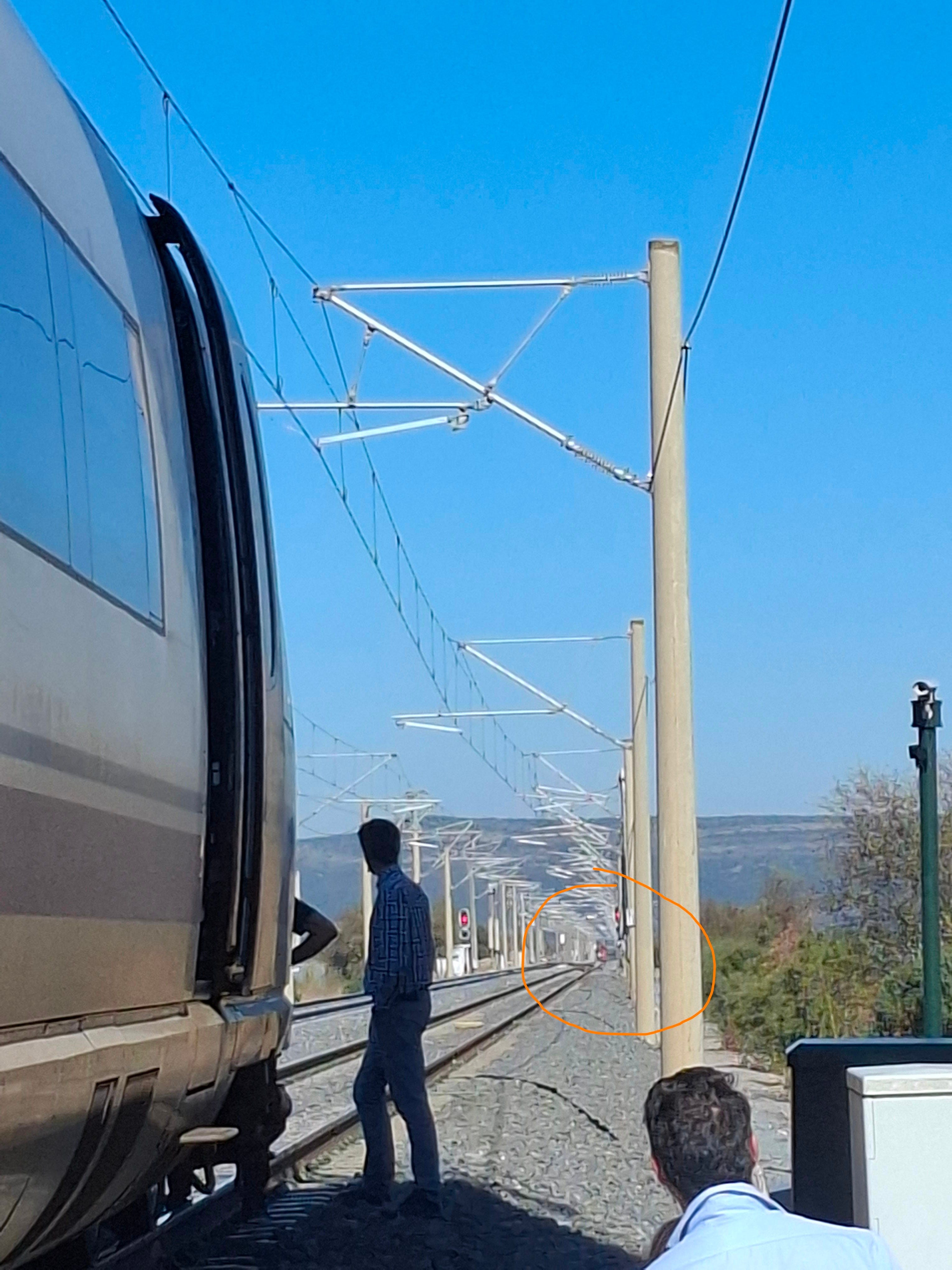
On 28 October, I was very close to the train accident. I was travelling to Madrid to attend the Young Water Professionals Spain Conference when our train stopped just a few metres away from the scene of the collision between two high-speed trains.
Investigations are still ongoing, but we came very close to witnessing an even greater tragedy, with the possibility of another collision.
It’s difficult to put into words everything I experienced, both inside and outside the train, and all the moments.
I just want to thank everyone who reached out and sent me messages. I’m doing well, both physically and mentally, and I’m happy to be back working on our business.
Thank you all. Now, let’s get on with today’s episode.
Last June in Marrakesh, between sessions, I was standing in a corridor with Haroon from ACWA, one of our members and a supporter of The Water MBA since the very beginning.
He just watched Darío Salinas present on the geopolitics of desalination in the Mediterranean.
Haroon turned to me and said: “It was superb. You should bring him to The Water MBA”
Darío and I already worked together in the early days, in Spanish, on a conversation about the Tajo-Segura transfer and the geopolitics of water in Spain (the video is linked above).
We’ll be back soon with a dedicated edition in English.
Today’s edition is sponsored by The Water MBA.
We are proud to announce our partnership with Kartex, the geopolitical risk and strategic intelligence consultancy.
Together, we now offer geopolitical services to any water company that could benefit from bringing this intelligence into its decision-making.
Reach out through info@thewatermba.com to request a proposal.
Why geopolitics, and why now
If you have followed recent episodes, you already know my view: geopolitics now shapes almost every decision we take on real water projects.
Which markets we bid. Which vendors we can still buy from. How a shipment of equipment reaches site. Whether a tariff survives a change of government. How to refinance a project or rescue it from lenders.
I find the field fascinating.
Darío brings the rigour of a geopolitical analyst and expert.
I bring the practitioner view. I know what hurts when these conflicts land on a project. I know what a client actually needs on a Tuesday morning, and where an analysis stops being interesting and starts being useful.
Announcing: Kartex × The Water MBA
So Darío and I decided to make it formal. Today we are announcing a partnership between Kartex and The Water MBA.
As Darío put it in Marrakesh, sometimes water “is no longer only an engineering choice. It is a territorial decision with engineering implications.”
Kartex is Darío’s geopolitical risk and strategic intelligence consultancy.
It specialises in the territorial dimension of risk, with deep experience in water, energy and climate projects.
Its method rests on three things: reading the territory at every scale that decides a project’s viability, mapping the actors who decide, block or condition each phase, and using strategic cartography as a decision tool.
The Water MBA adds the other half: the lived experience from inside business development, bids, contracts and construction sites.
Together we want to give water companies analysis that is both rigorous and usable.
From today, you can request these services through The Water MBA.
Reach out by email, or simply talk to me in person, to ask for a proposal or more information.
Six pillars: where we think we can help
To make this concrete, we have grouped the work into six pillars.
Each one comes from a pain I have seen on real water projects and inside companies.
Read them and tell me honestly: does any of this resonate with you?
1. Country risk and market prioritisation.
Before entering a new market, you need more than a water-stress map.
We cross real demand with the financial and institutional strength of the public client and the legal certainty of each country.
We also map the local actors you will have to work with, from ministries and utilities to potential industrial partners.
Why it matters: too many companies pick markets by headline pipeline, then discover who really decides only after the first contract.
2. Geopolitical due diligence for tenders and concessions.
This is analysis done before you decide to bid an EPC contract or a BOT/BOO concession.
We look at the public offtaker’s solvency and payment track record, the risk of tariff or contract renegotiation after a change of government, regulatory and currency exposure, and the country’s history of disputes with foreign investors.
Why it matters: a bid/no-bid decision is the cheapest moment to understand political risk. After signature, it becomes a claim.
3. Risk assessment during project implementation.
Delivery is where territory bites. We examine permitting and administrative timelines, electoral cycles that can redirect water policy, environmental controversy such as brine discharge and energy use, and local or cross-border tensions over the resource.
Then we build scenarios on their impact on schedule, cost and viability.
Why it matters: Torrevieja, in Spain, ran roughly ten years late. The engineering was not the problem.
4. Supply-chain risk.
Our supply chain is sometimes concentrated in a handful of suppliers and countries: membranes, pumps, tanks, pipes, chemicals...
We analyse dependence on specific manufacturing countries, exposure to sanctions and export controls, and disruption on shipping routes.
Then we propose ways to diversify suppliers and strengthen operational resilience.
Why it matters: anyone who has tracked a critical package through a closed strait or a new sanctions list knows this is no longer theoretical.
5. Strategic communication in a geopolitical context.
Water is a politically sensitive resource. We design communication and public-engagement strategies tailored to the territory where you operate or want to enter.
That includes reputational risk assessment, anticipating controversy, and preparing positions and messages for institutions, media and local communities.
6. Social licence and monitoring of public debate.
We track the online conversation around your project and your company. We map who is talking, their narratives and where opposition is forming: fishing and farming communities, anti-desalination platforms, campaigns against private water management.
We also flag possible disinformation dynamics, so you can anticipate territorial conflict and protect your licence to operate.
Why it matters: by the time opposition reaches the press, the narrative has usually been set for months.
Seven maps, seven ways a project gets exposed
Maps are the fastest way to show senior leadership what a risk register cannot.
A board member who will never read a 40-page report will understand a good map in thirty seconds.
Here are some examples from extraordinary Kartex’s work, moving from the basin down to a single transfer, and then out to the global economy.
I recommend downloading the images, displaying them on a big screen, and letting your brain connect the dots. You’ll start to appreciate the incredible complexity of how water is embedded in every aspect of this amazing life.
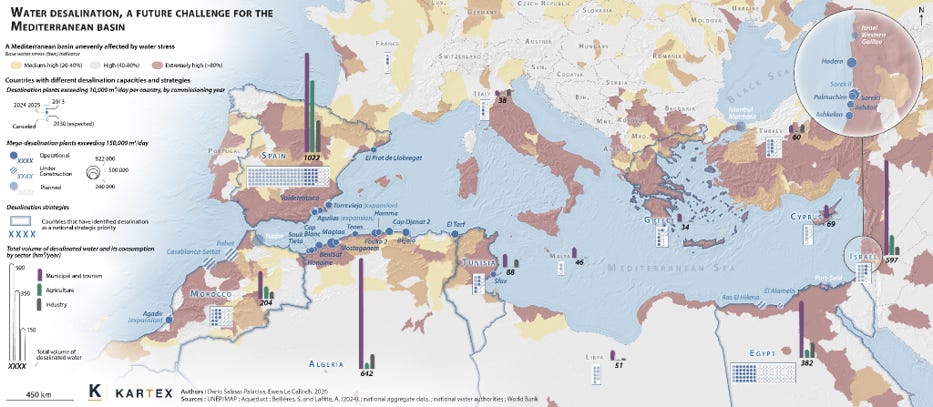
1. Mediterranean: desalination depends on the territory
Water stress, desalination capacity, major plants and where the water goes, country by country.
The lesson: desalination is not one homogeneous market. Two technically similar plants can carry very different exposure through regulation, energy, foreign dependence or water-policy priorities.
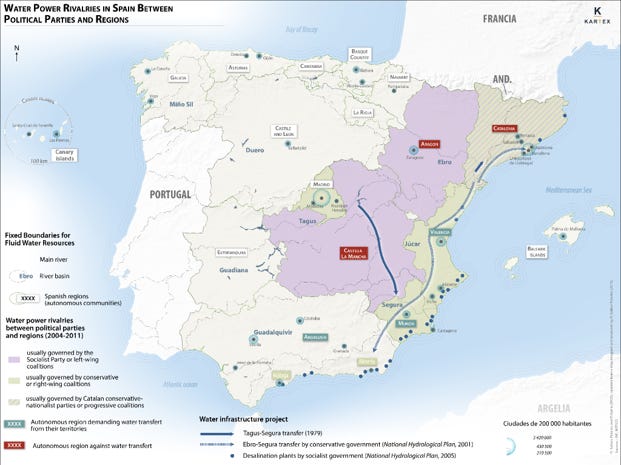
2. Spain: water, territories and governance
Basins, regions, transfers, desalination and territorial rivalries on one sheet. Water infrastructure does not only move a resource.
It redistributes dependencies, costs and benefits between territories and sectors. Any project assessment must ask who decides, and who gains or loses room to manoeuvre.
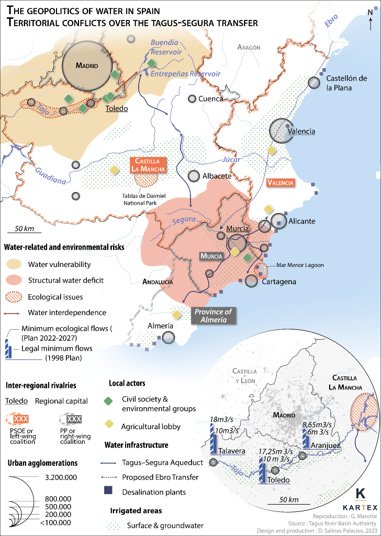
3. Tajo-Segura: when the project’s environment changes
Structural deficit, irrigation, cities, environmental limits, local actors and large infrastructure in one view.
The engineering can stay exactly the same while the political, regulatory or environmental frame around it shifts.
Territorial diagnosis is about knowing what can change, who can drive it, and which scenarios to have ready.
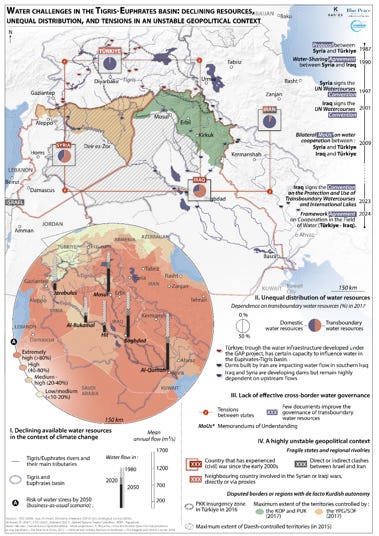
4. Tigris-Euphrates: risks born outside the project
Water availability, transboundary dependence, large dams, cooperation agreements and an unstable region.
It makes the asymmetry between upstream and downstream states visible.
The exposure of a plant, a network or an investment can depend on decisions taken by another state, far from where the water is used.
Remember our essay with Tabark Majid from Burop Happold, I link here.
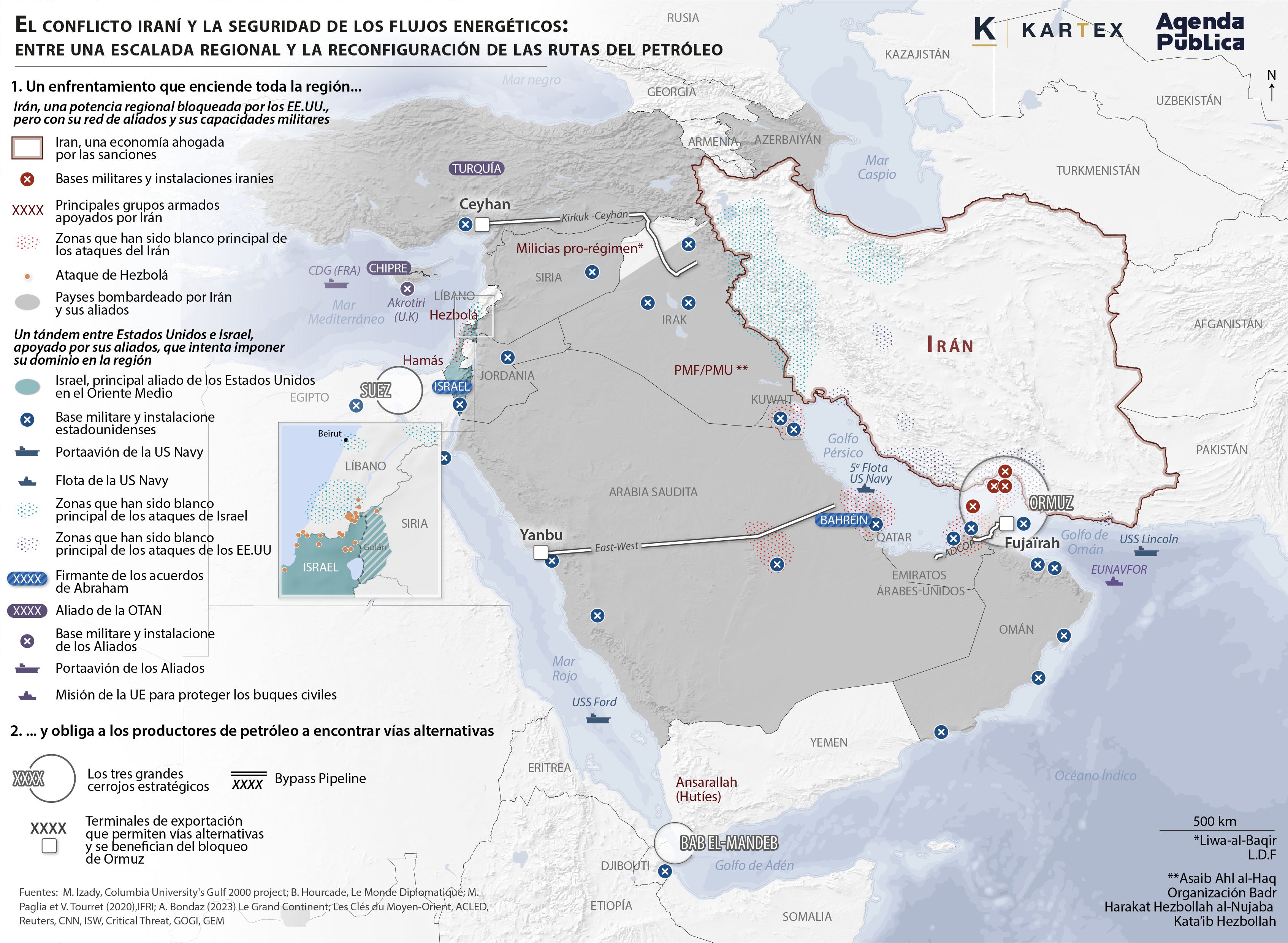
5. Hormuz: desalination, energy and security in one geography
Energy facilities, terminals, ports, shipping lanes, security assets and the Gulf states’ reliance on desalination, layered together.
A plant is never isolated. Its continuity depends on power, maritime access, neighbouring infrastructure and the stability of the system around it. This is critical-infrastructure thinking applied to water.
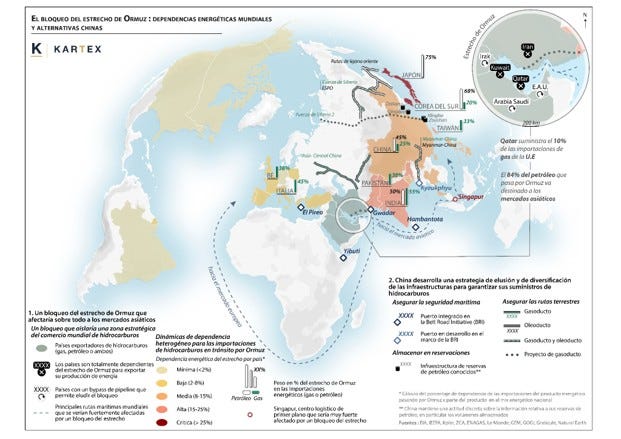
6. From Hormuz to the global market: how a local risk scales
Zoom out and the importing markets, alternative pipelines, reserves and diversification strategies appear. The focus moves from the strait to the dependencies linking it to companies thousands of kilometres away.
A local disruption becomes energy costs, supply-chain delays and investment decisions. That is where scenario work earns its place: not to guess what will happen, but to prepare plausible options.
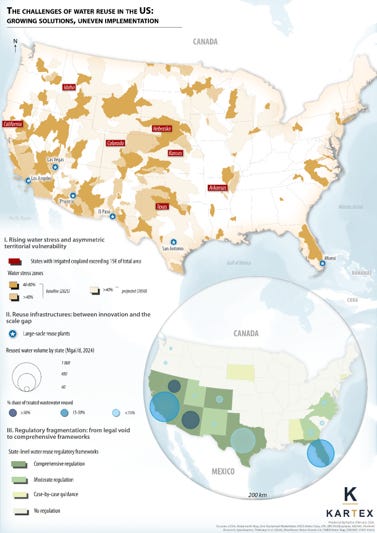
7. United States: water reuse and territorial gaps
Water stress, irrigated agriculture, reuse plants and state-level regulation. Reuse is growing, but very unevenly, and it depends heavily on the regulatory frame and the scale of investment.
This only takes off when the institutional environment makes it scalable.
Let’s talk
This partnership is our attempt to close the geopolitical gap for the companies that need it.
If you are weighing a new market, preparing a bid, delivering a project in a tense environment, or worried about your supply chain, write to me through The Water MBA, by email, or catch me at the next event.
We will come back with a proposal shaped to your case.
Thank you everyone!
Discussion about this video
The Water MBA
The Water MBA exists to turn lived experience into shared knowledge, so water professionals don’t just learn faster, but think clearer, act better, and stay relevant in a changing industry.
The Water MBA exists to turn lived experience into shared knowledge, so water professionals don’t just learn faster, but think clearer, act better, and stay relevant in a changing industry.