

Anyone who wakes up at 4 a.m. by choice has my full respect.
I can tell you, from experience, that it takes something special.
I also wake up at that hour sometimes, but I have no merit whatsoever: my alarm clock is one of my kids.
So when Steve Coffee mentioned that he starts his day at four, my first question had nothing to do with water. How? Why?
The habit was learned, first through university athletics and later in the oil field, where days start early.
He has kept it because the four hours between 4 and 8 a.m. are when the most important things get done, and because, for someone who is always in a different time zone, it keeps him mentally grounded wherever he lands.
His other two rules are simple: more sleep and more water (literally).
Exercise, he admits, is still a work in progress.
I liked that answer because it says a lot about the person.
Discipline that was built rather than inherited.
And a practitioner who, after more than three decades in the field, still talks about water as the first thing he takes care of every day.
📢 Today’s essay is self-sponsored.
We still have a few seats available for our AI in Water course. We’ll be starting soon, but you can join anytime.
If you work for a company, remember to include it in your 2026 corporate training plan. Or simply take action yourself — you’re just 2 clicks away from accessing the content.
Believe me, learning how to use AI in water is an important step.
I have to confess something before going any further.
Until I started preparing this episode, I had no idea what “produced water” meant.
I did not even know how to translate it into Spanish.
I have spent fifteen years in the business and yet an entire universe of water, measured in hundreds of billions of barrels per year, was sitting right next to my sector without me knowing its name.
When I started researching, one organisation kept appearing: the Produced Water Society, probably the largest association in the world dedicated exclusively to this topic, with events in Texas, the Middle East, Argentina and beyond.
And at the centre of it, its president: Steve Coffee.
Who is Steve Coffee?
Steve has spent 32 years almost exclusively in produced water.
His background is in filtration and separation technologies for upstream oil and gas, with international expertise onshore and offshore, and he is known as an innovator in hydrocyclones and sand management.
He is Director of International Business Development and Marketing at Produced Water Solutions, and he created the Society’s Young Professional Program.
Thousands of people follow what he says and shares on LinkedIn, and once you speak with him you understand why.
He explains complex things simply, he is generous with what he knows, and he is genuinely enthusiastic about bringing new people into the field.
He is exactly the kind of person who must be part of The Water MBA’s network: a continuous source of knowledge for anyone who wants to understand how water really moves through the global economy.
Upstream, midstream, downstream: a map for the rest of us
For those of us who come from municipal water, desalination or conventional industrial treatment, oil and gas can feel like another planet. Steve gave us the map.
The industry is usually divided into three silos.
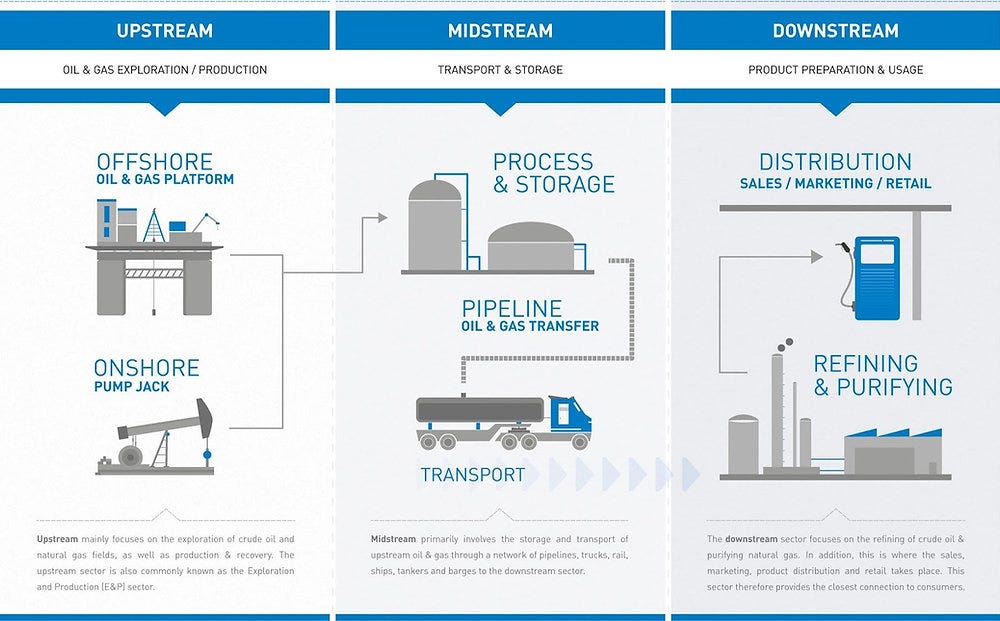
Upstream is exploration and production: everything related to bringing hydrocarbons up from the ground.
This is where Steve spends most of his time, and this is where produced water is born.
Midstream traditionally meant transport: moving product from point A to point B, mostly by pipeline.
The interesting part is that, according to Steve, in places such as the US, Argentina and Saudi Arabia, wherever unconventional (shale) production is being developed, “midstream” today increasingly means one thing: water.
An entire midstream water business was born and grew out of the US shale boom, roughly in the years just before COVID.
Downstream is refining and final processing, the part most people picture when they think about oil.
Technically, the water there is no longer “produced water,” but the volumes are phenomenal, and much of it is reused for utilities, especially in water-scarce regions.
So what exactly is produced water?
Produced water is the water that comes up from the reservoir together with oil and gas during production.
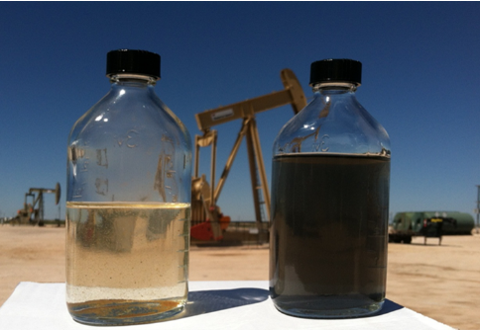
It is not added by anyone.
It is already down there, and it comes up with the hydrocarbons.
There is a joke in the industry that Steve shared with a smile: oil and gas companies are really water companies that happen to produce some oil and gas.
In some cases, he explained, the volume of water can be twenty to twenty-five times the volume of oil or gas produced.
Globally, Steve estimates, with some controversy about the exact figure, that somewhere between 210 and 240 billion barrels of produced water are generated every year.
This is a water industry in its own right.
What happens to all that water?
It depends on the type of production:
In conventional production, there is traditionally more water and much of it is reused. The most common reuse is reinjection for pressure support and secondary recovery: treated water is pumped back into the reservoir to push out more oil and gas.
In unconventional production (shale), until recently most of that water was simply disposed of. That is changing. Treatment of fracking flowback for reuse, which would otherwise require fresh water, has gone from essentially zero to somewhere between 50% and 85% in some basins over the last ten to fifteen years, depending on volume, geology and cost.
A new boom? From waste to commodity
Not long ago, natural gas was a byproduct that was simply burned off.
It was a waste, a cost.
Produced water was treated exactly the same way: a problem nobody wanted to talk about.
Today, treated produced water is starting to be seen as a resource, in some cases even as a commodity.
And the key insight is that what changed was not the technology. What changed was the mindset.
For a long time, in the Permian Basin in West Texas, it was simply much cheaper to dispose of produced water in injection wells and buy fresh water.
That economic logic dominated for years.
But disposal has its own consequences, including the induced seismicity debate, and in neighbouring water-scarce areas such as New Mexico, fresh water is contested between oil and gas, cattle ranching, agriculture and people.
Add data centres looking for cheap land in the same regions, and the competition for water becomes very real.
This connected directly with my recent conversation with Paul Gagliardo about the US Southwest, the Colorado River and the water embedded in exported crops.
Different sectors, same underlying question: who gets the water, and at what cost?
Steve also reminded us that recycling produced water is not science fiction.
Places like California and critical areas in the Middle East proved decades ago that it can be treated and reused safely, even for crop-related uses.
There is also room for creativity with byproducts: sand from produced water being used for road mix or building materials, moving closer to a closed-loop, zero-liquid-discharge approach.
He believes that within five to ten years, these things will simply happen naturally, without the need to debate them.
Energy expansion, not transition
Steve never uses the term “energy transition.” He says “energy expansion.”
We are not consuming less energy; we are consuming more.
We are not replacing one thing because it was wrong; we are adding new sources to meet a massive and growing demand for both energy and water.
And much of the development of the last hundred years was made possible by what the oil and gas industry gave the world.
You may or may not agree with the framing, but for water professionals the conclusion is the same: this market is not shrinking.
If anything, water in energy is becoming more relevant.
The water itself: why is it so hard to treat?
I shared a personal memory with Steve.
Years ago I worked on a wastewater treatment plant for a Saudi Aramco project, treating spent caustic.
When I saw the water quality parameters, my first reaction was: this must be a mistake.
I had never seen anything like it.
The materials specified for the steel were, in my eyes, insane.
My experience with conventional industrial water was simply not enough to approach it reasonably.
Steve was not surprised. Produced water is very different from any industrial water most of us have seen, and it can be challenging mechanically, chemically and metallurgically, even just to move the fluid.
The traditional focus of treatment has been:
Solids reduction, measured as total suspended solids (TSS).
Oil and grease, reducing hydrocarbon content, both to allow reuse and to recover the hydrocarbon rather than waste it.
And then there are local nuances: mercury, NORM (naturally occurring radioactive material), water-soluble organics, and more recently PFAS, which, as Steve put it, seem to be everywhere anyway.
The next big frontier is total dissolved solids (TDS).
In high-salinity, high-temperature regions such as West Texas, Saudi Arabia and the wider Middle East, produced water can, in his words, reach salinities of almost ten times that of seawater.
For those of us who design seawater reverse osmosis plants around 35–45 g/L, that number alone explains why storage tanks can become super duplex conversations and why CAPEX estimates become so volatile.
Interestingly, Steve’s view is that over 32 years, not much has changed technically in terms of new obstacles.
The good news is that there are not many new, scary things coming.
What has changed is how organisations think about water: admitting they have it, talking about it across departments, and managing it strategically across its full life cycle.
Redundancy, safety and specifications
This was one of the questions I had in mind before the conversation, and we only touched it indirectly, so let me add my own practitioner view here.
Coming from EPC, my experience is that oil and gas water systems are specified at another level compared with conventional municipal treatment.
The metallurgy alone shows it: when your water is several times saltier than seawater, hot, and potentially carrying hydrocarbons, H₂S or radioactive material, a material selection that would be conservative in a desalination plant can be inadequate.
Specifications are driven by the operator’s own standards (and in the Gulf, the national oil companies’ standards are famously demanding), and water treatment is not a stand-alone utility: if it fails, it can constrain production.
That changes how you think about availability, spares and redundancy.
The Produced Water Society
The Produced Water Society is approaching 37 years of existence.
It is a Texas-based non-profit, historically made up mainly of oil and gas engineers, but increasingly open to business professionals and people from adjacent industries.
Membership has grown significantly in recent years, driven mainly by two regions: the Permian Basin and the Middle East.
The Society first went outside the US around eleven years ago, starting in the UAE, and now rotates across the UAE, Oman and Saudi Arabia, with regional events in Doha and an eye on Kuwait and the rest of the GCC.
New areas include the UK, with its offshore sector, and Argentina, with its shale gas and unconventional market, as well as the rest of South America.
Steve has watched many young engineers arrive in oil and gas without knowing where they wanted to spend their careers: chemical, civil, mechanical, environmental.
When they touched water, many felt a connection.
Not long ago, young people were discouraged from entering oil and gas because of its image.
Now, he sees more of them choosing water as the place where they can make a difference inside the industry.
That is a message I want every young member of The Water MBA to hear.
The events: every region has its own story
I found the Society because of its events, and I have already added them to our Event Tracker in the Water MBA Knowledge Hub.
Permian Basin (Midland, Texas). When we recorded, the event was starting the following Monday. The format says a lot about the culture: a field trip to recycling and reuse facilities, with local companies opening their doors to 80–100 people (a rare chance to see what others are doing); a consortium meeting; and two days of conference, workshops and exhibition. The whole world watches what the Permian does.
Annual Conference (Houston). Held in the second week of February, this is Steve’s recommendation if you want one event: easier to reach, more global, and very well attended by water leaders.
Middle East. UAE, Oman, Saudi Arabia and Qatar: high salinity, high temperature, water scarcity, and a long history of reuse born out of necessity.
Argentina. Driven by shale, the unconventional market, and a growing interest from South America. I have personally started receiving questions from Argentina about industrial water reuse, which confirms that something is moving there. The event is taking place this week!
UK. Offshore production and a European perspective.
In total, the Society now has eight events, six of them outside the US, some annual and some biennial.
And Steve left us with one request: an event in Spain.
I made a public commitment.
For the 2030 World Cup in Spain (hopefully), The Water MBA will organise its own gathering, as our members have been discussing in the Networking WhatsApp group, and there will be a space for oil and gas.
The main purpose, to be clear, is to have fun. If we learn something about water along the way, even better.
Thanks Steve!
I started this episode not knowing what produced water was.
I finished it convinced that it is one of the most underexplored opportunities for water professionals.
Treatment, reuse, midstream water infrastructure, high-TDS challenges, byproduct valorisation: every one of these is a place where our knowledge creates value.
Thank you, Steve, for your time, your generosity and your authenticity.
If you are not following him on LinkedIn yet, you should.
And if you ever see a post from him timestamped at 4 a.m., now you know why.
Key quotes as usual
On waking up at 4 a.m.
“I’m probably not naturally a morning person, more of a night person… I kind of learned this trait.”
“Waking up and getting things done between the 4 a.m. and 8 a.m. time range is a very nice way to start your day.”
“The four o’clock also keeps me very grounded mentally… regardless of what time zone you’re in or how much sleep you get.”
On sleep and water
“More sleep and more water are the two things that I do. I’m trying to do more exercise, but that doesn’t always work out so well.”
On the energy-water nexus
“There’s a really interesting intersection between water and energy, and we’re seeing this even more today with AI and data centers.”
“Water touches pretty much everything.”
On water companies in disguise
“There’s a small joke in the industry that all the oil and gas companies are really just water companies that produce some oil and gas.”
On the scale of produced water
“We’re pretty confident that there’s somewhere between 210 to 240 billion barrels per year that are generated.”
“In some cases, twenty to twenty-five times more water than oil or gas production.”
On the birth of midstream water
“When you talk about midstream, you’re really talking about almost exclusively water, produced water.”
On reinjection and reuse
“The most common reuse is for reinjection or for secondary recovery… injecting treated water back into the reservoir to produce more oil.”
“That number has really increased in the last ten, fifteen years from 0% to, in some cases, somewhere between 50 and 85% reuse.”
On waste becoming a commodity
“Not too long ago, gas was a byproduct that was just burned off. It was a waste, it was a cost, it was a nuisance. Much like water had been thought of for so long.”
“It’s always been a valuable resource. It’s just a matter of how you think of it and where you apply it.”
On mindset over technology
“A lot of what has changed really is the mindset. It really isn’t the technology… It was really just changing the way we thought about a byproduct.”
On the economics of disposal
“There was a point in time, especially in the Permian Basin in West Texas, where it was just cheaper, much cheaper, to dispose of your produced water and buy fresh water.”
On competing for water
“You’ve got oil and gas combined in with cattle, ranching and farming. So they’re really all competing, if you will, with the water demands.”
On public perception
“There’s a public perception problem with this toxic, evil, deadly produced water. But we’ve already proven out decades ago that this water can be cleaned up and reused safely.”
On closing the loop
“There’s a wide range of ways to be innovative and reuse the byproducts of oil and gas to come a little bit closer to a closed-loop system.”
“Hopefully in the next five to ten years, all these things will just happen naturally and we won’t have to debate whether it should be done.”
On energy expansion
“We are not consuming any less energy. We’re only consuming more.”
“I never use the word energy transition… I always say energy expansion, because we’re expanding on what we’re doing, not moving away from one thing and replacing it with another.”
“If you say transition, it’s like something was wrong with it.”
On treatment challenges
“Produced water can be very challenging… mechanically or chemically, or from a metallurgy standpoint, just being able to flow that fluid.”
“The main things we’ve traditionally looked at are solids reduction, total suspended solids, and then oil and grease.”
“Since it came up, you might as well capture it and benefit from that.”
On the TDS frontier
“Probably the biggest next challenge will be reducing TDS… almost ten times the salinity of seawater, which is kind of crazy when you think about it.”
On PFAS
“I feel like PFAS is everywhere anyway. So why would produced water be excluded?”
On what hasn’t changed
“The good news is there’s not a lot of new big scary things coming at us.”
“Companies are admitting basically that they have this, and being able to talk about it with different groups within their organization.”
On the Produced Water Society
“We’ve mainly been made up historically of engineers from the oil and gas space, but now we’re seeing a lot of different folks coming in from business and other industries.”
On young professionals
“When they touched on water, I think a lot of them felt a connection with water.”
“Regardless of their technical book learning, a lot of them are choosing water and choosing to focus on produced water.”
“Now we’re slowly starting to have a more positive perspective on oil and gas, and the role that young people can play in water in this arena.”
On oil and gas where you least expect it
“Sometimes I’ll be in Bali, where you don’t think of oil and gas, you think of resorts and beaches. But the reality is Indonesia has a large oil and gas market.”
On the Permian
“No doubt everybody’s looking at what the Permian is doing.”
“We don’t always get to take a peek into what others are doing, but the local companies have allowed this to happen.”
On where to start
“Probably the most accessible one for a lot of people to get to is the annual conference in Houston.”
On Spain
“Now what we need is one in Spain.”
On the people in water
“It’s always great to talk to people that are excited about water and helping push to educate others and really embrace change.”


