

Three years ago, when I started The Water MBA, I did what anyone does before building something: I went looking for what already existed.
One of the first things I found was The Water Entrepreneur.
I’ve said this publicly more than once, and I’ll say it again here: it remains one of my favourite podcasts in this sector.
Because it is pure, unedited authenticity. At a time when so much of what reaches us feels… you know… too superficial, too sponsored, too polished, too politically correct, and too much like AI slop… this feels real,…Paul’s podcast is a breath of fresh air.
So having Paul Gagliardo on our show felt, to me, like touching the sky!
Today’s publication we share some factual knowledge on the Colorado River — why it was over-allocated from the start, how seven states plus Mexico are trying to cut back within the laws of the river, and the fact that more than a quarter of the river grows cattle feed, much of it exported to the Middle East.
We also cover Paul Gagliardo's great idea for a docuseries travelling the length of the river from Wyoming to the Gulf of California, what he needs to make it happen, and an open call to anyone who might want to join and fund the project.
Plus the insights and evolution of The Water Entrepreneur podcast, from founder stories to money to policy — and why Paul now believes educating the general public is the missing piece of the puzzle.
Great for investors, start-ups, utilities and anyone who wants to understand how water decisions actually get made.
Who is Paul Gagliardo
He deflected the question “We don’t have that much time to go through all that”.
The short version: almost forty years in the water business.
The City of San Diego. American Water, where he ran a research centre and served as innovation director.
Which meant, for a long stretch of his career, sitting across from technology companies and listening.
What’s interesting is what he says he was actually listening for.
I spent a lot of time talking to new technology companies, which I find fascinating. One, to hear what technologies people are trying to develop, but also it’s interesting to understand what problems people are trying to solve. That gives me a very good insight into the business.
I confess I kind of embrace this. Listening to colleagues, gathering feedback, following interests, and paying attention to community comments, it feels like I can almost read the business instinctively. It has become embedded in who I am, and it takes less and less effort to understand what people need, where the opportunities are, and where things are heading.
He describes the sector as a triangle, and he’s spent his career standing in the middle of it.
On one side, the technology companies — who, in his words, think their baby is beautiful and believe they have the perfect solution…many of you reading this are at this stage too, you know exactly what we mean :)
On another, the actual problems, which may or may not be the ones anyone is solving.
On the third, the money: what venture capital and private equity think is important, what they think will make money.
The evolution nobody announced
When I first started listening, I was there for the founder stories.
I built a water tech to solve this problem, here are my challenges. For someone coming from the EPC side, it was a new world, and I learned a great deal.
Then the episodes started widening. Money. Policy. And lately…congressmen!!
I put it to him that he’s practically in politics now. He didn’t disagree.
In the United States there’s probably almost a hundred times more money being allocated for roads and bridges versus water and wastewater projects.
Paul’s argument is that he has already mapped the solutions and the problems, he knows what’s out there. The unsolved piece is the decision layer.
Why do elected officials fund what they fund? What actually moves a policy decision?
Work top-down with the officials, and bottom-up by educating the consumer, so that pressure arrives from both directions at once.
That’s kind of the next piece of the puzzle that I feel like needs to be addressed. From inside the industry.
Is he still enjoying it?
A year ago, when I was a guest on his show, I asked him why he does this.
His answer was simply that he enjoys it, which, off the record, I took as the real answer to how long it would last.
So I asked again. And I told him what I’d observed: that in the recent videos he looks happier than ever, recording from an Italian volcano, from everywhere…
We’re still having a great time. I guess I can’t really stay or sit still. I always like to evolve.
It’s a lot of work, but it’s a lot of fun. I get to meet many, many interesting people, hear interesting stories, and I guess that keeps me young.
Then, almost as an aside: we’ve got some bigger plans in the works.
I recognise the feeling he described, because I have it too. It is a lot of work.
But every month the surface area of what you might actually be able to change gets a little larger, and that’s what keeps you at it.
The docuseries
Here’s what the bigger plans look like.
The evolution so far: audio podcast, then what he calls Wednesday Water — one-minute editorial video pieces, because short-form video is currently the best way to attract engagement. Fine. Necessary, even.
But short form is not a destination.
Paul’s real ambition is long form: a half-hour or hour format, a television show, a docuseries.
Stories complicated enough to require the runtime, told well enough to be entertaining.
One of the things I found is we in the water business tend to talk a lot to our peers. I think it’s really important to kind of break out of that a bit and get more to a general public audience.
He illustrated it with something small and perfect.
Friends of his install whole-house water filters and ask him whether that’s better for them.
His honest answer is maybe — he’s not sure of the value proposition, and if it makes them feel better, fine.
But the exchange reveals how little the public actually has to work with, an absence of factual knowledge on which to base a judgement.
Alongside the film work, there’s a Washington DC track: press conferences and media events, one held in April, another in September, all aimed at raising the industry’s profile with elected officials and using that platform to explain to the public what’s going on and what they can do about it.
And I agree with him on the format question, more than he probably knows.
Short form buys visibility. But transformation tends to happen in long form — a book, an essay written by an actual human being, a film…
That’s where storytelling can build the mental journey. Doing it for water professionals is hard, but in my case I can handle.
Doing it for everyone else is harder still, I would not be that good so far in my opinion.
It’s a very good idea, and it deserves to exist.
The first subject they’re planning is the Colorado River.
A very brief journey through Colorado River story
The Colorado River system has transitioned into a state of triage: a forced prioritization of systemic survival over standard operating procedures.
For the better part of a century, the expansion of the American Southwest was predicated on the myth of “cheap, reliable water.”
That era has reached a definitive end.
As the 1,400-mile river system faces unprecedented hydrological insolvency, the physical decline of its reservoirs is forcing a recalculation of the cost of life in the West.
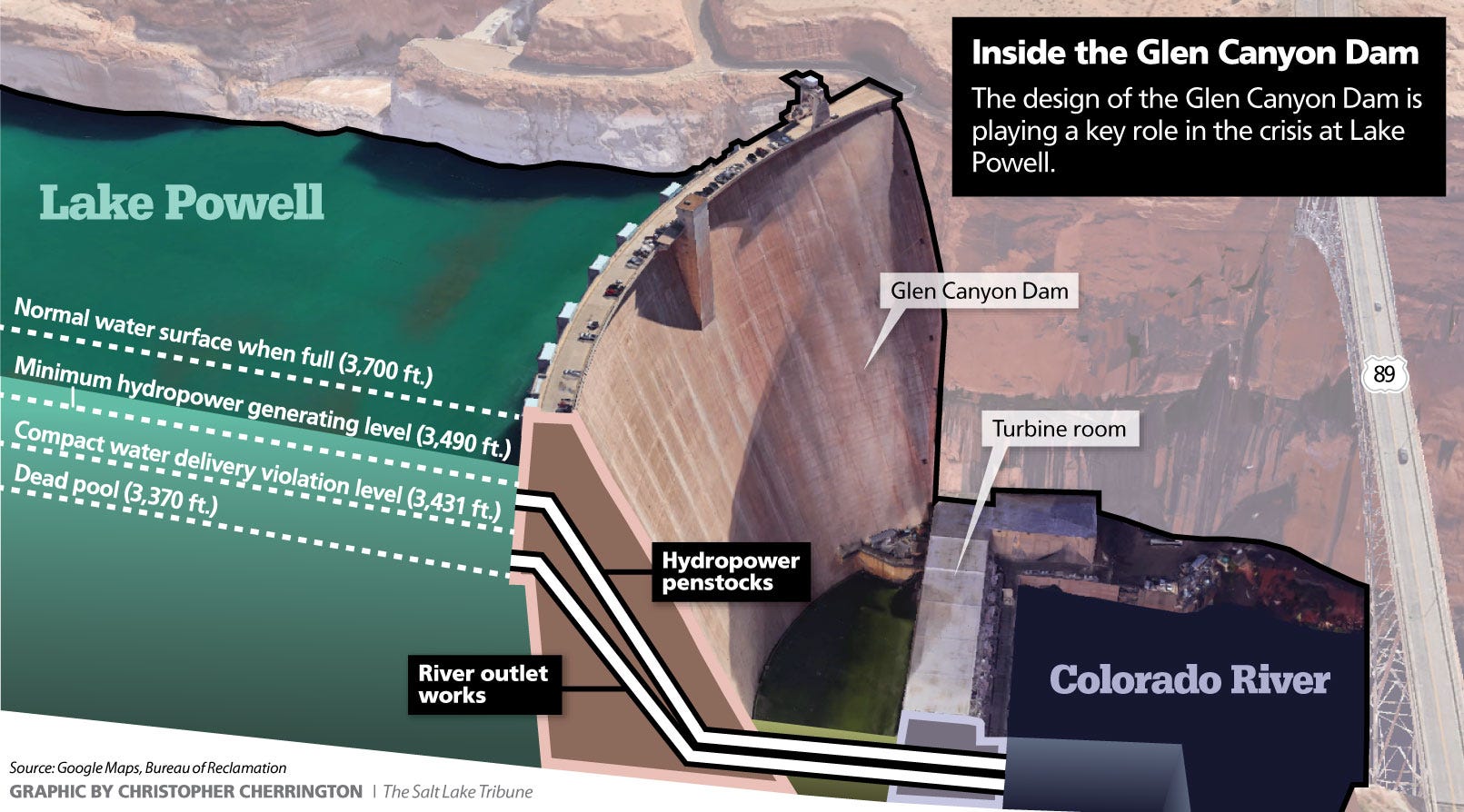
One of the threats is the approaching “power pool” elevation at Lake Powell. Unlike “dead pool” (where water can no longer flow downstream), reaching the power pool limit represents an energy crisis.
Below this level, the reservoir lacks the pressure to drive the turbines that generate hydropower for major Western cities.
This shift moves the crisis beyond water security into the realm of regional grid instability and energy insecurity.
The Geography of the Basin
The management of the Colorado River is bifurcated by the 1922 Compact into two distinct administrative regions: the Upper Basin and the Lower Basin.

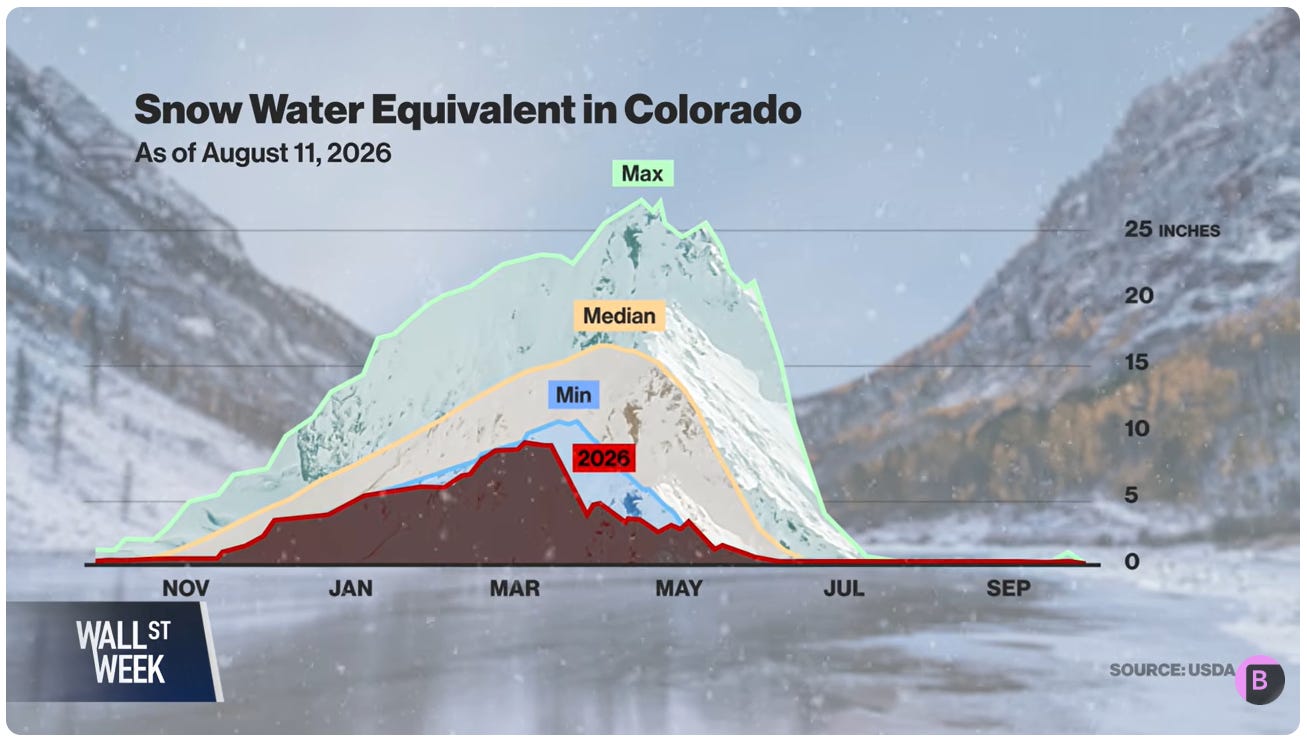
The system’s viability is tethered to the Rocky Mountains, where winter snowpack historically generates 50% to 70% of the surface water for the entire region.
This reliance has become a liability due to a catastrophic shift in climate patterns.
Recent data highlights a dual-threat event: the lowest snowpack on record followed by an anomalous March heatwave.
This triggered an abrupt, early snowmelt that bypassed existing capture infrastructure, essentially wasting the primary water “bank” before it could be effectively managed for the summer irrigation season.
The Legal Hierarchy: Seniority and the Imperial Valley
The Colorado River supports $1.4 trillion in annual economic activity and provides a livelihood for 16 million Americans.
Protecting this economic engine requires navigating a dense legal hierarchy governed by “Prior Appropriation”—the principle of “first in line, first in right.”
At the apex of this hierarchy sits California’s Imperial Valley.
Their water claims are not merely administrative allocations but adjudicated property rights that have been upheld by the U.S. Supreme Court.
This legal seniority gives the Imperial Valley immense leverage; it serves as the nation’s winter breadbasket, producing the vast majority of the country’s winter food supply.
Stakeholders in the valley argue that if these rights are ignored, the very concept of property rights in the United States is undermined.
Where’s all the water gone?
Start in Wyoming at the headwaters and work down the whole length to the Gulf of California, asking one question the entire way:
Where has all the water gone, and what happens to the people it no longer reaches?
I asked Paul to explain the situation in a few plain words so we could understand easily. He gave me considerably more than a few, and it’s the most valuable stretch of the conversation.
It was over-allocated from the start. The river was divided up in the 1920s, and the volume everyone agreed to share was measured during an unusually wet period.
The long-term availability of the river was overestimated at the moment of division.
Every dispute since has been downstream of that founding error.
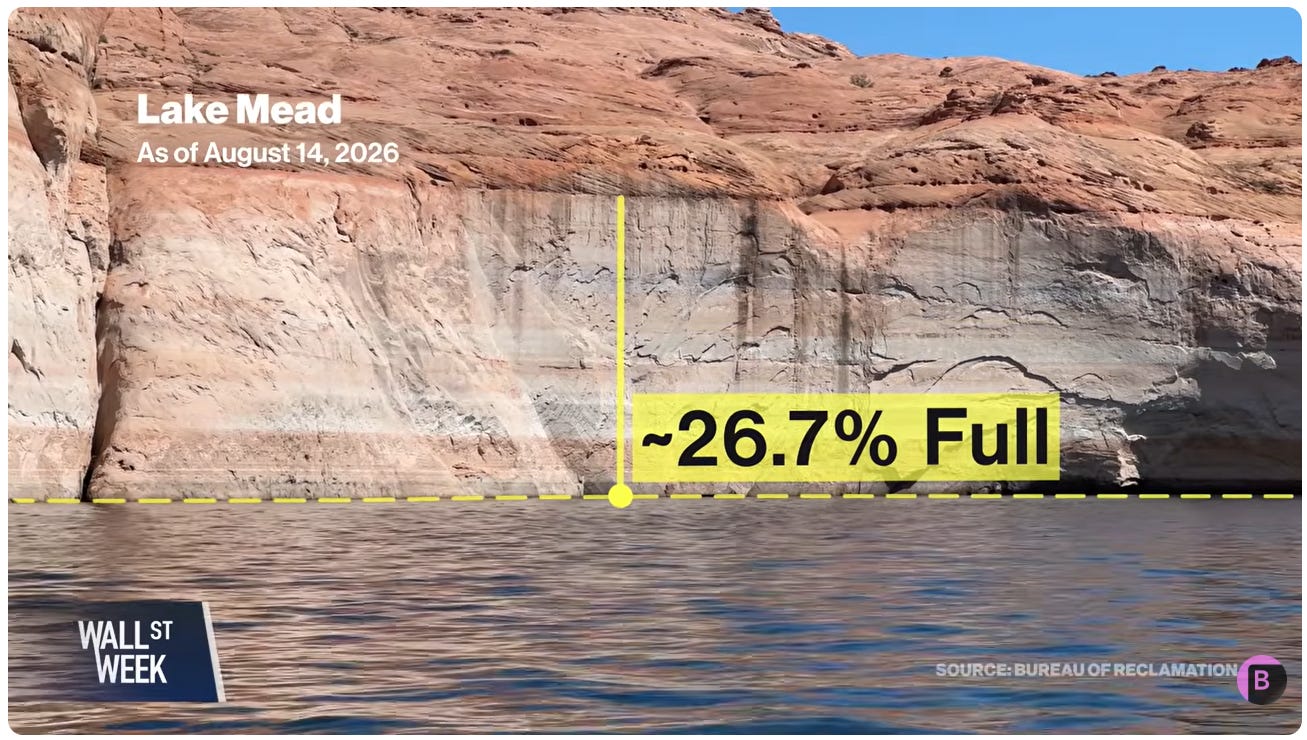
Climate made a bad estimate worse.
Less snowpack, less water coming through, a shrinking total volume.
Habit hardened around the wrong number.
Through the eighties, nineties and two-thousands, users got comfortable fully consuming their allotment.
Now they have to cut back, and the operative question is not whether, but how, within the existing laws of the river.
What is the formula for cutting back?
And the governance is genuinely hard.
Seven states plus Mexico hold a piece of the river.
The federal government is the watermaster, through the Bureau of Reclamation and the Interior Secretary — that’s where the rules are made.
Upper basin, lower basin, and inside the lower basin a hierarchy: California holds the largest rights allocation and uses the most, while Arizona sits on lower-priority rights.
🤯 Then he described a very interesting solution he heard recently.
Arizona has no coastline. California does.
So agencies in Arizona would fund seawater desalination or water recycling projects on the California coast — increasing supply there — and in exchange receive a share of California’s Colorado River rights.
It’s a very interesting idea because you really can’t create water except on the coast (in related to main Desal you know…)
The plant is an interstate water-rights trade — coastal capacity converted into inland entitlement.
Paul thinks it has real potential to change how the river is used.
Then the uncomfortable part:
🚨 Somewhere between fifty and sixty percent of Colorado River water goes to agriculture. More than half of that goes to cattle feed. Which means more than a quarter of the entire river is being used to grow alfalfa and hay, to feed cattle, to produce beef — and a significant share of that feed is shipped overseas, to Saudi Arabia and the wider Middle East.
So we’re essentially exporting water, if you want to look at it that way.
I’ve spent years working in the Gulf building plants to manufacture water in one of the driest places on earth.
Learning that the same region imports embedded water from the driest corner of the United States puts the geopolitics** of the whole thing in a different frame.
**Do you like geopolitics? Next Sunday’s episode is exactly about it. Stay tuned. 👀
Paul is careful here. The farmers would say this is the highest and best use, they hold the rights, it’s their choice, and that’s a legitimate position.
His objection isn’t to the farmers.
It’s to the logic of everyone maximising their individual entitlement:
What happens to it if people just continue to take their allotment and it sucks it dry and then nobody has anything?
I live in San Diego. Half of my water comes from the Colorado River. And I don’t want my taps to run dry.
One last image, from a guest on his own three-part Colorado series — episodes 110, 111 and 112, covering the law of the river, the hydrology, and the usage.
At the end of the river, where Arizona meets California and Mexico, sits a small city called Yuma.
Yuma is the Cairo of the Colorado. Like the Nile, the water comes from far upland; by the time it arrives there’s no rain, and that’s precisely where it all gets used.
Less historically significant, geographically identical.
That’s the kind of line a documentary is built on.
The funniest thing he said
So I asked the obvious question. To make this, you need to raise money. How do you go about it?
“I was thinking — I always ask the startups, how do you find it raising money? And they always have interesting stories. And now I’m in that position now. I should probably go back and listen to some of the episodes and see what their suggestions were.”
I laughed. He admitted he’s figuring it out.
What he’s actually doing: talking to networks, and using early interest as leverage to attract funding.
He has individual sponsors who’ve helped get certain things off the ground.
But the emphasis now is on high-net-worth individuals — impact investors, people looking to make a difference — and philanthropic organisations focused on environmental issues, approached directly.
What he needs first: a pilot.
Something concrete enough to take to a streaming service or public television. They already have a trailer and a sizzle reel, which they’re tweaking to reflect the current thinking.
What it comes down to, in his words:
And then it just depends on how good of a salesman I am.
If you’re reading this and you fund environmental storytelling — impact investor, foundation, network, or a company that would rather sponsor something real than another logo on a conference lanyard — this is a genuinely good use of money.
I told Paul I don’t have much money, but I can help disseminate. I meant it, and I’ll say why.
I recently listened to an interview with Alexander Loucopoulos of Sciens Water in Bloomberg and thought: this is already excellent conversation, already made, and almost nobody in our community has seen it…
So I wrote about it. The response was immediate and positive. People loved it!
We spend a lot of energy creating and not nearly enough getting good work in front of a wider audience.
So: whatever The Water MBA can do to put this in front of people, it’s yours.
The rest of the conversation, briefly
Two other things worth carrying away.
On PFAS, and the power of branding. Paul made an argument I found bracing.
There’s a finite pool of public money. Someone once put it to him that it doesn’t much matter how clean the water is if the pipes can’t deliver it.
So — and he flagged this as controversial — should the federal government be spending what it’s spending on PFAS while a quarter to a third of treated water leaks out of the ground?
I firmly believe that without that branding, we would not be spending as much money on PFAS as we are today.
A professor at the Harvard School of Public Health branded them forever chemicals, and Paul believes the name did more work than the science.
His lesson for everyone: branding is very, very important — almost more important than the problem itself.
Microplastics are next in line, he says, and the same dynamic will apply.
His own priority is unglamorous and, I suspect, correct: aging infrastructure, especially pipelines, is the biggest problem facing the water business.
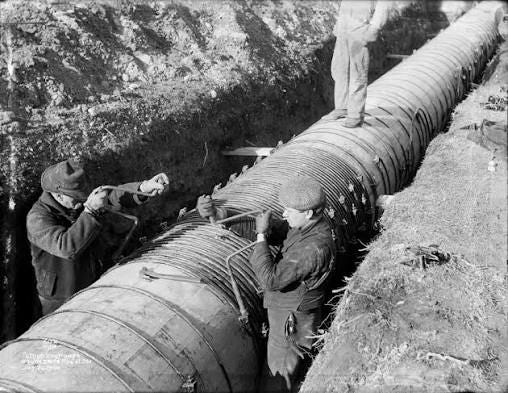
In Los Angeles, three major pipeline failures in two weeks. One of the pipes was a hundred and ten years old…
On New Mexico, and states that get ahead of the game.
He’s been working with the state’s environment department, which passed a 2050 water action plan on the expectation of twenty-five percent less available water by 2050.
Eight or nine hundred very small utilities, so consolidation is on the table for economies of scale.
Leak detection too — one estimate puts leakage as high as forty percent, which makes repair the cheapest new supply available.
And in many systems the pipelines aren’t digitised at all; there’s no GIS, so nobody is certain where the pipes are.
To be able to manage a system, you need to know what you’ve got.
What he applauds is that the state is front-funding the diagnostic work rather than leaving it to tiny utilities with no money and a handful of customers. One of the few he knows of doing it that way.
He closed on the Clean Water Act and the Safe Drinking Water Act, both around fifty years old. Great for that generation. Overdue for a re-look in the current financial, political and environmental climate.
That solution worked then, it doesn’t work now.
The water business is thirsty for professionals like Paul. It is also thirsty for the people who make the work possible without ever appearing on the recording, so thank you, Anna Gagliardo, for the enormous effort behind this fantastic podcast.
A few great quotes!
On What He’s Actually Listening For
It’s interesting to understand what problems people are trying to solve. That gives me a very good insight into the business.
They think their baby is beautiful, and they think that they have the perfect solution for some problem. And then there’s the problem.
On Where the Money Goes
There’s probably almost a hundred times more money being allocated for roads and bridges versus water and wastewater projects.
On Why He Moved Toward Policy
I’ve seen all the solutions and the problems and kind of know what all those are. Now we’re trying to get to the place where we are impacting the decision makers.
That’s kind of the next piece of the puzzle that I feel like needs to be addressed. From inside the industry.
On Still Enjoying It
We’re still having a great time. I guess I can’t really stay or sit still. I always like to evolve.
It’s a lot of work, but it’s a lot of fun. I get to meet many, many interesting people, hear interesting stories, and I guess that keeps me young.
On Talking to Ourselves
We in the water business tend to talk a lot to our peers. I think it’s really important to kind of break out of that a bit and get more to a general public audience.
We just want to get factual knowledge to the general public so that they can make some decisions.
On the Colorado River
They allocated a certain amount of volume, and that was in a very wet year. So they kind of overestimated long term how much water would be available.
The question is: within the laws of the river, how do you cut back? What is the formula for cutting back?
It’s a very interesting idea because you really can’t create water except on the coast.
More than a quarter of the river is being used to grow alfalfa and hay to feed cattle to produce beef.
So we’re essentially exporting water, if you want to look at it that way.
What happens to it if people just continue to take their allotment and it sucks it dry and then nobody has anything?
I live in San Diego. Half of my water comes from the Colorado River. And I don’t want my taps to run dry.
On Raising the Money
I always ask the startups, how do you find it raising money? And now I’m in that position now. I should probably go back and listen to some of the episodes and see what their suggestions were.
And then it just depends on how good of a salesman I am.
On Branding
I firmly believe that without that branding, we would not be spending as much money on PFOS as we are today.
Branding is very, very important. I think it’s almost more important than the problem itself.
On the Unglamorous Problem
It really doesn’t matter how clean the water is if the pipelines to get it to you are leaking and you can’t get the water.
To be able to manage a system, you need to know what you’ve got.
On Rewriting the Rules
That solution worked then, it doesn’t work now.
Somebody needs to take the lead to create the new reality. And I’m optimistic. That’s why I’m pushing hard.


