
There is a Spanish saying that I think has no elegant English translation: “Entre todos la mataron y ella sola se murió.”
Literally: between all of them they killed her, and she died all by herself.
It describes a death by distributed responsibility. Everyone contributed. Nobody is guilty.
The victim, conveniently, appears to have expired on her own…
I asked Jesús Maza a simple question — whose fault is it that our sector doesn’t move faster and better and with more money allocated to it? — and he answered with that proverb.
And honest description of water governance, and it is the reason this essay is titled the way it is. Everybody’s business is nobody’s business.
The man, and why I wanted to talk to him
I have worked in water since 2012 all around the globe, visited more than 15 countries, participated in Tenders and Projects in more than 30 countries.
Thirteen years in the sector and I have never once added value to my own country.
My entire career has been export. This is not unusual, it is the Spanish water paradox.
A dry country with a structural water deficit that happens to be one of the global technology leaders in water, which means our companies do most of their business abroad, which means Spanish water professionals often know Riyadh and Santiago de Chile better than they know Valladolid.
So two years ago, when I started The Water MBA from Seville, I realised I had a gap: I did not understand the sector in my own country. I did not know who the institutions were. Until late last year, I did not even know what DAQUAS was.
I wanted to meet the highest representative of the association that represents most of the water utilities in my country.
As it turns out, life had other plans: my children attend the same school than his grandchildren, and I’ve built a good relationship with his sons. We now often run into each other at the kids' dance performances. Life is awesome!
Jesús Maza is an economist, not an engineer, which matters more than it sounds.
Before water, he worked in the research and consultancy arm of a savings bank, and then on territorial development projects for the World Bank and the Inter-American Development Bank across Latin America.
He was CEO of EMASESA between 2011 and 2015, later director of the Escuela Internacional de Servicios Públicos, and in 2024 he was appointed to lead DAQUAS (below story).
EMASESA matters to me personally: it is the utility that sends me my bill. And I pay. It serves Seville and eleven surrounding municipalities — over a million people — with the El Carambolo treatment plant that I visited last year (here the report)
As Jesús put it about his own career arc: water hooks you.
A brief history of an alphabet soup
For decades, urban water in Spain was represented by two associations that coexisted, mostly cordially, because they did two different jobs.
AEAS — the Asociación Española de Abastecimientos de Agua y Saneamiento — was the technical body. Nearly fifty years old, it grouped the vast majority of urban water operators along with pipe manufacturers, valve makers, contractors and technology suppliers. Its function was to hold the technical level of the sector, through a structure of specialist commissions: treatment, cybersecurity, supply, infrastructure, quality.
AGA — the Asociación Española de Empresas Gestoras de los Servicios de Agua Urbana — existed for a different reason.
In 2023, the reunification process began. AEAS and AGA agreed to merge into a single business association covering public companies, private companies, mixed companies, suppliers and even public administrations.
When I recorded this conversation, the merged entity still did not have its final name — Jesús literally told me they were “waiting to find the definitive name.”
That name arrived on 13 May 2025: DAQUAS, Asociación Española del Agua Urbana. Around 300 members. Operators representing roughly 80% of the Spanish population for supply, sewerage and treatment services.
The politicised utility
Utilities were created to do something simple: bring water in, take wastewater out.
That was the mandate.
But the mandate has been quietly rewritten every few years for four decades — new drinking water directives, new discharge limits, new micropollutant obligations, extended producer responsibility, cybersecurity requirements, digitalisation plans, carbon footprint reporting, drought resilience — while the revenue model has stayed frozen in a municipal political debate about not raising the bill.
Water is a human right. it is also a capital-intensive industrial business with a 100-year asset base.
Those two truths are both correct and they pull in opposite directions, and the tension between them is resolved not by economics but by the electoral calendar.
Jesús was blunt about this. Water tariffs become a weapon thrown between political parties that, on the substance, believe exactly the same thing — party A says the other one raised the bill, party B says the same when the roles reverse.
Which is why his stated objective as president is, in his words, to take water out of the political debate and put it into the government’s agenda of priorities.
Out of politics because it actually matters.
The one-cent coin
He asked me to imagine walking down the street and seeing a one-cent coin on the pavement.
Would you bend down to pick it up? Nobody does. It is not worth the effort of bending.
One cent is what a Spaniard pays for five litres of tap water. He had bought a 25cl bottle of water on the AVE the day before for three euros.
And then he walked me through what that cent buys‼️
Rain into a reservoir, transfer conduits and pumping stations, a treatment plant meeting an ever-tightening European standard, more conduits and more pumping to reach your kitchen, a sewer network to collect what you flush, a wastewater plant that now has to clean the water to something approaching potable quality, and a discharge back to the river that must comply.
In Catalonia, under drought, treated effluent is now being pumped back up to the head of the catchment to be treated again as raw water. That is the full integral cycle. It is priced at roughly two euros per cubic metre.
His other analogy, when you buy a beer (this may sound more familiar to you), the price includes the hops, the malt, the bottle, and the truck that brought it to the bar.
The numbers, since we are being economists about it
DAQUAS published its XVIII National Study in December 2025, covering 36.4 million inhabitants.
Average domestic price: €2.23/m³ — around 43% below the European average, among the six lowest in Europe.
The price that would actually cover the service and the investment deficit: €4.69/m³.
Accumulated investment deficit: €4.485 billion.
Annual sector investment: €2.415 billion — operators have doubled what they invest.
Network renewal: 0.54% of supply mains and 0.12% of sewers per year, against a recommended 2%.
Non-revenue water: 19%, of which real losses (leakage) are 10.1%.
Total annual billing for urban water in Spain: €9.617 billion.
The water bill represents 0.84% of the average household budget, against the UN affordability threshold of 3%.
Sit with the renewal rate for a second, at current coefficients, some pipes will only be replaced every 400 years.
There is no asset management framework on earth in which that is a plan. It is a slow-motion decision to let the network fail, taken by nobody in particular.
And the leakage debate makes his point better than anything. Brussels is currently arguing about which efficiency indicator to adopt.
Jesús told the ministry, essentially: fine, let’s find an index, but let’s be clear we’re building an instrument to measure misery. If we invest in the index instead of in meters and mains renewal, the index will simply keep measuring the same misery with more precision.
Doubling the tariff would take the household water bill from 0.84% to something like 1.5–1.8% of household spending, still half the UN affordability limit.
And every Spanish operator, public and private, already runs social tariff mechanisms: nobody is cut off for inability to pay.
Nobody.
Every country solves this differently, and most of them don’t
This is where the Spanish debate connects to the global one, and to the conversation we had in the podcast with Ben Solís on how water gets funded (below link), amazing episode.
The ideal is a self-sustaining business: the tariff covers OPEX, CAPEX, renewal and a reasonable return, while staying affordable.
The world is full of examples where this does not happen, and each failure mode looks different.
England and Wales: a fully privatised, economically regulated model where the regulated tariff has proven insufficient to simultaneously pay investor returns, cover operating costs, remain politically acceptable for affordability and renew infrastructure.
🔥 Something had to give, and what gave was renewal, until the storm overflows became front page news and the whole regulatory settlement came under review.
Egypt: tariffs heavily subsidised, with the gap absorbed by the general state budget. Affordable, socially defensible, and structurally dependent on fiscal space that competes with every other ministry.
The sacrificial line item is always asset renewal, because it is the only cost you can defer without anyone “noticing” for twenty years. Until it does.
Public, private, mixed and why the argument is a distraction
Roughly speaking, Spain splits into about 30-something per cent purely public operators (municipal services and public companies), around 35% private concessions, and the remainder mixed companies where a private partner and a municipality or provincial council share a commercial vehicle.
Jesús’s verdict, which I think is the correct one and which I will quote for years:
Efficiency is not the property of the private or the public. Efficiency belongs to the efficient.
There are efficient public companies and inefficient ones.
Efficient private companies and inefficient ones.
The same private operator can be efficient in one contract and inefficient in another, because topography, environment, politics or simply the person in the chair changed.
And the public/private line is far blurrier than the ideological debate assumes.
He told me a story about being asked, when he arrived at EMASESA, whether he had come to privatise it.
His answer: there’s no need — EMASESA is already partially privatised.
It is a 100% public entity with twelve municipalities on its board, and it works superbly. And its treatment plants are operated by private companies. Network maintenance is contracted out. Leak repair is contracted out. Building an in-house workforce to cover all of that would produce a payroll that no utility of that size could sustain.
That hybrid is the model. And Jesús argues it is a model worth studying and worth defending, because other countries copy it.
The corollary he raises is one every contractor in this industry feels: stop awarding on price alone. The EU has opened a review of public procurement, and DAQUAS’s position going in is that lowest-price auctions damage quality, efficiency and the health of the supply chain.
Term, technical quality, improvements, sustainability — these should carry weight. Cheap gets expensive. We know this in EPC. It is no different in O&M.
So whose fault is it?
Back to the question that titles this essay.
Spain has more than 8,000 municipalities, 17 autonomous communities with very high levels of autonomy, a central administration with increasingly diffuse competences, and a European layer that legislates directly on the environmental obligations.
Water service is, ultimately, a municipal competence.
So: ask a mayor of a village of 200 inhabitants what his infrastructure investment plan is. He is legally responsible. He has no capacity whatsoever. He discharges the problem onto an operator, public or private, and moves on.
The result is dispersion. And dispersion produces inequity: a Spanish citizen’s relationship with water is materially different depending on whether they live.
Different tariffs, different rules, different service standards, different transparency. That inequity should worry politicians far more than it does.
DAQUAS is asking the ministry to take up the flag of harmonisation — to gather urban water legislation, which fragments further with every transposition patch (wastewater here, drinking water there, cybersecurity somewhere else), and integrate it.
Not necessarily a national economic regulator — Jesús concedes that is very hard in Spain, whatever other countries have done — but at minimum a coherent, homogeneous, stable framework.
And he added the line that should be on a poster in every ministry:
Harmonise it outside the political debate, because when you play politics with a basic good, the person who pays is the citizen — and specifically the most vulnerable one.
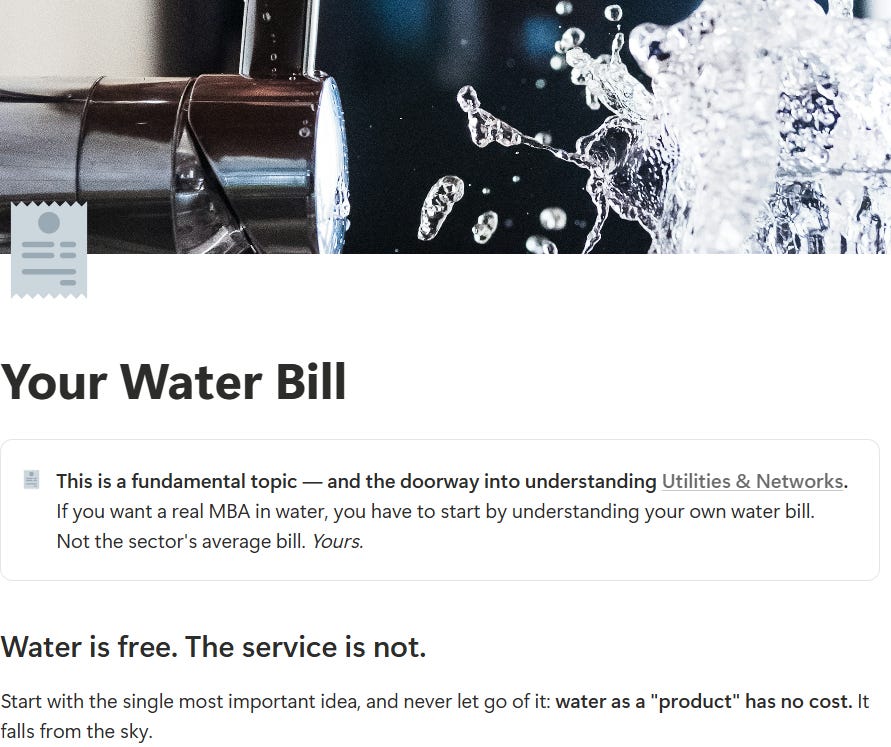
DAQUAS publishes an annual tariff calculation model, and he wishes people would use it, because — his words — have you ever tried to understand a water bill? I don’t understand it. And I’m the president.
That’s why our Knowledge Hub to be released soon during next weeks will include a specific page explaining a water tariff :)
What we can actually do
I closed by asking what an individual professional can do. His answer had nothing to do with technology.
Explain water to the people closest to you. My wife has never in thirty years had a problem with water — it arrives, always, even during COVID when the entire country was at home.
That reliability is the single greatest achievement of Spanish urban water and simultaneously the reason it is not valued. Invisibility is the price of excellence.
When we’re told the supply will be cut for two hours, we fill entire bathtubs in panic, and then we empty them. We have no calibration for what this service costs, because we have never lived without it.
So: talk about water outside the circle of civil, industrial and chemical engineers. Explain that regenerated water can irrigate crops and feed industry. Explain that the world technology leader in this field is sitting here, in Spain, exporting.
There is one more thing I would add, which I raised with him and which he did not disagree with: we may be losing the generation that built this.
The professionals retiring right now are the ones who made Spain a global reference in urban water, and the intake behind them is thin.
Capital that took forty years to accumulate can be lost in five. Whether the sector gets revalued in Spain before or after that gap becomes visible is, I suspect, the real question of the next decade.
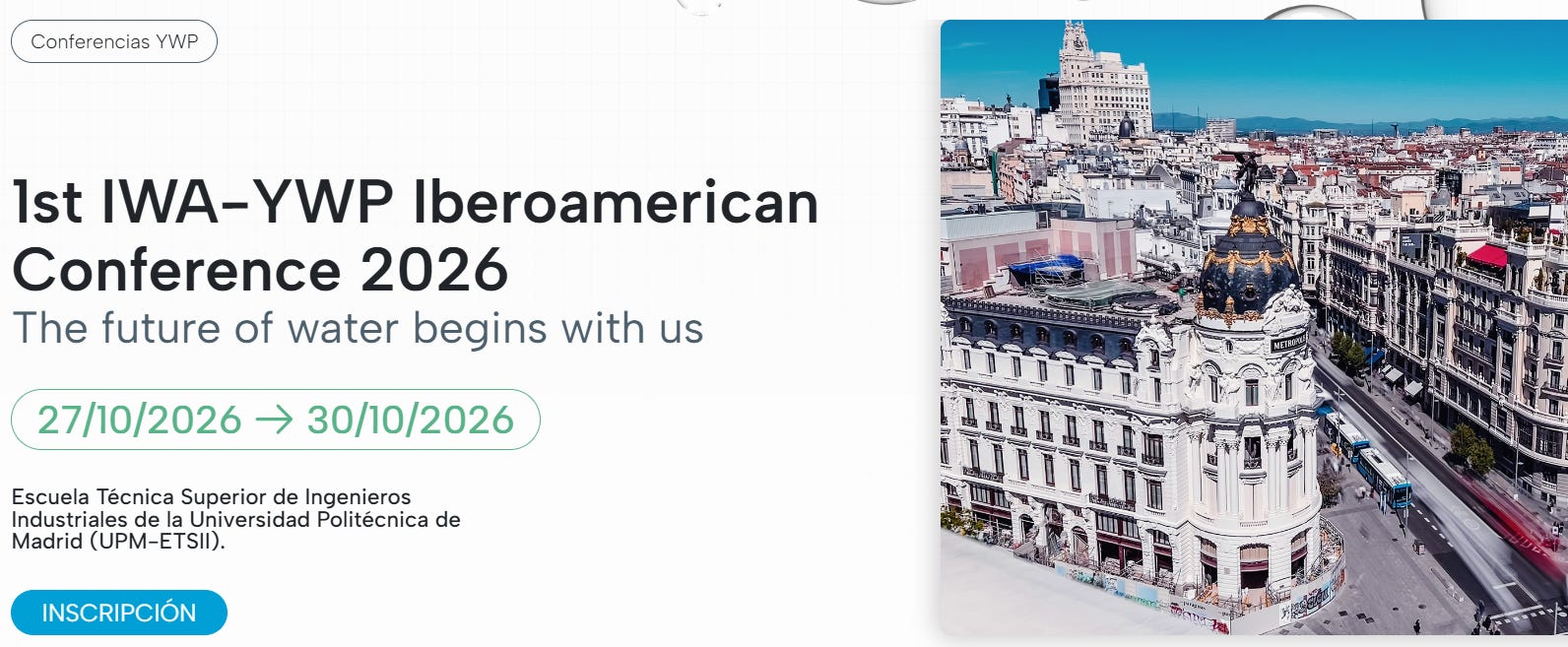
FORTUNATELY, there is hope. And this will be demonstrated through the 1st IWA - Young Water Professionals Iberoamerican Conference, were the new generation with less than 35 years old will gather in Madrid.
Water conditions everything. Agriculture, industry, the economy, where people can live. It is a physical asset.
Nobody is going to change that.
The demand for what we do is not in question.
Quotes worth keeping
On the price of water
“If you see a one-cent coin on the ground, you don’t bend down to pick it up. One cent is what we Spaniards pay for five litres of water. Yesterday on the train I bought a quarter-litre bottle for three euros.”
“When you buy a beer, the price includes the hops, the malt, the bottle and the truck that brought it. With water, the price only includes the water.”
“The tariff imbalance is genuinely alarming. Producing five litres of water does not cost one cent — not remotely.”
On investment and infrastructure
“At the current renewal coefficient, there are pipes that will only be replaced every 400 years. That makes no sense at all.”
“Fine, let’s agree on an efficiency index. But we’re going to have an index to measure misery — because if we invest in the index instead of in meters and mains renewal, the index will keep on measuring the same misery.”
On regulation without financing
“You read the directive and it says genuinely interesting things, and I don’t dispute a single obligation in it. But it doesn’t say one line about how it’s financed. Not one line.”
“It’s not just transposing an environmental directive. A serious financial burden arrives with it, and nobody talks about that.”
On contract structure as a financing tool
“Maybe it doesn’t all have to come from European subsidies, and maybe it doesn’t all have to come from price. Maybe it’s enough to tell an operator: instead of managing for five years, you’ll manage for twenty — and you’ll make the investments.”
On politics
“The tariff is a weapon thrown between parties that actually believe the same thing. Water should come out of the political debate and go into the government’s agenda of priorities.”
“If we play politics with water, the one who pays is the citizen — and the most disadvantaged one. Not the comfortable family in Málaga or Seville, but the man in a village in the Sierra de Granada where the water arrives almost by accident.”
On public vs private
“Efficiency is not the property of the private or the public. Efficiency belongs to the efficient. There are efficient public companies and ones that aren’t; efficient private companies and ones that aren’t.”
“They asked me if I’d come to privatise EMASESA. I said there’s no need — EMASESA is already partially privatised. It’s 100% public, with twelve municipalities on its board, and it works superbly. And the treatment plants, the network maintenance and the leak repairs are all run by private companies.”
On procurement
“Let’s not depend on price alone. If you go to a pure auction system, you’re damaging quality and efficiency. Term, improvements, technical quality, sustainability — these should count too.”
On governance and responsibility
“Entre todos la mataron y ella sola se murió.”
“The problem is that it’s difficult to find someone responsible, because it depends on so many people, and with such disparity between them.”
“Have you ever tried to understand a water bill? I don’t understand it. And I’m the president.”
On what professionals should do
“Help us tell the story. Help people understand water — not just civil, industrial and chemical engineers. Help people appreciate a sector that is a world technology leader and that is right here, in Spain.”
“Technical people have to do a lot of evangelising for water, because water is fundamental.”
On the job
“They told me at EMASESA that water hooks you. And it does.”


