
Professional DJ? CEO of Veolia? What's next for Walid Khoury?
Earlier this week, I came across a LinkedIn post that I wasn’t expecting:
When I founded Desalytics, the goal was simple: solve real-world water challenges in Africa and build a sustainable legacy in the process. After an unforgettable journey, I have stepped down as CEO.
Reflecting on that legacy:
We built an extraordinary, world-class, highly technical team across Sub-Saharan Africa with >45% women.
We brought clean, sustainable water solutions to communities and industries that needed them most.
We created a strong, scalable company poised for long-term growth.
We empowered young aquapreneurs to start and grow their businesses.
And we won multiple awards in the process!
To our incredible team, suppliers, clients, global events organizers, and partners: THANK YOU. A founder is only as good as the people who join them on the ride, and I was lucky enough to be surrounded by the very best. A big thank you to my wife, who has always remained supportive of my mission.
I'll always be Desalytics' biggest champion. Onward!
Before we find out what’s next, I wanted to take the opportunity to openly publish the conversation I had with Walid a few months ago.
When you play the episode above, the first five seconds feature some music. That music is Walid’s.
Desalytics has become a reference for many by creating immense value across Africa.
Walid has always been on the front line of the industry, with a deep understanding of where the sector is heading. I wanted to hear his perspective on what was happening, where the industry was going, and what he believed was coming next.
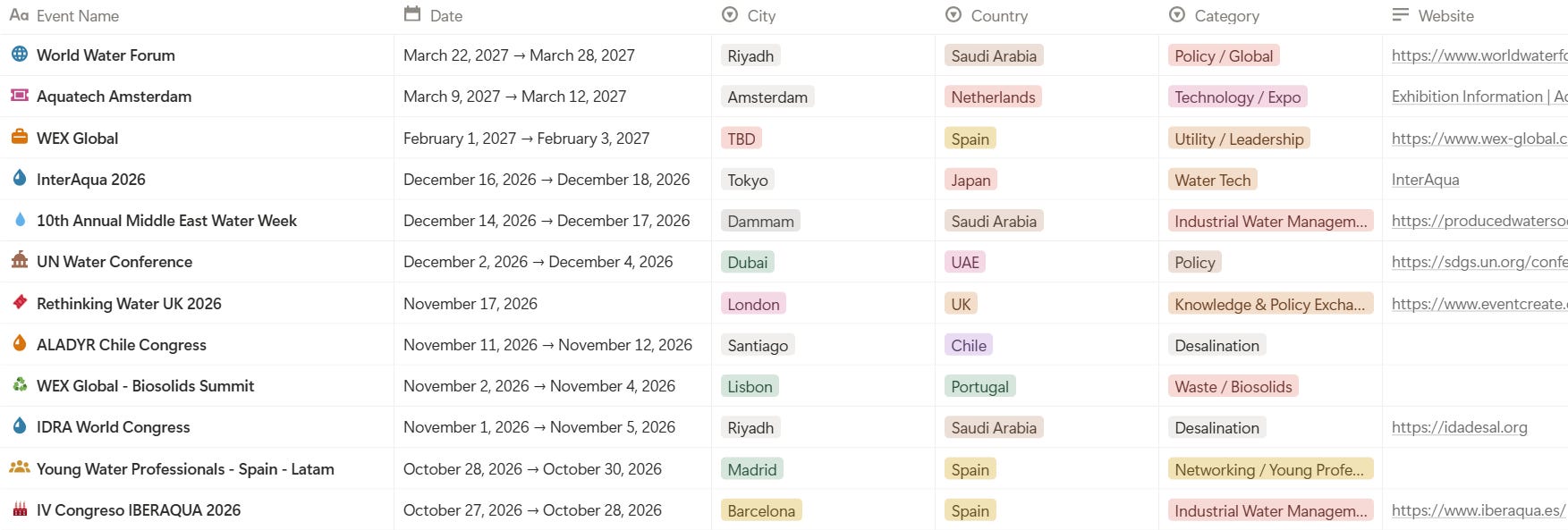
I’d also like to take this opportunity to introduce one of the features that will be available in our Knowledge Hub, which will be released over the coming weeks: the event tracker!
Having attended so many conferences and industry events, Walid shared his recommendations on which ones are most worthwhile depending on your interests.
I’m sure his wife is incredibly proud of him because I’ve witnessed firsthand how hard he works. The effort he puts into attending events, building relationships, and connecting people across the water sector is remarkable.
What’s next for Walid? I don’t know. But in this talk, he said:
“Water is addictive. Once you’re in, you stay in. If people try to leave, they ultimately join another water company.”
So…I hope we’ll soon see him in a major interview or long-form conversation with Antoine Walter or another leading voice in the industry. I’ll definitely be paying attention!
He got into water almost by accident
Curiously, Walid did not choose water.
His father pushed him into civil engineering, and in the final year a new option appeared: water and environment.
Notice that subtle detail: water and environment. This has been the traditional way of looking at water for last decades. And that's why many are surprised by the rise of the new water economy we have been discussing lately — corporate water, water reuse, water resilience, and beyond…
He signed up. He was the only student who did, and the faculty was ready to cancel it.
Then the dean gave a speech about water and the future of water, and fifteen students enrolled. That was roughly thirty years ago.
I find that story disproportionately important. A single speech, one afternoon, decided whether a cohort of water engineers existed.
From there: a master’s in water sciences, then a first job at Nalco that had nothing to do with what he had studied — boilers, cooling towers, an industrial water world he did not know existed. Then GE. Then Danaher. Twenty years moving from service engineering to sales to leadership.
Three companies, three competencies, one career.
The Desalytics thesis: capital and proximity
Walid told me that in his corporate years, Africa was permanently on the slide deck and permanently postponed. Everyone studied it but nobody committed.
A US-listed company reports quarter by quarter, and Africa is a mid-to-long-term market. The maths never worked.
Then a young entrepreneur he had worked with in Africa called him for coaching on how to grow his business. Walid listened and concluded the problem was not selling, it was access to capital.
The entrepreneur asked if Walid could finance his orders. Walid’s answer was better than a loan:
“Look, I’m not a bank. But maybe if I partner with you — I have ownership in your company — I can bring you much more value than just the financing part.”
Money plus somebody who walks into the customer meeting with you.
A month later a partner in Zambia wanted the same arrangement.
And Walid asked himself the obvious question: if I have spent five years saying Africa is the future, why not replicate this across sub-Saharan Africa?
Clients across the region named two problems, and only two:
No local stock. Every order meant waiting for a distributor to ship from far away.
No local expertise. Nobody to call, nobody to come to site, nobody to troubleshoot.
Solve those two and you have a company. That is the whole thesis.
“Our best-selling product is our people”
I asked him the standard commercial question: of everything in the portfolio — water quality testing, treatment, disinfection, membranes, dosing pumps, antiscalants — what are the top sellers?
He refused the premise.
“If you ask me about one product that we’re selling the most, I would say our people. Which we don’t really price, but indirectly, companies are buying from us because of the people, not because of the products themselves.”
Anyone can find any product online today and buy it from the cheapest source.
Nobody needs a distributor to be a catalogue.
What a customer cannot buy online is somebody who imports, holds stock, invoices in local currency, delivers to site, and then stays on site to explain how the thing actually works.
Somewhere in that exchange we landed on a formulation I have not stopped using since: not B2B — P2P. People to people.
And Walid treats that literally, which is the part I respect most.
Desalytics partnered with Wilson Learning to run commercial development for their African teams. Every employee has Udemy access (now they need The Water MBA access!). The team is roughly 50% women.
“I don’t believe in all these government-funded aid and donations. I think you need to build from within. And what better way than to build the next generation of commercial and technical expertise within Africa?”
The events map and a preview of what’s coming to the Knowledge Hub
Walid attends everything. Or at least it looks that way from the feed haha. So I asked him to be selective: which events actually earn the flight?
He has deliberately compressed his own calendar to six or seven per year. I highlighted in green those which I also visited during last 3 years, which I’d definitely revisit.
Exhibitions
WEFTEC — the largest in the US, around a thousand exhibitors, with a serious technical conference running in parallel. Rotates between cities. I am thinking of attending the 100th edition in Chicago in 2027. Reaching 100 editions is a remarkable milestone and could make the event truly special.
Aquatech — Amsterdam as the anchor, plus Mexico and China. Smaller, but they give you a genuinely different regional lens.
Conferences
GWI Global Water Summit — the place to be, but senior. As he put it: you cannot go there and talk about an antiscalant. Match the room to what you sell. It’s not on my radar in the short term, mainly due to the cost barrier for me personally. However, I guess it is a great high-level networking event.
WEX Global — boutique, heavily weighted to decision makers, and frequently held in Spain. The key feature is retention: 60–70% of attendees come back every year, so relationships compound. Next 2027 in Madrid!
European Desalination Society — consistently well-built events, and one I can vouch for personally. Next 2027 in Liverpool, UK! Yeah desalination in UK! We talked about this recently you know already the story behind.
“When you go to an event, be engaged — otherwise don’t go. If you’re going just to walk around the exhibition, there’s no point. Try to be a speaker, try to be a moderator.”
This conversation is part of why we are building an events module inside our Knowledge Hub, going live over the coming weeks: which event, for which profile, at which stage, with what objective…
So members of our community can discover events or webinars that were not previously on their radar, or simply identify emerging patterns. For example, the rise of a new Biosolids Summit in Portugal.
When new events start appearing, it is usually because something is happening, a new trend, a growing challenge, or an emerging opportunity in the sector…
The gap is adoption.
Walid does not accept the premise that water is a laggard sector. His argument:
“We can take water, reuse it, recycle it, and drink it again. We’ve managed to shortcut the natural water cycle into a few hours. No other industry has shortcut a nature cycle in such a good way.”
The failure is downstream in adoption — the business models, the incentives, the liability structures.
At GE Water, with a chemicals division and an equipment division under the same roof, it took him three years to convince GE’s own equipment people to use GE’s own antiscalant.
Because the equipment team carried a contractual liability: deliver a cubic metre to specification, with pH and conductivity monitored, or lose payment per day.
Under that risk profile, the rational move is to change nothing.
That is the adoption gap in a sentence. It has nothing to do with R&D and everything to do with who eats the downside.
Then the counter-example: Hong Kong flushes its toilets with seawater.
A network of dedicated seawater pipes, chlorination and filtration and nothing more, mandated for new buildings starting in the 1960s. Today around 80% of toilet flushing in the city runs on seawater.
“It’s not really rocket science as innovation. It’s more of adoption.”
Ask a contractor to voluntarily run two pipe networks instead of one and he will decline, correctly, because it costs him money now and saves someone else money later.
Mandate it and the entire supply chain reorganises within a cycle. Same with greywater recycling: trivially implementable today, almost nowhere implemented.
For those of you who have followed my argument about the knowledge gap versus the investment gap, this is the same animal seen from a different angle.
The binding constraint is that the people who decide have no mechanism, and no incentive, to say yes.
From scarcity to abundance
Walid told me he changed his conference talks last year. He stopped talking about water scarcity and started talking about water abundance.
His reasoning: if the political will exists, abundance is technically achievable.
The bottleneck is not physical.
And here he named the typical structural problem:
“The worst part with water infrastructure is that it’s underground. Nobody sees it.”
Build a two-billion sewer and the electorate sees a hole in the road for eighteen months and then nothing. The infrastructure that determines whether a city functions is, by design, invisible to the people who vote on it.
Walid’s diagnosis of why we are stuck is that our conferences are internal. Water professionals talking to water professionals about water.
The message rarely leaves the room. It is the reason I have started accepting invitations to podcasts that have nothing to do with water — entrepreneurship shows, renewable energy platforms — to occupy one small seat at a table where nobody was going to mention water otherwise.
“Very few of our friends would know that water crosses all the energies — food and beverage, power, mining, petrochemical. Cooling, heating, cleaning, diluting, mixing. It’s everywhere.”
What he would tell a young engineer
I asked him for advice for someone starting now.
Many companies have cut training and development as a cost line. So choose employers who have not.
“Don’t get too comfortable. After four, five, seven years, if you’re not growing — not moving departments, not learning — you will not be learning. Take every learning opportunity, and create your own. Some people say they’re not lucky. Of course you’re not lucky if you don’t create your own luck.”
And on money: it will come. Optimise the next role for where it takes you, not for what it pays.
Then the word that closed the conversation:
“You’ll have setbacks in your career. Stay grounded. If you’re where you are, it’s because of chances and opportunities you had that others might not have had. Be humble, and take care of the people around you.”
Walid, in his own words
As usual, a brief journey through the talk:
On how he got into water
“I started by chance in the water industry. My dad was pushing me to do civil engineering — it wasn’t really my choice originally.”
“I was the only student registered for the option, and they were about to shut it down. Then our dean came and made a big speech about water and the future of water. So I ended up being fifteen in this option.”
“My first job was in Nalco. It was nothing like what I had studied. I never thought that this existed.”
On Africa
“We’ve always talked about Africa, how it can be the future for growth. But Africa is very complicated. When you’re a stock-listed US company driven to deliver growth quarter by quarter, Africa is mid to long term.”
“Currency fluctuations, currency shortages, commodities, political instability. If oil and gas is down, Nigeria and Angola are down. If mining is down, Zambia and Tanzania are down.”
“Their main challenge was that they don’t have local stock, and they don’t have local expertise to support them. If we can solve these two, we could be successful.”
On the partnership model
“Look, I’m not a bank. But maybe if I partner with you — I have ownership in your company — I can bring you much more value than just the financing part.”
“I don’t believe in all these government-funded aid and donations. You need to build from within. And what better way than to build the next generation of commercial and technical expertise within Africa?”
“In our team we have 55% women, which is really great in our industry — especially now, when talks about diversity are getting challenged.”
On people, not products
“If you ask me about one product that we’re selling the most, I would say our people. Which we don’t really price.”
“Companies are buying from us because of the people, not because of the products themselves.”
“Today with the internet you can find any product and buy it from anywhere. If you don’t add the local support, what’s the point? It’s all about price then.”
“People to people. P2P, not B2B. We should use that going forward.”
On events
“It depends on what you want to achieve. You cannot go to a CEO and talk about an antiscalant.”
“When you go to an event, be engaged — otherwise don’t go. If you’re going just to walk around the exhibition, there’s no point. Try to be a speaker, try to be a moderator.”
“WEX is a boutique event. Almost every year you have 60 or 70% coming back, so you become at ease working with them.”
“I’ve tried to limit my trips to six or seven events per year. You don’t want to go as a spectator. You want to add input. It’s a better usage of your time.”
On meetings and AI agents
“One time someone sent his AI agent to record the call. I was like — seriously? At the point of joining, we want you to interact, not just to listen.”
“What’s the point of wasting an hour to attend as a listener? Just take the notes. Don’t invite me to this call.”
On innovation versus adoption
“We can take water, reuse it, recycle it and drink it again. We’ve shortcut the natural water cycle into a few hours. No other industry has shortcut a nature cycle in such a good way.”
“Where I see a gap is in the innovation of adoption. The models for adoption, the incentives for adoption. That’s where we’re really struggling — not on the innovation part.”
“It took me three years to convince our own equipment guys to use our own antiscalant. Not because they didn’t want to, but because they had liabilities.”
“Hong Kong mandated that every new building would use seawater for toilet flushing. Today 80% of toilet flushing across Hong Kong is seawater. It’s not rocket science as innovation — it’s adoption.”
“If you’re a contractor, why would you build with two different pipes? Same with greywater recycling. Why would you do it if the government doesn’t force you to?”
On political will
“That’s the elephant in the room.”
“I shifted from talking about water scarcity to talking about water abundance. If the political will is there, we can shift to a world of water abundance.”
“The worst part with water infrastructure is that it’s underground. Nobody sees it. Implement a two-billion sewer project and the people who vote will not see it.”
“Once the political will is there, there are no water challenges. Singapore, the Netherlands, Namibia — these are places that had to deal with water issues and dealt with them.”
“Singapore even created a song for water that schoolkids had to sing. It took them twenty or thirty years. It’s not a short-term gain.”
“Our conferences are internal conferences — water professionals talking to water professionals. We’re not really taking the message outside.”
On the next twenty years
“We’re good at predicting after the fact.”
“Water positive will really gain a lot of traction. It will create opportunities for reuse, for decentralised systems, for emerging contaminants.”
“People talk negatively about desalination because it’s energy-driven. But if you don’t have water, you need water. There is no miracle. First you reduce, then you reuse, but eventually you have to generate new water.”
“If you spoke to Amazon, Google or Intel in the past, none of them would put water as a key challenge. Today they’re hiring people from our industry to drive their strategies.”
On building a career
“So many companies have dropped their training and learning programmes for cost cutting. Work for companies that value your development.”
“In Nalco I learned value selling. In GE, leadership, diversity and compliance. In Danaher, continuous improvement. Try multiple companies.”
“Don’t get too comfortable. After four, five, seven years, if you’re not growing, you will not be learning.”
“Some people say they’re not lucky. Of course you’re not lucky if you don’t create your own luck.”
“Don’t put the money first. Money will come. Work on developing yourself, and everybody will want to hire you after.”
“People in our industry are very helpful. If you ask anybody for help, they will help you. But you should be willing to help others — it’s give and take.”
On staying grounded
“You’ll have setbacks in your career. Stay down to earth. If you’re where you are, it’s because of chances and opportunities you had that others might not have had. Be humble, and take care of the people around you.”
“Water is addictive. Once you’re in, you stay in. If people try to leave, they ultimately join another water company.”


