

Today I’m bringing post-treatment into the desalination section.
It may be one of the less CAPEX-consuming parts of a desalination plant.
But it can become one of the most important when it comes to performance guarantees such as LSI, pH, Alkalinity and Hardness.
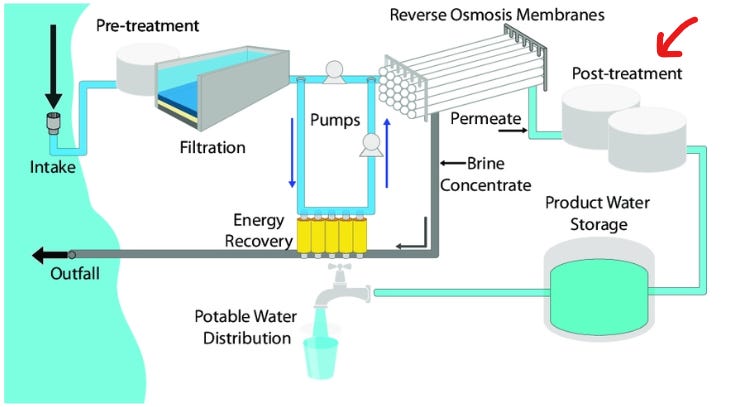
I’ve been looking more closely lately at calcite contactors / limestone filters, the problems we can encounter with them, and how different arrangements can affect the final result.
And I found something particularly interesting.
In recent projects, I’ve seen:
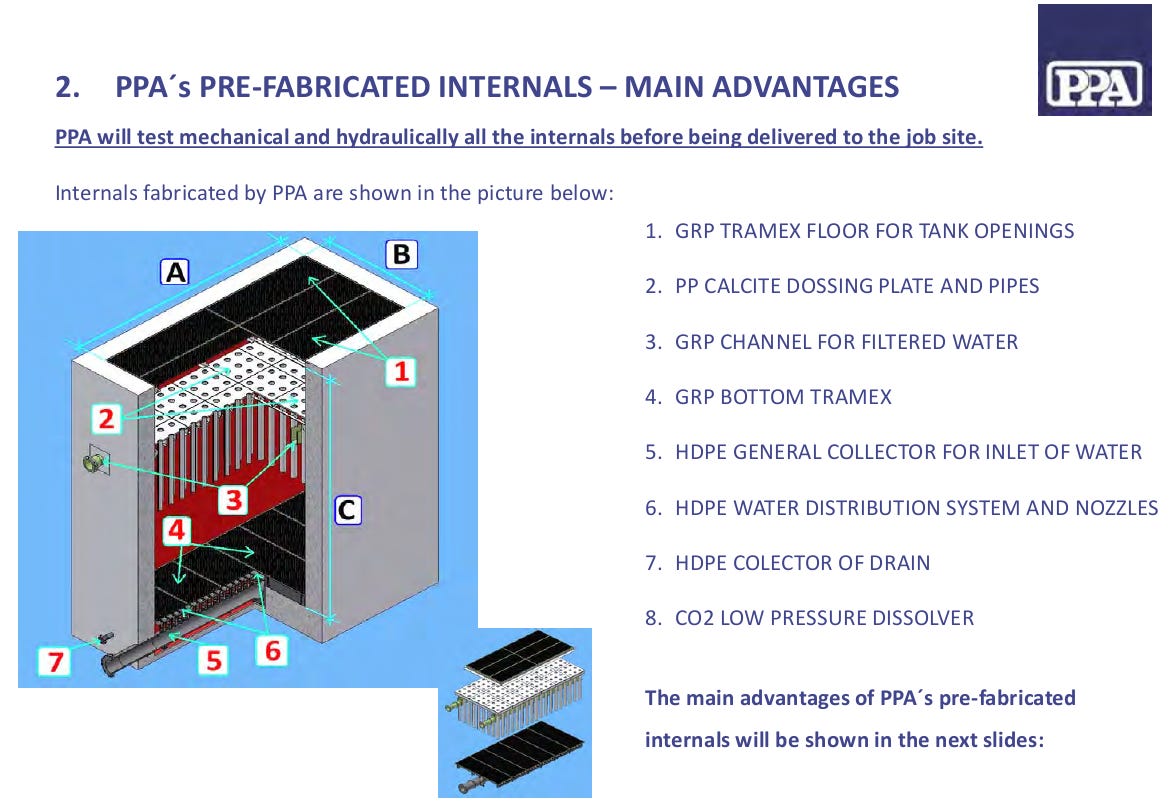
→ PPA special internal arrangements used by Metito in Al Jubail 1,000,000 m3/day. They make the following pitch:
The main problems PPA claims to solve are, in short:
CO2 not dissolved; water not contacting the whole calcite mass; dead zones at the surface caused by perimeter channels; cells running at different flows; and the site interface mess of civil, piping and steel trades working in the same box.
The second half of the pitch is construction: factory testing, fewer workers on site, no scaffolding for perimeter channels, no drilling into concrete walls, and civil works that can finish before the internals arrive.
→ Leopold underdrain systems installed by GS Inima in Shuweihat 4 320,000 m3/day (I thought I’d use this opportunity to share above the Spanish workshop with Xylem on these elements)
→ and more conventional arrangements that we still find across many plants.
They may look like three different solutions for the same problem.
But they are not exactly the same thing.
And then go one step further:
What are actually the key things we should be looking at when designing or reviewing a remineralisation system?
Because post-treatment is one of those areas where the equipment can look relatively simple…until you have to guarantee the water coming out of it.
Today’s publication is sponsored by The Water MBA
If you work in desalination — or simply want to understand it properly — we’re cooking the slides for our Desalination Crash Course.
Register your interest directly through the Academy below.
The first module will be uploaded in November, and official registration will open then.
No rush. Just get on the list.
1. Why we remineralise
Reverse osmosis permeate is almost pure water, and that is exactly the problem.
Seawater RO membranes reject divalent ions and bicarbonate better than they reject sodium and chloride, so a typical second-pass permeate leaves with less than 1 mg/L of calcium, 1–3 mg/L of bicarbonate, and an LSI between –4 and –7.
Water like that is hungry.
It dissolves the cement matrix of concrete tanks, strips the protective scale off ductile iron and steel mains, leaches copper and lead from household plumbing, and tastes flat.
It also delivers none of the calcium and magnesium that health authorities increasingly expect in drinking water.

Magnesium, by the way, is that mineral whose lack in drinking water is something countries such as Israel have noted may create health issues in the future, and the mineral that big creators such as Jay Setty are now promoting as the latest fashionable supplement. Curious to think about it.
Post-treatment has one job: put back enough calcium and carbonate alkalinity, at the right pH, that the water lays down a thin protective CaCO3 film instead of eating the network.


