
This week, Rome hosted the EuroMediterranean Water Forum.
For four days, institutions, businesses, the research community and civil society from both shores of the Mediterranean discussed water as a shared resource and the choices needed for the future of the countries that border it.
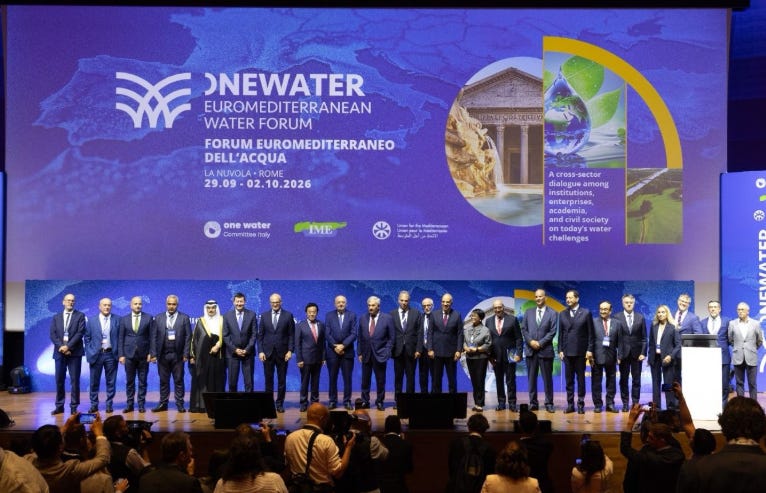
A few months ago I had the chance to sit down with Alain Meyssonnier, president of the Mediterranean Water Institute (IME).
A water professional of such calibre and uniqueness that you’ll struggle to find anyone else like him in the world.
Listen to him on our podcast, and you’ll understand why.
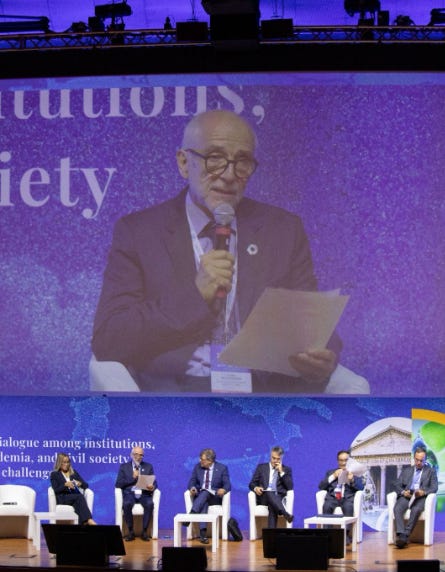
It felt like the right moment to share some of what came out of some conversations about this event.
What came out of Rome
I talked to some of the attendees, and my notes:
Resilience Over Infrastructure
Success can no longer be measured simply by the “kilometres” of pipes or dams built.
Large-scale engineering must be paired with Nature-based Solutions, and investments must be evaluated on the actual resilience they generate for local communities.
The Rise of the “Water Manager”
There is a critical skills gap.
The region needs a new class of professionals capable of breaking down silos to integrate agriculture, energy, environmental protection, and digital technology across multiple government ministries.
So I guess many of those water managers will come from this community 😎
Innovation Through Reuse
Rather than relying solely on high-energy solutions like desalination, countries need to scale up water recycling.
Examples include Egypt’s advanced quantification of drainage water reuse and Italy’s TANIT cooperation project, which channels treated wastewater from Tunisian cities into the desert to foster a “green” economy.
The 2026 Global Water Agenda
The Rome forum is just the beginning of a highly coordinated diplomatic push to integrate water security into global climate frameworks.
UN Water Conference (Abu Dhabi) on Dec 8 – 10, 2026 will be the capstone event of the year.
It will feature six thematic dialogues (focusing on people, prosperity, planet, cooperation, multilateral processes, and investment) to summarize the cycle and build upon the historic 2023 New York conference.
What the IME is
For more than 40 years, the IME has been a meeting point for water in the Mediterranean.
Its structure is unusual: three “colleges” sitting at the same table.
One is institutional, with ministries and regional authorities.
Another brings together public and private operators from around fifteen countries, from Aguas de Barcelona to Morocco’s ONEE.
The third gathers independent experts and academics.
That makes more than a hundred members, supported by a permanent team of just three people.
Its goal isn’t to deliver projects but something harder: to be the voice of water.
It collects what has worked and what hasn’t on each shore, and makes that experience available to the people who have to decide.
The Mediterranean’s problems
Alain argued that demography, even more than climate change, is the biggest pressure on water.
The southern and eastern Mediterranean are growing at a pace that has nothing to do with the north.
More people means more food, and agriculture already accounts for around 80% of water use in the region.
On top of that, rainfall is increasingly erratic.
It falls all at once and runs off to the sea before it can be captured, as we saw so tragically in Valencia.
Then there’s pollution: in many places there is still no wastewater treatment, and Alain reminds us that you can’t talk about reuse where there’s no treatment.
And there’s a silent bill, the networks. In a water system, he told me, the plant costs 10 and the network costs 100, and for decades nobody saved up to renew it.
The IME works on four priorities.
The first is to know and protect natural resources.
The second is sobriety in water use.
The third is efficiency across the whole life of infrastructure.
The fourth is the water mix, which includes reuse and desalination.
The need for coordination
One idea runs through everything Alain says: the problem is about conversation.
Scientists who design technologies need to talk with the operators who will have to buy and run them, which is why the IME has moved into the École Centrale de Marseille and works with universities such as Málaga.
People who criticise a dam or a desalination plant need to talk with those who understand the economic and social context behind it.
Generations need to talk too: at the Tunis forum, the conclusions were presented by a group of ten young engineers and political scientists.
Countries need to talk as well.
Alain is convinced that water may be one of the few topics that can bring people who don’t speak to each other back to the same table.
Why is water blue?
An anecdote. When he worked at the Marseille water company, Alain used to visit schools to talk about the water cycle.
Children would ask him things like why water is blue, questions far harder to answer than they seem.
But the one that made him think most was different: what’s the point of saving water here if it doesn’t help Algeria?
For years he answered that it was a matter of awareness.
Today his answer has changed. There is only one water cycle.
The drop that falls in Cartagena today may have been in Turkey two weeks ago.
The amount of water on the planet doesn’t change.
What changes is how it rains and how much we pollute it.
So yes, saving water in Spain helps Morocco (not sure if this is the best reference nowadays due to geopolitics concern…just kidding)
That may be the best summary of the Mediterranean.
We share the same sea, the same water and, more and more, the same problems.
The least we can do is share what we know.
Industry has understood the risk
One of the most interesting shifts Alain describes is in industry.
For large companies, water is no longer a line in the annual sustainability report.
It has become strategic, because a shortage threatens production itself.
His favourite example is OCP, Morocco’s phosphate group, a huge water user that also uses water to move phosphate from the mines to the port.
Over twenty years, it built its own engineering team, cut leaks in its network and then specialised in reuse and desalination.
Today roughly 30% of its water comes from treated wastewater from the three nearby mining towns and 70% from desalination.
It no longer takes a single drop from natural sources, which leaves that water for other uses.
Michelin, meanwhile, aims to cut its water consumption by two thirds by 2030, and every research project must now include water and energy savings.
Small is beautiful
Large treatment plants have solved enormous problems and aren’t going anywhere.
But Alain believes that when a city expands, the first question should be whether to treat wastewater on site rather than extend the network all the way to the central plant.
Reusing treated water within a neighbourhood is far easier and cheaper than doing it across a whole city, especially if it’s planned from the start.
In Singapore or Japan, it’s hard to imagine a building that doesn’t reuse its own greywater, which can cut consumption by 40 to 50%.
He sees an opportunity for Africa to leapfrog, just as it did with telephones.
Much of the continent skipped landlines and went straight to mobiles, and mobile payments took off in Kenya before they did in Europe.
Water could follow the same path if new projects consider these solutions from day one.
The tariff paradox
In 2008, when Alain was in charge of operations in southern France, his team organised shipments of drinking water by boat from Marseille to Barcelona.
Since then, Barcelona has made a huge effort to reduce consumption.
Today it uses around 106 litres per person per day, compared with a French average of 146.
However, this creates a paradox that few people outside the sector understand.
Between 80 and 90% of a water utility’s costs are fixed. I would need to check exactly this with my local utility.
If people consume less, revenue falls, and tariffs have to rise to keep the system balanced, whether the operator is public or private.
Add the backlog of network renewal, and Europe needs a new economic model for urban water.
For Alain, the key isn’t public versus private management but having renewal targets that are written down and actually met.
A few key quotes
On the water cycle
“We have to stop talking about the big cycle and the small cycle of water. There is only one water cycle.”
“The drop of water that falls in Cartagena today was maybe in Turkey fifteen days ago.”
“Saving water in Spain helps Morocco.”
“The amount of water on the planet is the same. What changes is how it rains, because of climate change, and pollution.”
On knowledge
“To protect something, you have to know it. You can’t talk about things you don’t know.”
“Many people talk badly about dams without knowing what they’re talking about.”
“You can’t criticise something for free. You need a calm analysis.”
On consumption and use
“Drip irrigation uses less water per hectare, but many more hectares get irrigated. We have to think beyond consumption. It’s about use: what for?”
On infrastructure and money
“In a water system, the treatment plant costs 10 and the network costs 100.”
“If you reduce consumption, and almost all your costs are fixed, you have to raise the tariff.”
“The problem isn’t public or private. The problem is having objectives that are written down and met.”
On 19th-century works still supplying a city: “If they had been told it was an investment for 150 years, they wouldn’t have argued about it for so long.”
On industry
“It’s not about the annual environmental report anymore. It’s strategic.”
“Reducing water reduces energy, and in the end it’s profitable.”
On reuse
“You can only talk about reuse if there is effective treatment.”
“Small is beautiful. It’s much easier to reuse treated wastewater in a neighbourhood than in a city.”
“The cheapest option is to treat the water where you build the new neighbourhood.”
On desalination
“We trust our technological capacity to find a way to avoid the pollution.”
“We have to work on the chemistry, not only the salt but the chemicals used to clean the membranes.”
On desalination for export agriculture: “It can seem completely absurd. But you have to look at the economic impact, at the jobs.”
On demography
“People talk a lot about climate change, but the first impact is demography.”
“Demography means, first of all, food.”
On operations and AI
On treatment plants built without sewer networks: “They put grease around the motors so they don’t get damaged.”
“Priority to operation, priority to training.”
“AI depends on knowledge. If tomorrow only AI has the knowledge, what happens to the employees?”
On young people
“We have to share our experience, but not take the decision. The decision has to be in the hands of the young.”
“They are the ones who will face the next 50 or 60 years, not us.”
“If someone isn’t interested, you can’t force them. We have to go to them.”
On priorities
“I’m quite optimistic about our capacity. The difficulty is making it a priority.”
“The countries that consider water a priority are the ones that develop best.”
On science and operators
“Scientists are very good, but the ones who will buy the technology are the operators.”
On communication
“Explain, explain, and always explain.”
“How can television talk about one topic every day for a week and never talk about water?”
On water and peace
“Water serves peace more than war.”
“Water is one of the topics that can let people sit down at a table, because it’s the same water for everyone.”
On lifelong learning
“I keep learning. That’s why I’m here.”
“Nothing obliges you. If you do it, it’s because you like it and think sharing experience can be useful. And you always learn.”
“And it helps keep the neurons working.”


