
I speak with many of you, and I often get questions like:
Where are we heading? What are the opportunities? What are the growth paths?
So, our baseline remains the same: exploring and explaining the water business, bringing great knowledge to the community, and connecting professionals from around the world.
By the way, I was honestly shocked last week when I reviewed our community stats from 2026.
This publication is being read in 102 countries around the world.
I still can’t quite believe it. This is insane.
Thanks, everyone, for your support.
Okay, now let’s get into today’s topic.
I want to highlight six very important actions where I’m going to invest significant time, and explain why.
#1 — AI
The AI thing is insane. Not just in water, but everywhere.
And I’m an analog guy. I’m a civil engineer. I sometimes feel I need to catch up.
It reminds me of when I started working in 2012. Some colleagues who were 50 or 60 at the time would say: “Excel file? No, no. I use paper. I’m too old to learn this.”
I don’t want to be that guy.
The way we work — and the way our businesses are evolving — means I need to significantly improve my knowledge of AI and digital tools.
That’s why learning AI with Sandro Hansen will be one of our major initiatives over the coming months, and probably years. This is also why Sandro has officially joined us as our international instructor.
I need to put my student hat on, take a step back, and start learning, step by step, how AI works in water and, more importantly, how this field is likely to evolve in the future.
I genuinely believe that every unit of time and every euro I invest in this learning journey will be worth it in the future.
I also suspect that many new water-related jobs will emerge with job descriptions that simply don’t exist today. So, if in five years—or less—this becomes widely visible and companies start demanding these new profiles, I want to be ready to take advantage of those opportunities.
We start in just a few days. REGISTER
#2 — Social media, communication & your digital asset
Driven by this digitalisation, I feel that more than 97% of professionals are missing the ecosystem and the behavioural changes happening in business and professional presence, especially around the digital asset ecosystem.
The rules of the game have changed.
Whether you are an individual or a company, creating and developing your own digital asset — your reputation, your knowledge, your network, your presence — may become one of the skills and mindset shifts that can generate much better returns in the future.
So I’m going to lead a brief course on social media & communication, based largely on my own experience over the last few years.
But I want to make it very practical and tailored to each person, because it depends enormously on the intersection between your personality, what you enjoy, what you are good at, which networks you use, and what you want to achieve in the future.
Many people simply don’t take action.
And even if you don’t like social media — I actually much prefer shaking hands and meeting people face to face — if you completely ignore this field, you are missing a lot.
You should probably consider it a kind of tax on your professional development: invest a bit of time and money consistently.
And I’ll help you understand how.
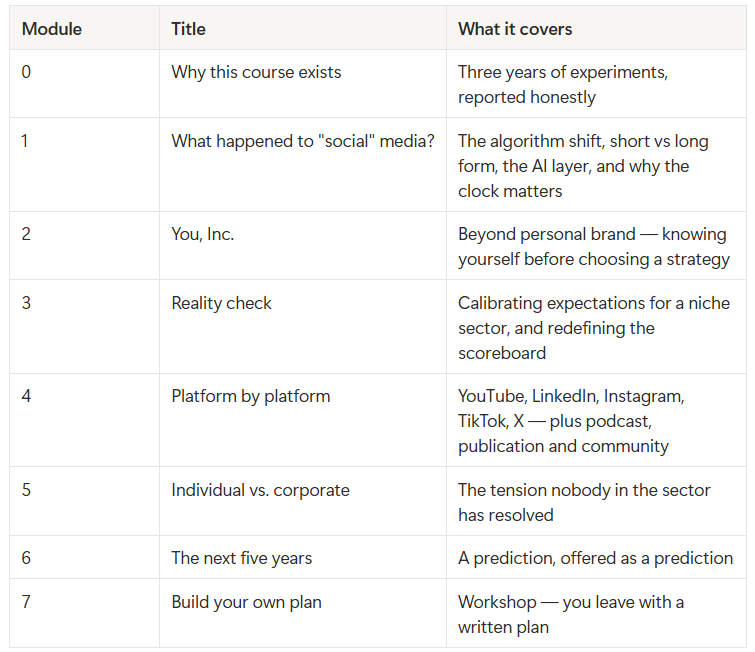
First cohort: Max 5 seats. Registration link goes here → HERE
#3 — Desalination
The knowledge gap in desalination is huge. Really huge.
And the demand for practical knowledge is skyrocketing.
The return on investing in education in this field is becoming increasingly easy to see.
So, especially for those with less than 5 years of experience, professionals moving from another area of the water industry, or newcomers coming from outside water, I genuinely believe this course should be a must-have.
I’ve been involved in 5–6 real projects across the full lifecycle — from design and procurement to construction — and over the last 14 years, I’ve probably had exposure to more than 50 desalination plant tenders.
That gives me a very particular perspective: not just the technical knowledge, but the context around how the business actually works.
And I think I can bring that context to these different profiles in the most practical and useful way possible.
That’s why we’re launching Desalination Crash Course: to explain the fundamentals and give you the precised knowledge you need to catch up really quickly.
Whether you work in feasibility studies, consulting, business development, engineering, construction, or plant operation, you’ll gain a solid understanding of how desalination projects really work from a big-picture perspective.
The business won’t wait. Now is a great time to get up to speed.
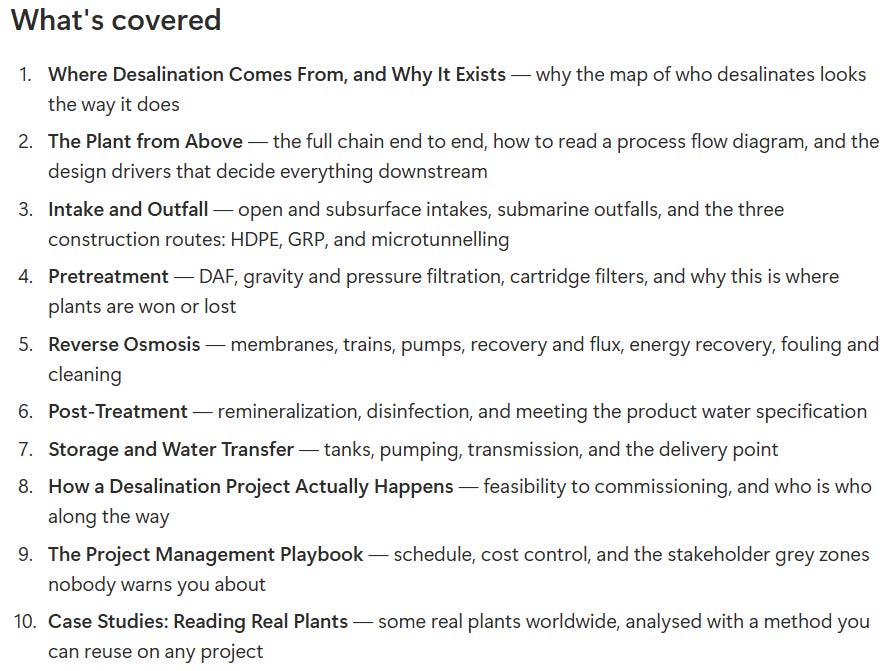
Limited to 8 seats, no more. Set aside around 10 hours spread over a few weeks. Register your interest HERE
#4 — Water reuse
Reuse is another major direction.
There is a lot of money and strategy flowing into this field. I naturally feel less comfortable with some of the highly technology-driven aspects, but I know how to navigate the ecosystem.
So rather than pretending to be the expert in everything, I want to do what I think The Water MBA does best: bring together the right experts.
The idea is to build and launch an International Water Reuse Programme, with instructors from Singapore, Australia, Israel, Spain, the US, Saudi, UAE, India and elsewhere…
Why?
Because I think it is extremely valuable to learn how different countries and markets approach specific cases and to get as much context as possible.
Every reuse project can be unique, particularly in industrial water.
My personal priority would be industrial water reuse, followed by agricultural schemes and indirect potable reuse, with less representation initially for direct potable reuse.
This is still at an early stage. The first step is selecting our instructors, people who share our values and genuinely understand the field and its reality.
We already have two selected, but we need more.
So this is probably a mid-to-long-term project, with an announcement for 2027.
#5 — Water stewardship & corporate water
By now, the economic impact of water in the corporate world is clear. That discussion is over.
Water has moved from being an operational cost line to being a risk, a licence to operate, and in some cases a strategic constraint on where and how companies can grow.
What is not settled yet is the how.
The frameworks, the procedures, the metrics, the actions companies are actually expected to take — all of that is still under construction.
But it is being built quickly, and I think it will consolidate into something sooner than most people expect.
That is exactly why I want to be very supportive here.
When a field is being built in real time, knowledge and education change really fast.
What was considered good practice eighteen months ago may already be outdated, and the gap between what a company thinks it should do and what it will be required to do keeps moving. I need to stay up to date. And so do you.
So I’ll apply the same logic I’m applying with reuse: rather than pretending to be the expert, I want to bring in someone who is on the front line, dealing with this on a daily basis, not someone commenting on it from the outside.
I’ll assign one official instructor as part of The Water MBA for this area — a person who lives corporate water and stewardship every day, and who can transmit that knowledge according to our values and our style: practical, honest, and grounded in what actually happens inside companies and projects.
I think these 5 pillars mentioned above are extremely important, both because of what our community is asking for and because of where the industry is moving.
#6 — The Knowledge Hub
And finally, the main introduction in the video is our Knowledge Hub.
The invitation to the Knowledge Hub will be sent during October to annual paid members as an additional layer of value.
At the end of the day, this is my workscape, so I also want to make sure that those engaging with it are the people who are most committed to supporting the initiative and, in turn, adding the most value to the community and its members.
I’ve spent around three years taking notes, researching, brainstorming, drawing conclusions, raising questions, designing, and building a place that could eventually be useful to our community.
It was, honestly, very messy.
Over the last few months, I’ve spent a lot of time cleaning it, organising it and polishing it to create a minimum viable skeleton from which I can now work systematically.
And it will finally be made available and I explain how in the video.
So, what will you find there?
The idea is not that you use it every day. Think of it more as an added layer of value for our members.
It is also my workspace, so feel free to correct me, challenge me or suggest improvements.
The bigger idea is simple:
How can we put the water business universe into a digital hub that is easy and entertaining to navigate — while allowing someone who explores it to learn a great deal along the way?
Let me walk you through it section by section, and tell you why each one is there.
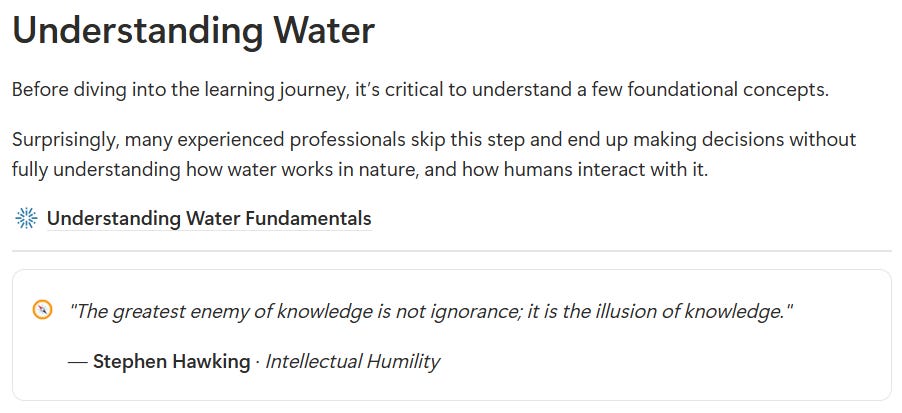
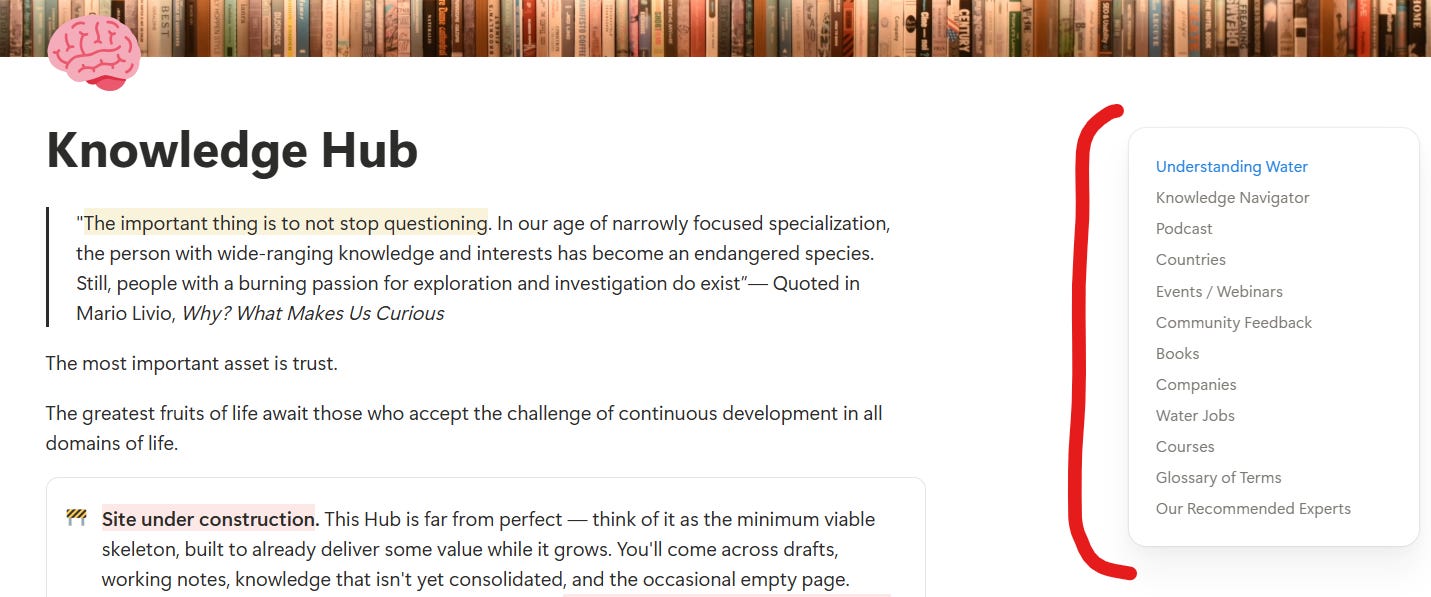
Understanding water, the fundamentals.
Before navigating anything else, there are a few basics that any water professional — and even someone completely outside our profession — should understand. This is the first step before you start clicking around.
The Knowledge Navigator.
This is the core of the hub, and probably where I will invest most of my time.
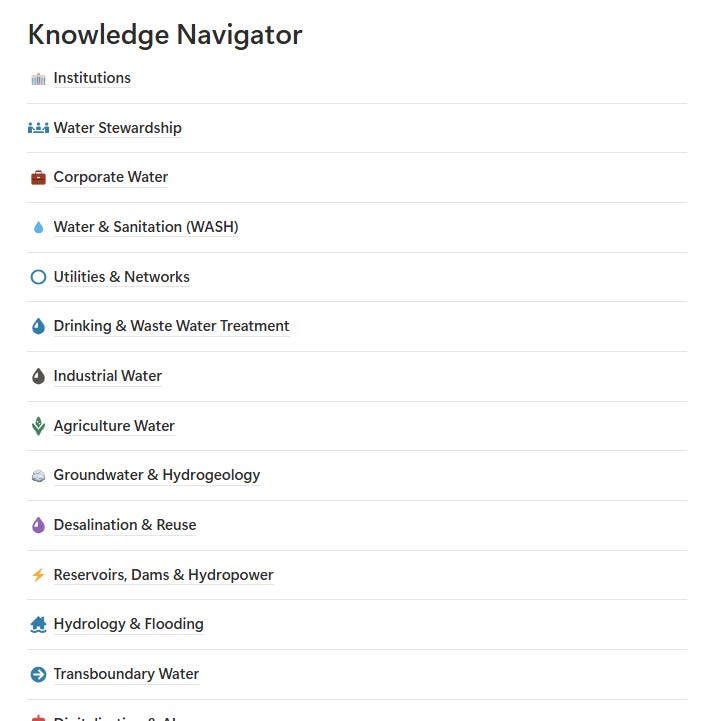
The structure is by fields.
You start from the top narrative — what a field is, why it is managed the way it is — and you can go all the way down to the bottom.
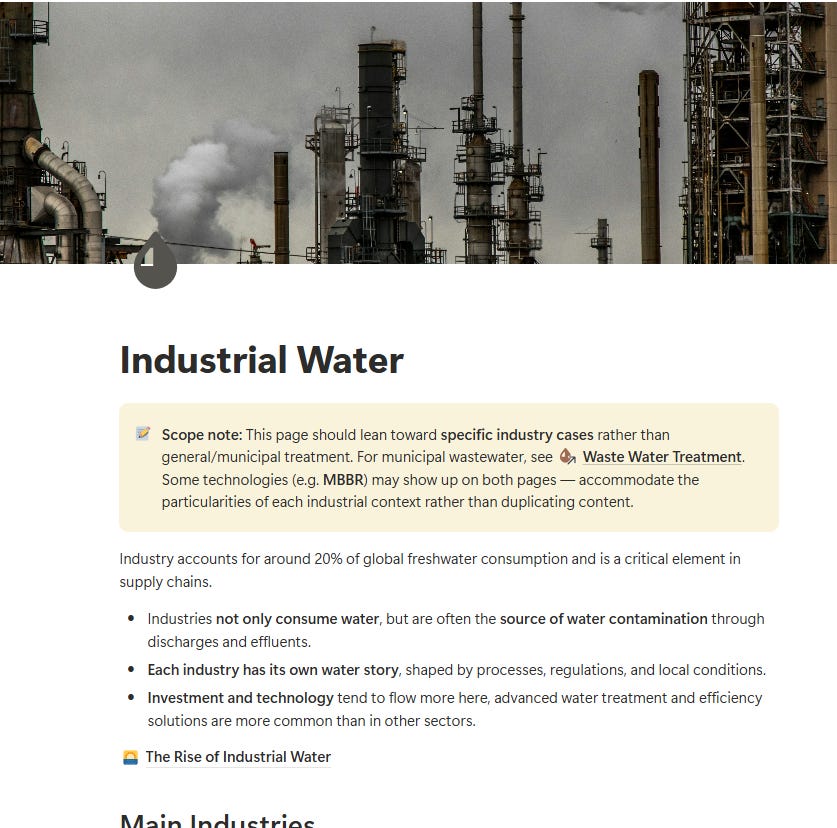
Desalination, then the desalination process, then pre-treatment, then DAF and filtration, pros and cons, lessons learned, the main technology providers for each piece of equipment…
Some pages have PDFs and videos embedded. You will notice the pages don’t all look the same, and that’s fine.
If you miss a specific field, it is probably inside one of these. Anyway I can change the whole thing tomorrow if required.
For instance, communication and media is in there for a reason: our business is not only technical, and understanding the media references, marketing and the creator economy is part of being prepared for what is coming.
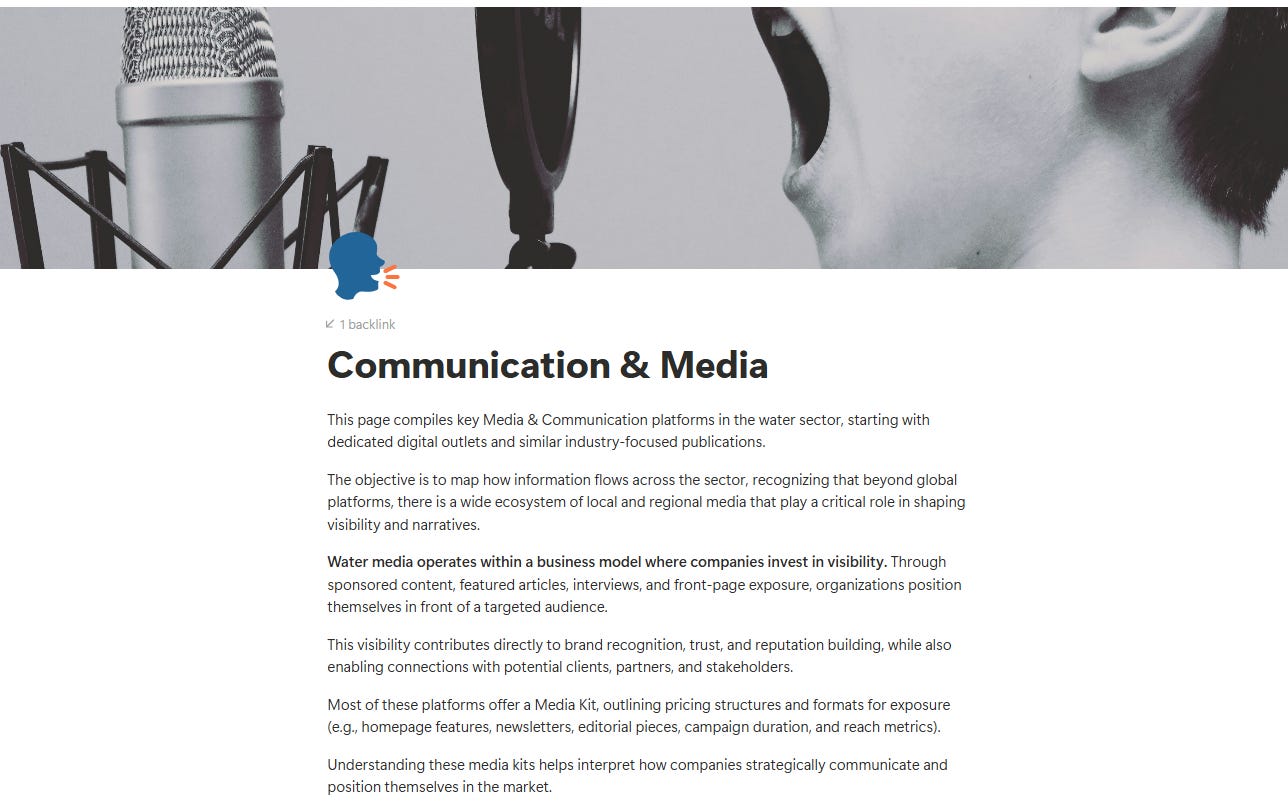
This is also where the instructors come in. I want to bring at least one instructor per discipline, and part of their role will be helping me design and tailor these pages so the framework is properly built — not just my own notes.
The podcast, reorganised.
All our episodes in one database: type (conversation, presentation, workshop), tags, language, direct link to the video and to the publication, and the attached files when there is a presentation or a workshop you can download and use.
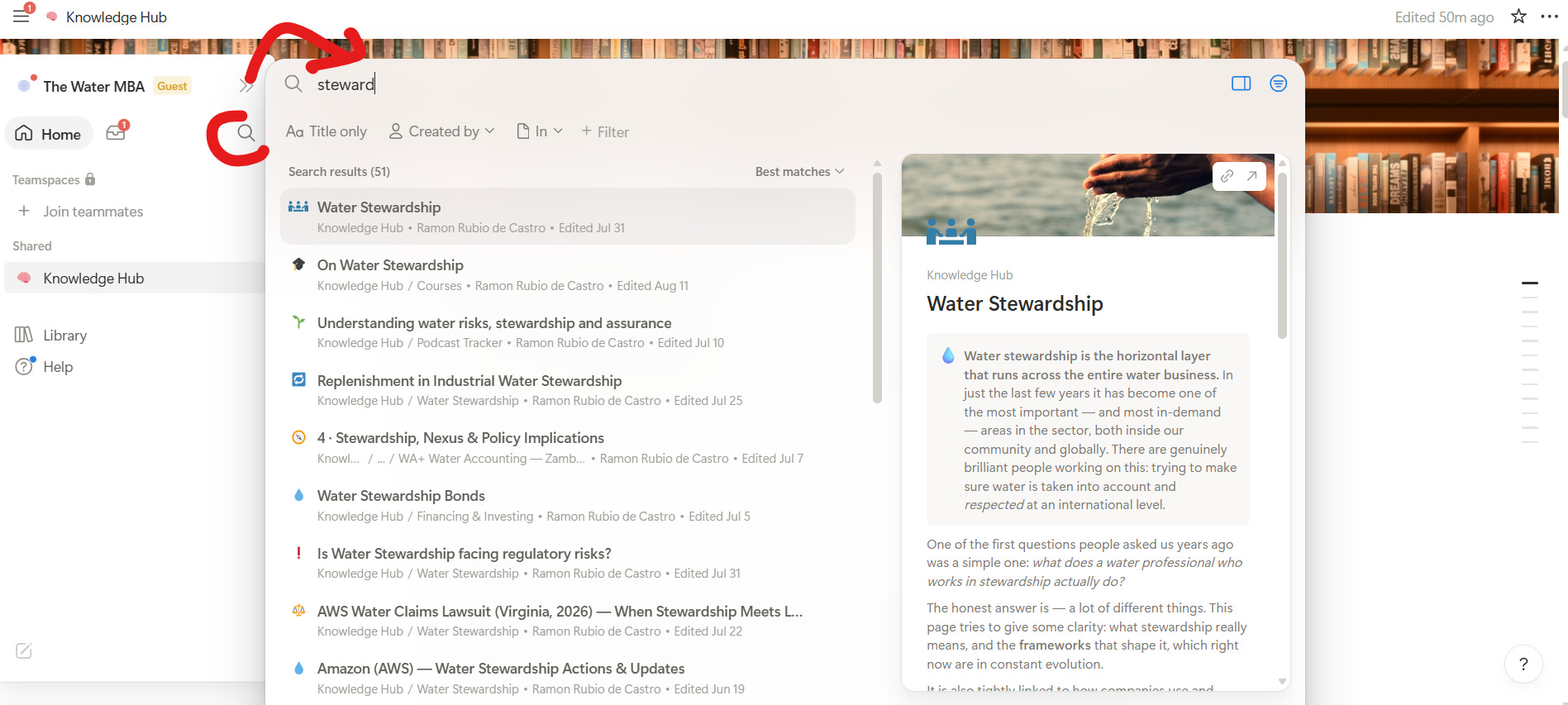
Search “stewardship” for instance, and you get the episodes worth your time.
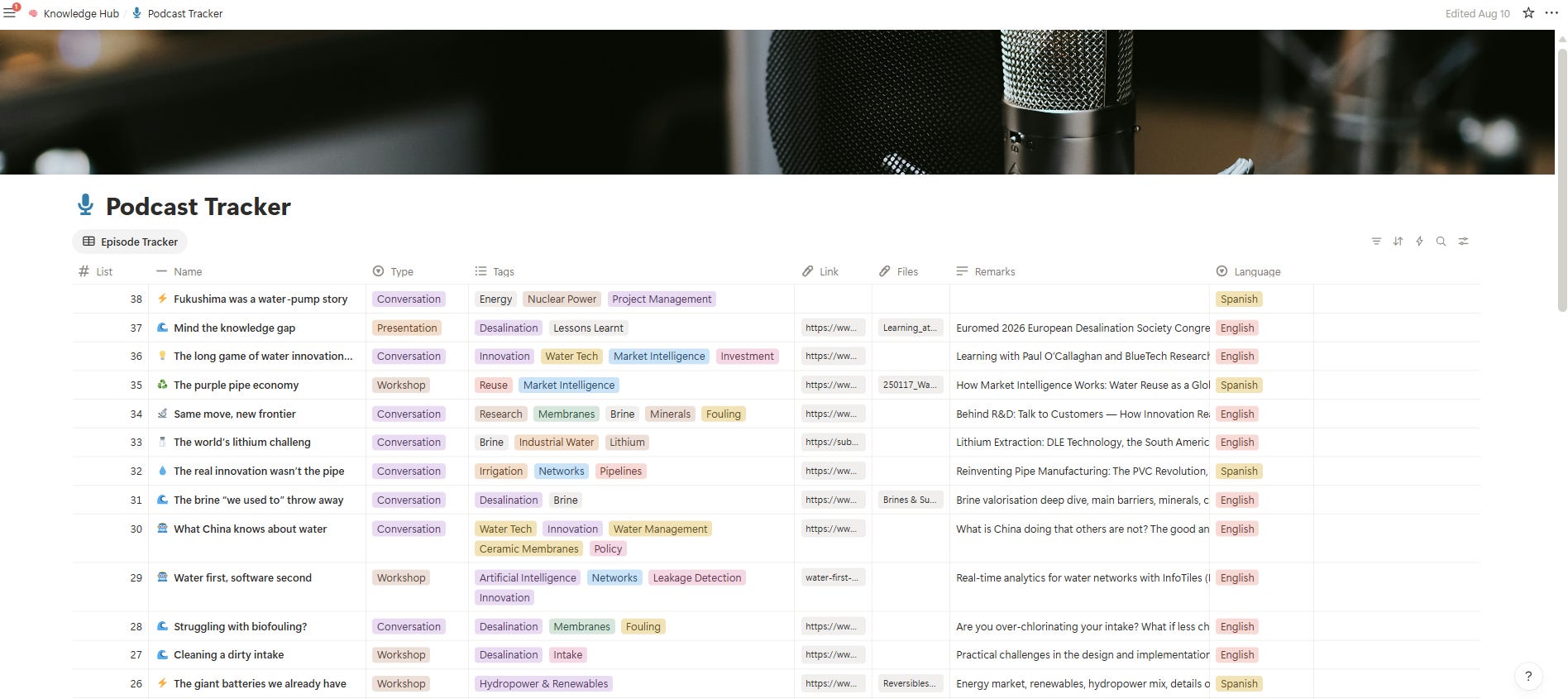
Why? Because on the website the podcast is chronological, and that is not how anyone looks for knowledge.
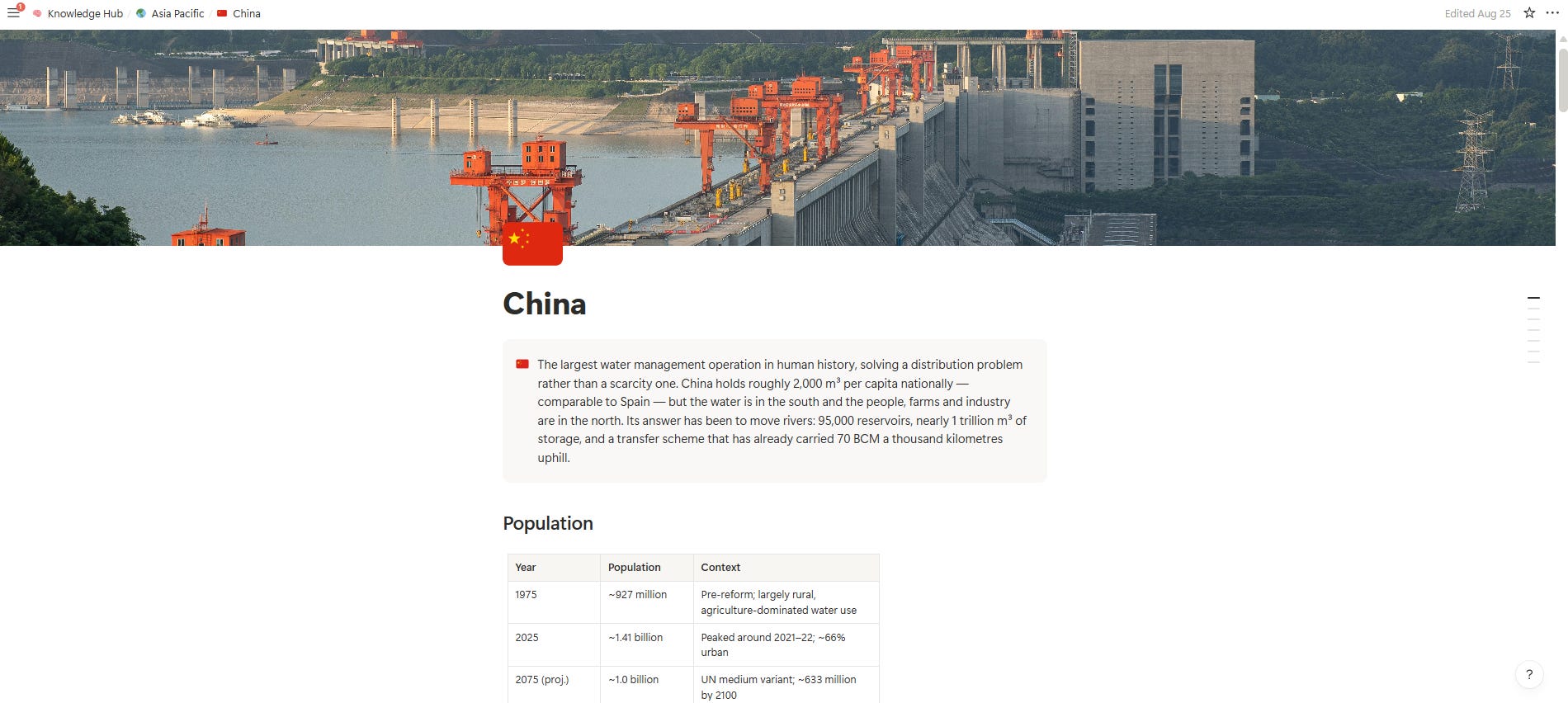
Countries.
I find it fascinating that every country manages water in a completely different way — different context, regulation, culture.
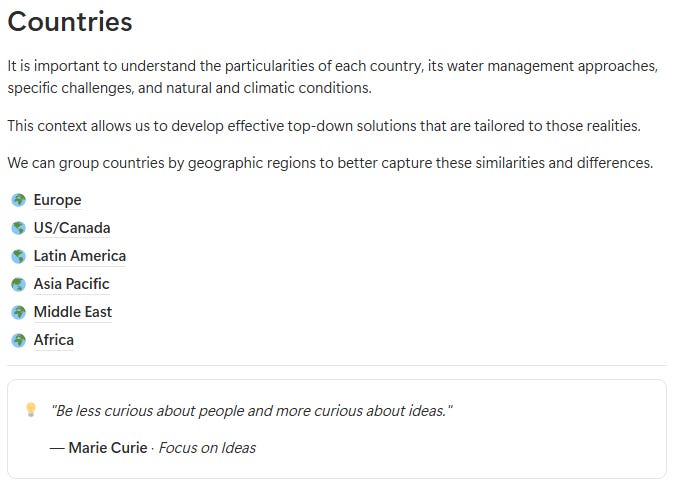
So each page has key data, why water is managed as it is there, main projects, case studies and anecdotes.
There are also cross-links: in Europe, for example, you will find a link to the Corporate Sustainability Reporting Directive, which lives in the corporate water page.
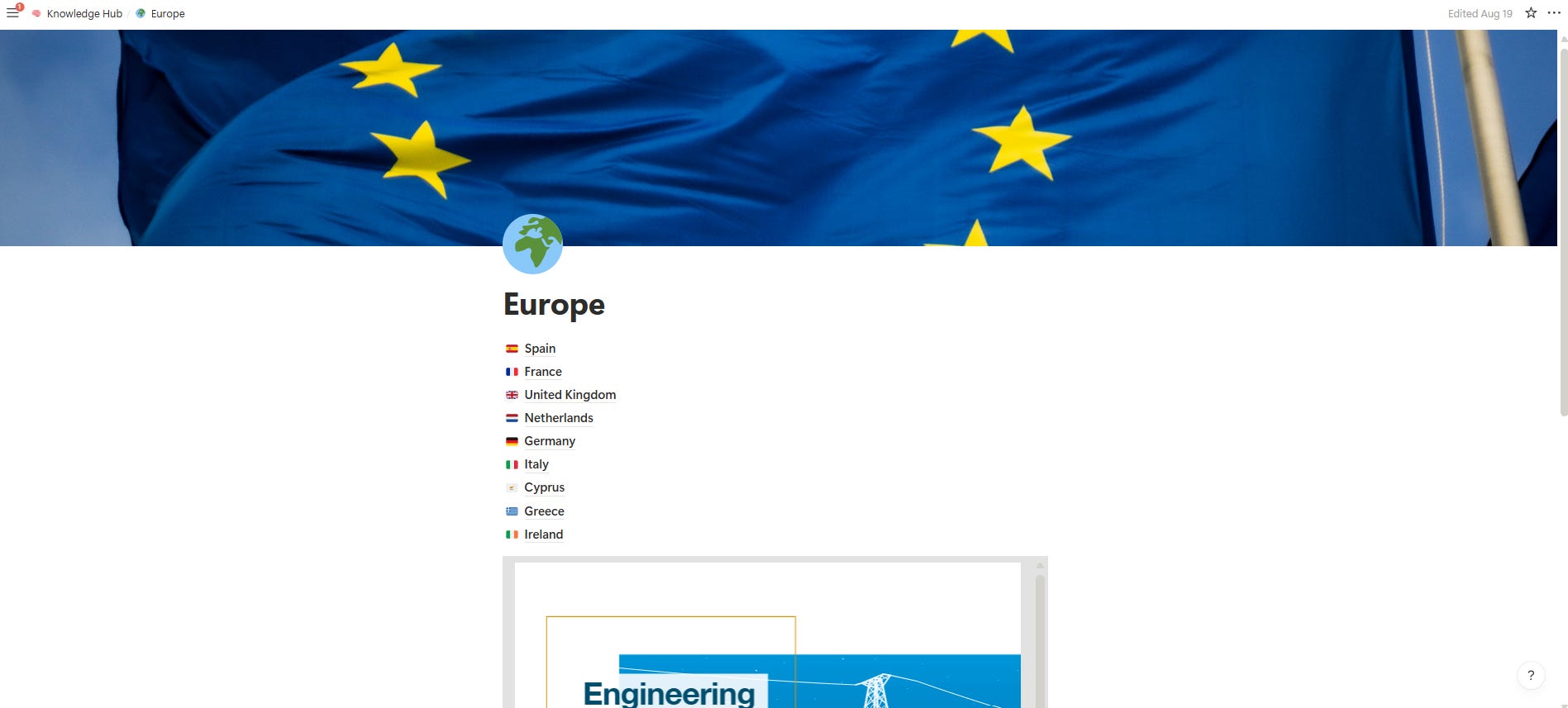
Not all countries are there. I simply haven’t had the time yet.
Events and webinars tracker.
One of my fav. Event name, date, city, country, category and website. And when an event has already taken place, I try to add takeaways — mine if I attended, or from the community and social media if I didn’t.
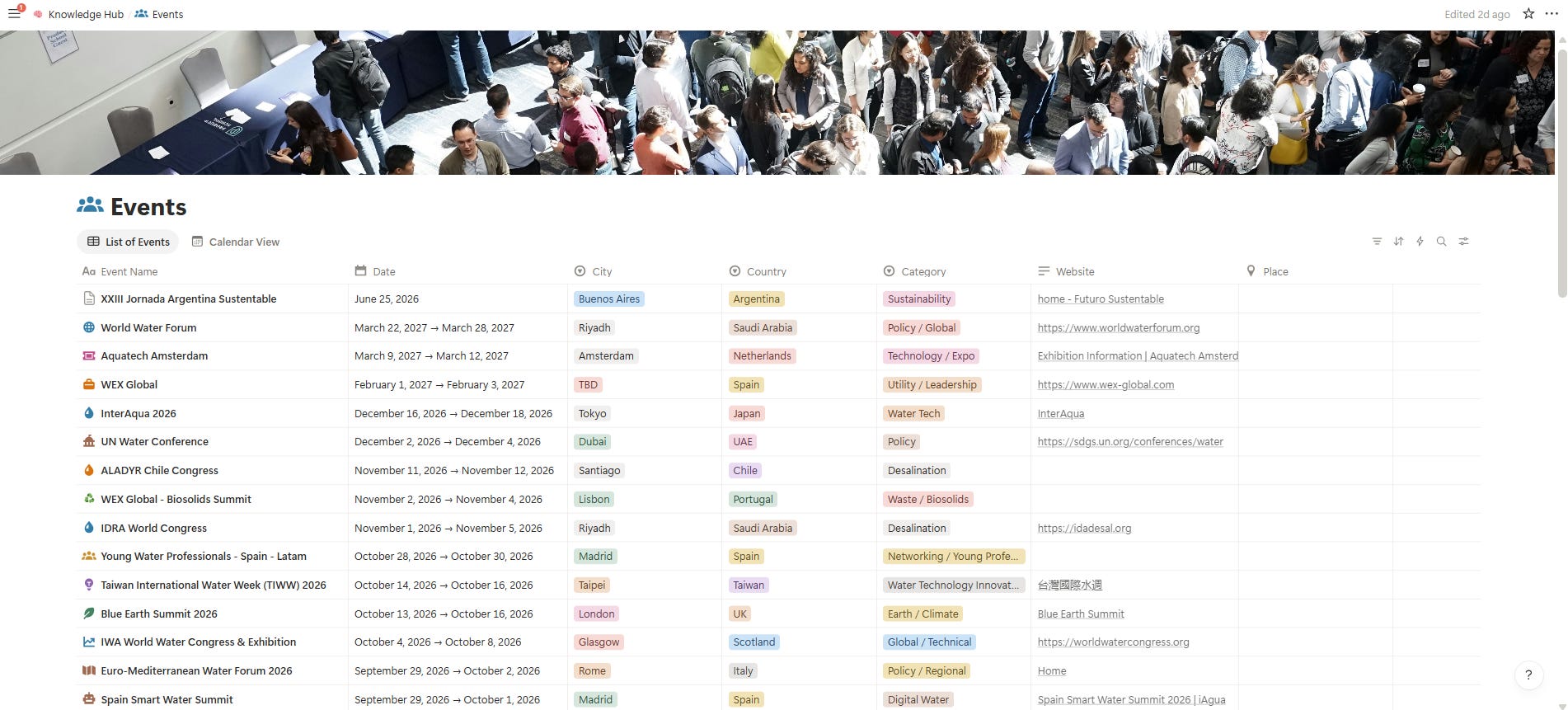
Why? Because too often you find out on LinkedIn that something interesting happened three days ago.
For 2027 I want to expand this a lot, especially with webinars.
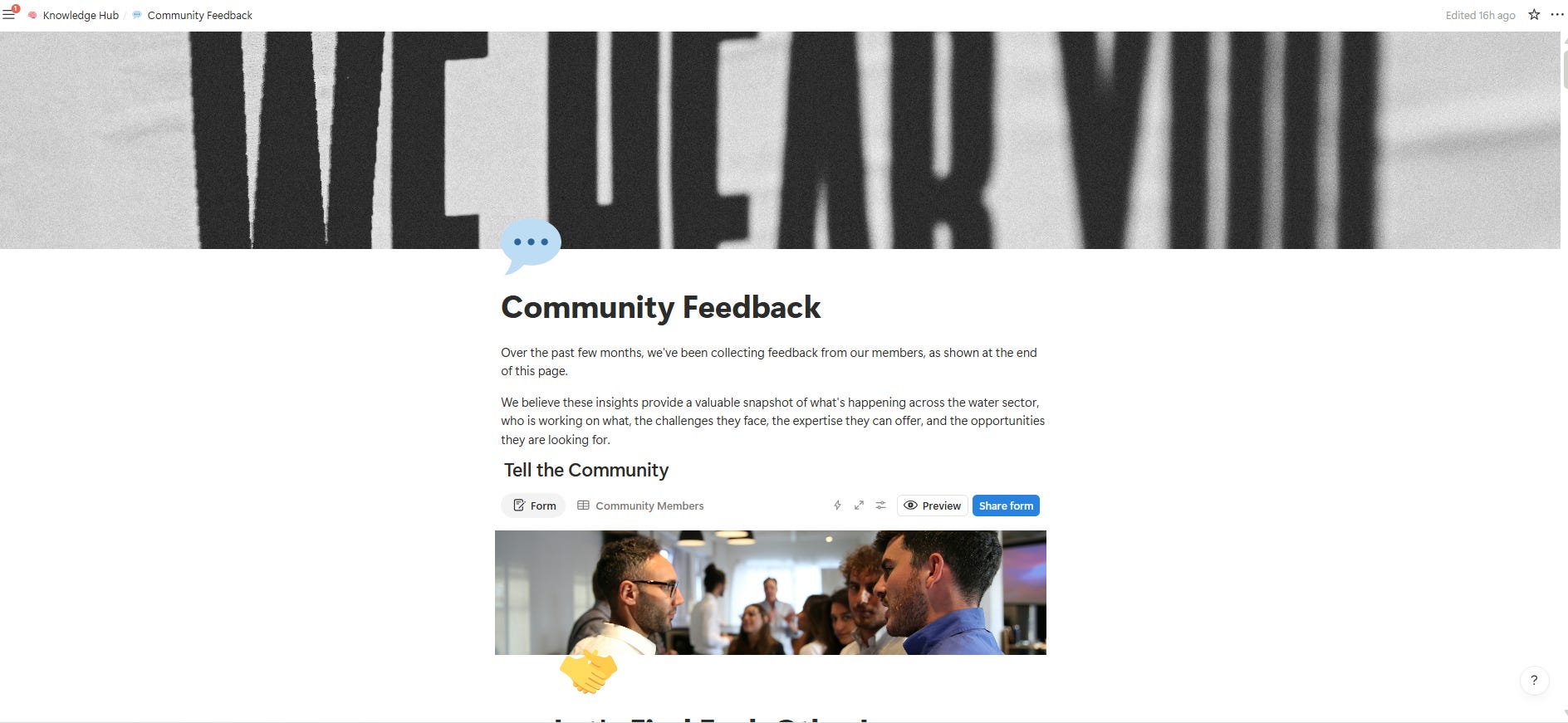
Community feedback.
A place where anyone in the space can leave feedback, publicly or to connect with someone else.
You can also volunteer to be featured on a podcast episode — I’d like to bring at least one community member per month.
This one is not finalised, because I still need to figure out how to make it work automatically.
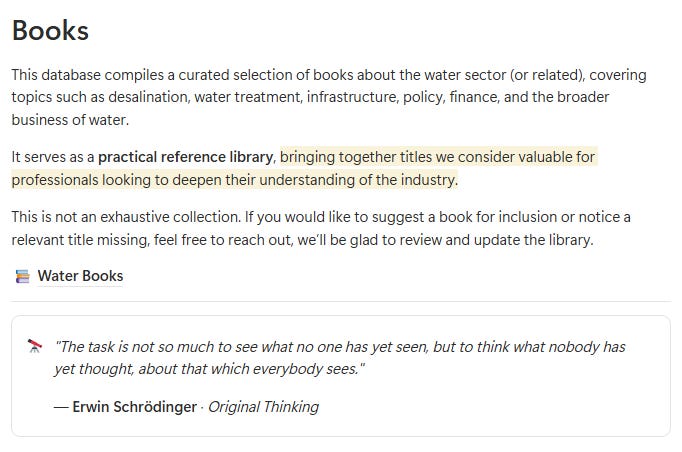
Water books.
Name, author, the fields you’ll learn from it, and a summary. Some I’ve read. Some are simply noted for the future. I still love learning on paper, so this one is for people like me.
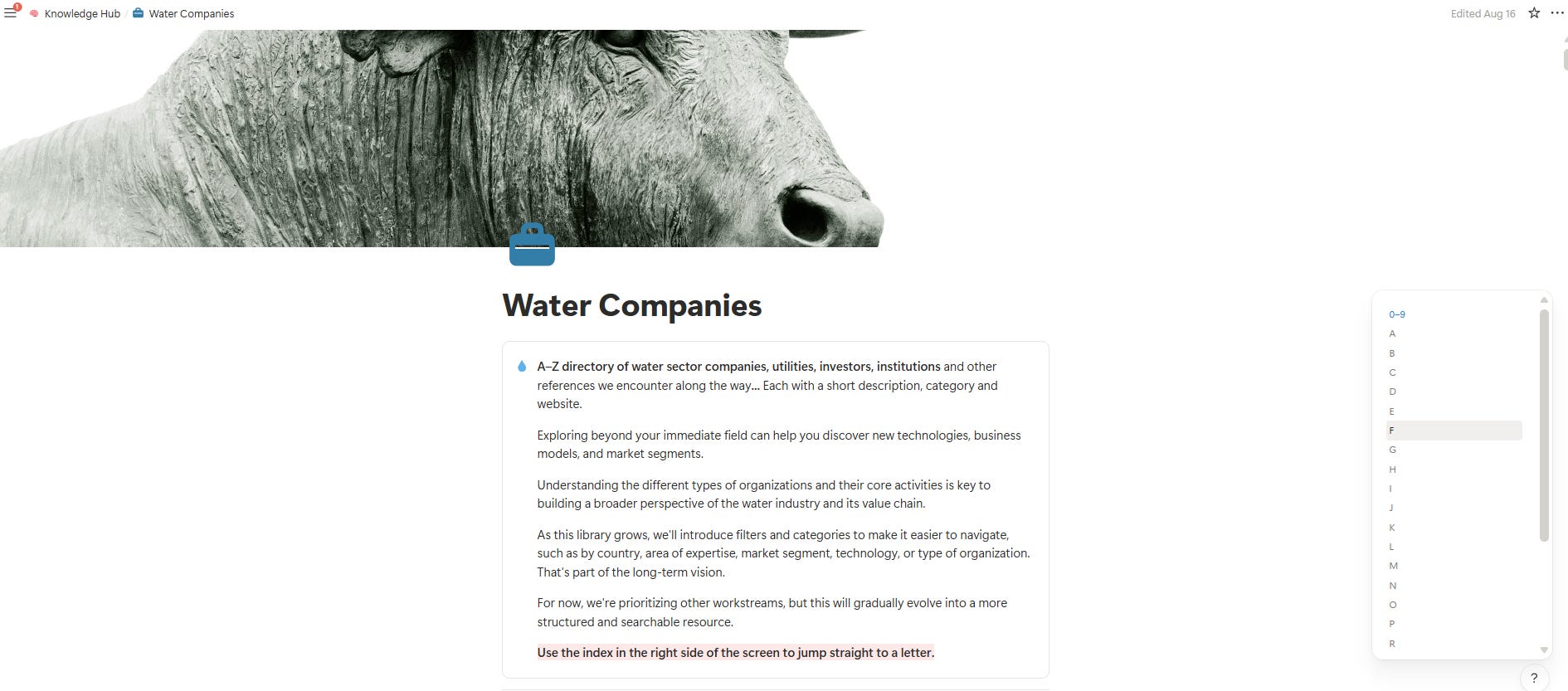
Water companies.
A database of the companies I consider relevant in the water business.
I’m missing hundreds of them, obviously, but every time I come across one I didn’t know, it goes in.
Once a month I scroll through it and pick one to look into properly.
Startups are not here — they have their own database inside the Water Tech and Innovation page, with technology readiness level, funding status, references and the problem they are trying to solve.
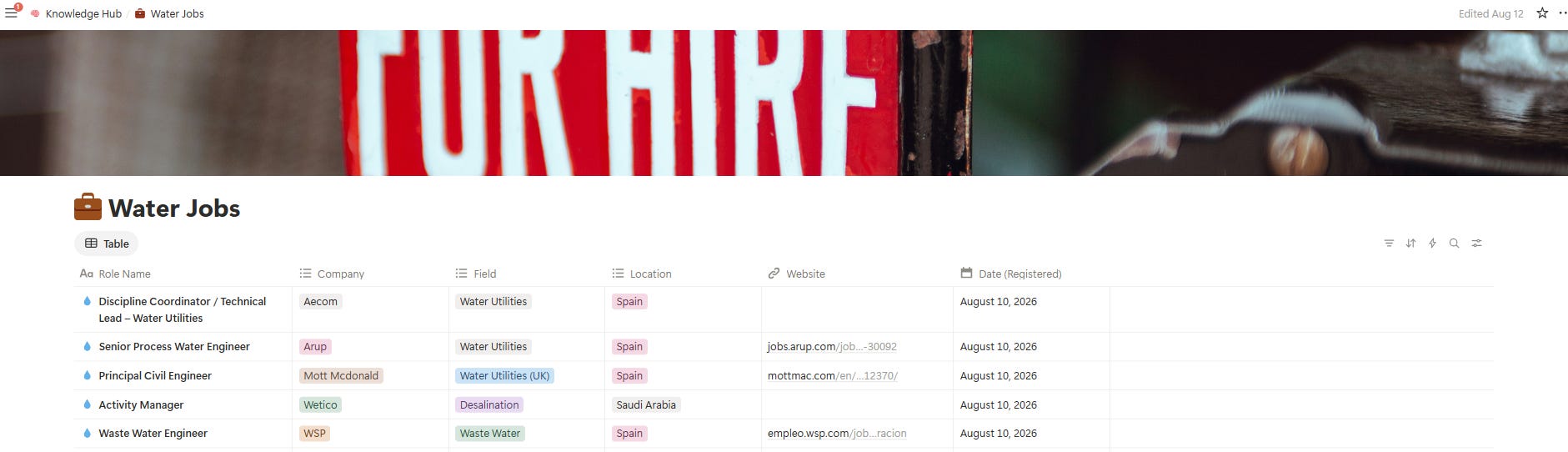
Water jobs.
Role, company, field, location, link, and the date I registered it, so you know how old it is, as I cannot track when those positions are closed.
This is not LinkedIn Jobs and it is not trying to be.
Reading what companies are actually asking for tells you a lot about where the demand is going — and that is strategic information for your own career.
Courses tracker.
What’s coming, organised by field.
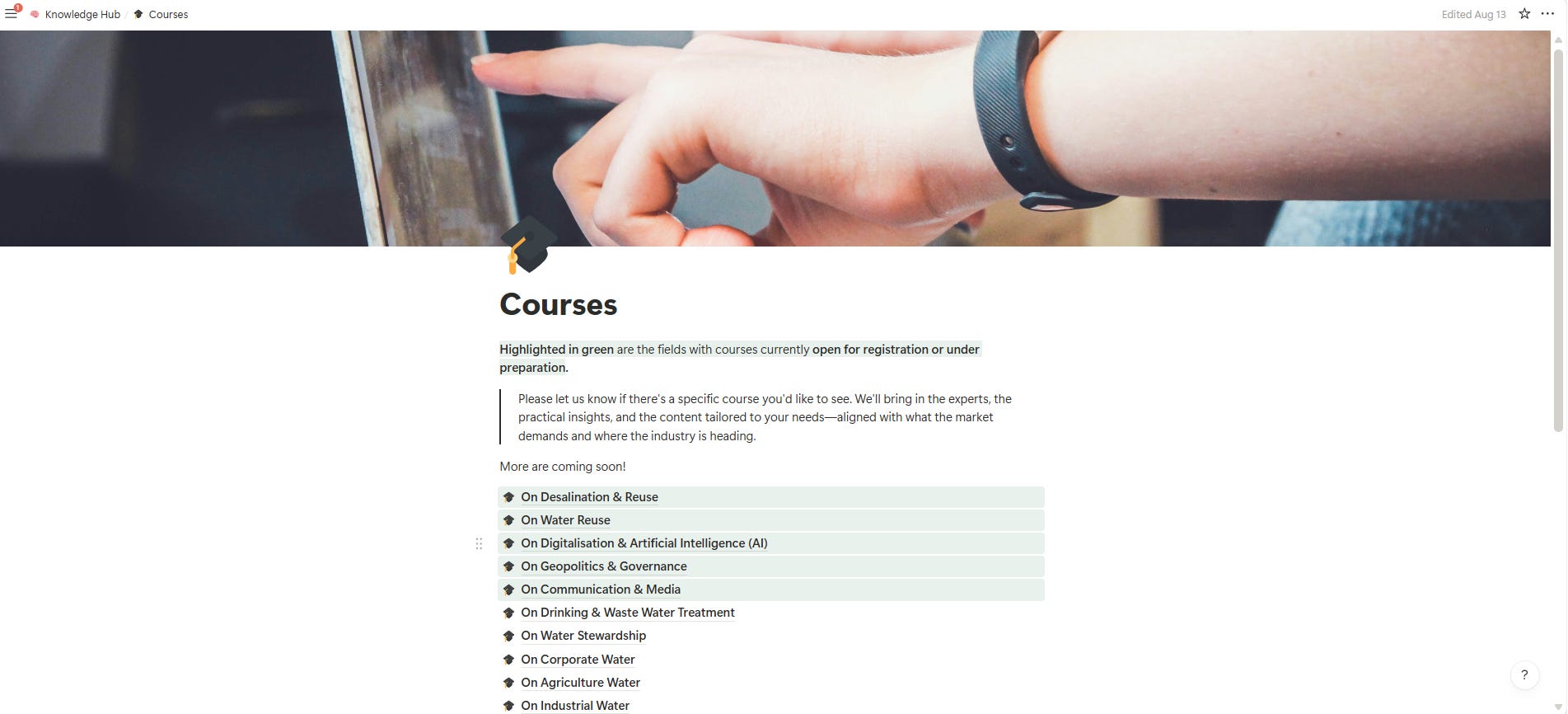
Click on AI and you’ll see the roadmap, starting with Sandro Hansen in a few days.
We are not trying to build an Udemy of water. It is not about quantity.
But this learning framework will become a major source of value creation over the next 3–5 years.
It’s time to build a proper range of courses, experiences and learning opportunities that people can access as another step in their personal and professional transformation.
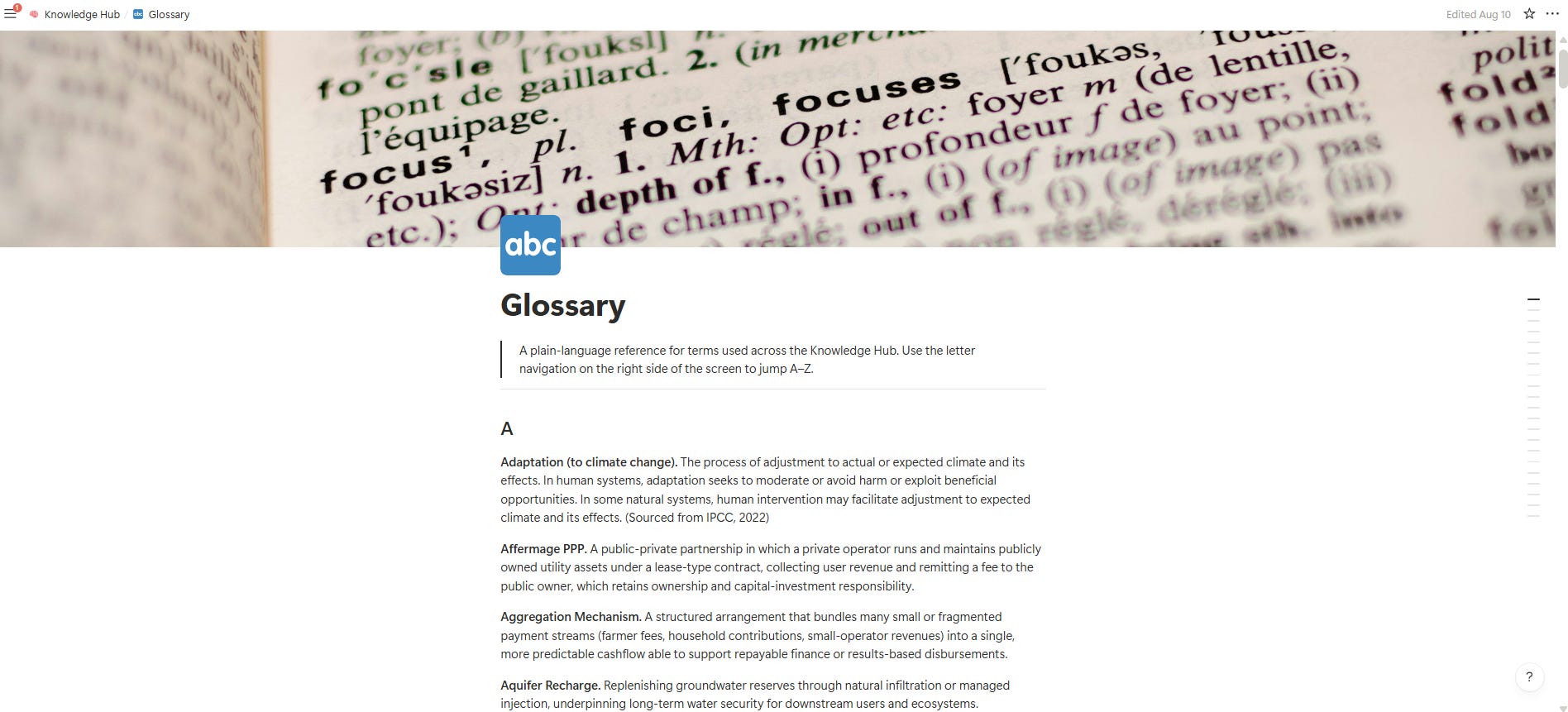
Glossary of terms.
What is a BOT contract, what is a bond,…You won’t use it often, but it’s there.
People I recommend.
Name, field, country, LinkedIn profile and key expertise.
People I’ve worked with or known for a long time and whose judgement I trust.
To be clear, they are not all official instructors of The Water MBA.
Some probably will be. But if I want to learn about any specific field, I know exactly who to call, and I’d rather share that than keep it to myself.
How to access
Check your inbox and open the email you’ll receive.
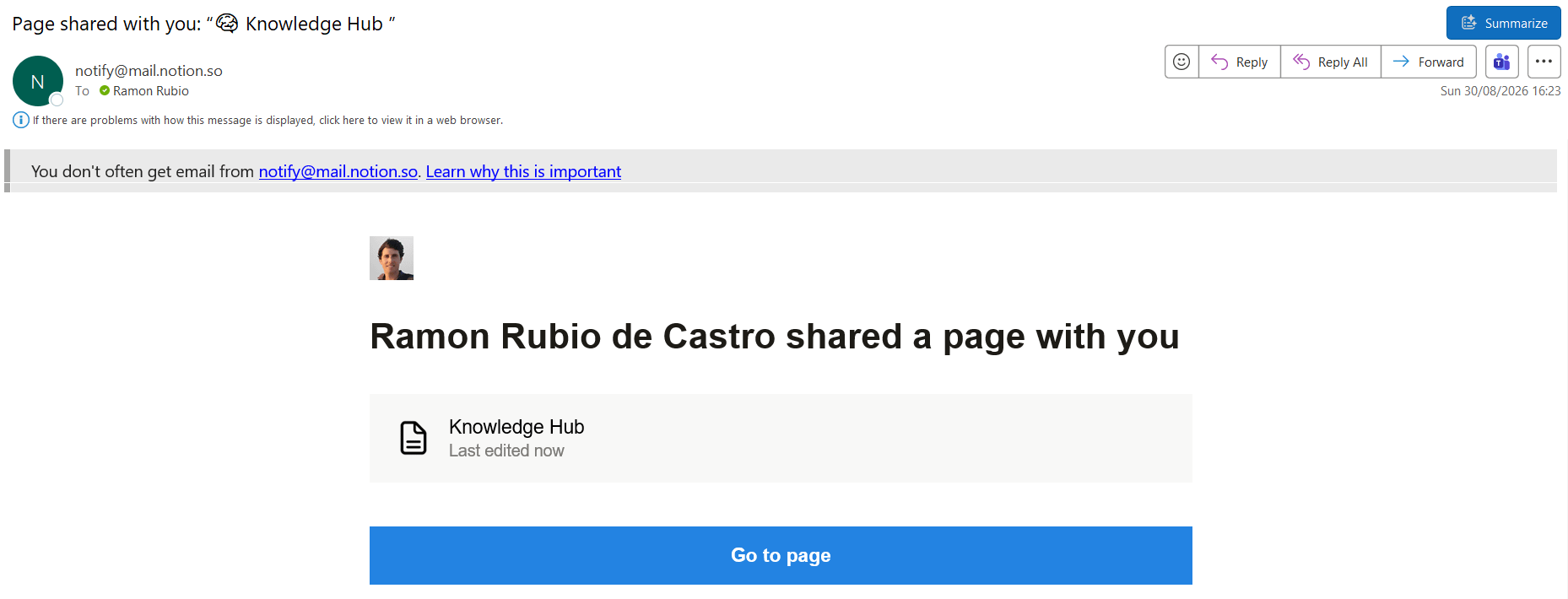
Create your profile in the Notion app. You can use it on your laptop or mobile phone, actually, the mobile experience is pretty good too!
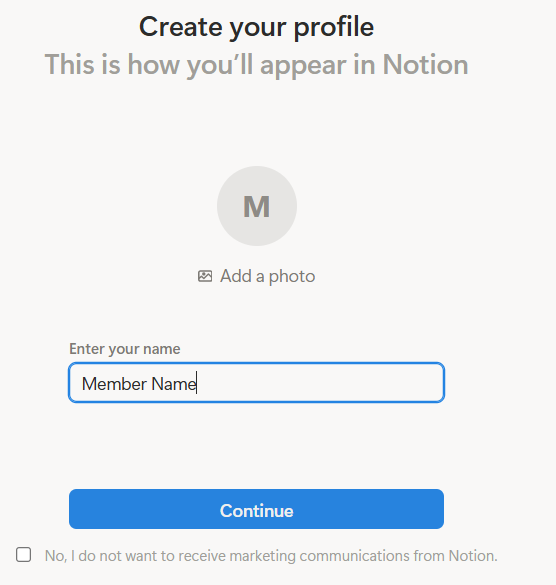
Complete the setup process — it takes less than 1 minute.
Skip creating a workspace when prompted...
Select the Free plan; no paid plan is required…
Go to your homepage.
Open the Knowledge Hub.
If it doesn’t appear directly, go back to the email and click the access link again.
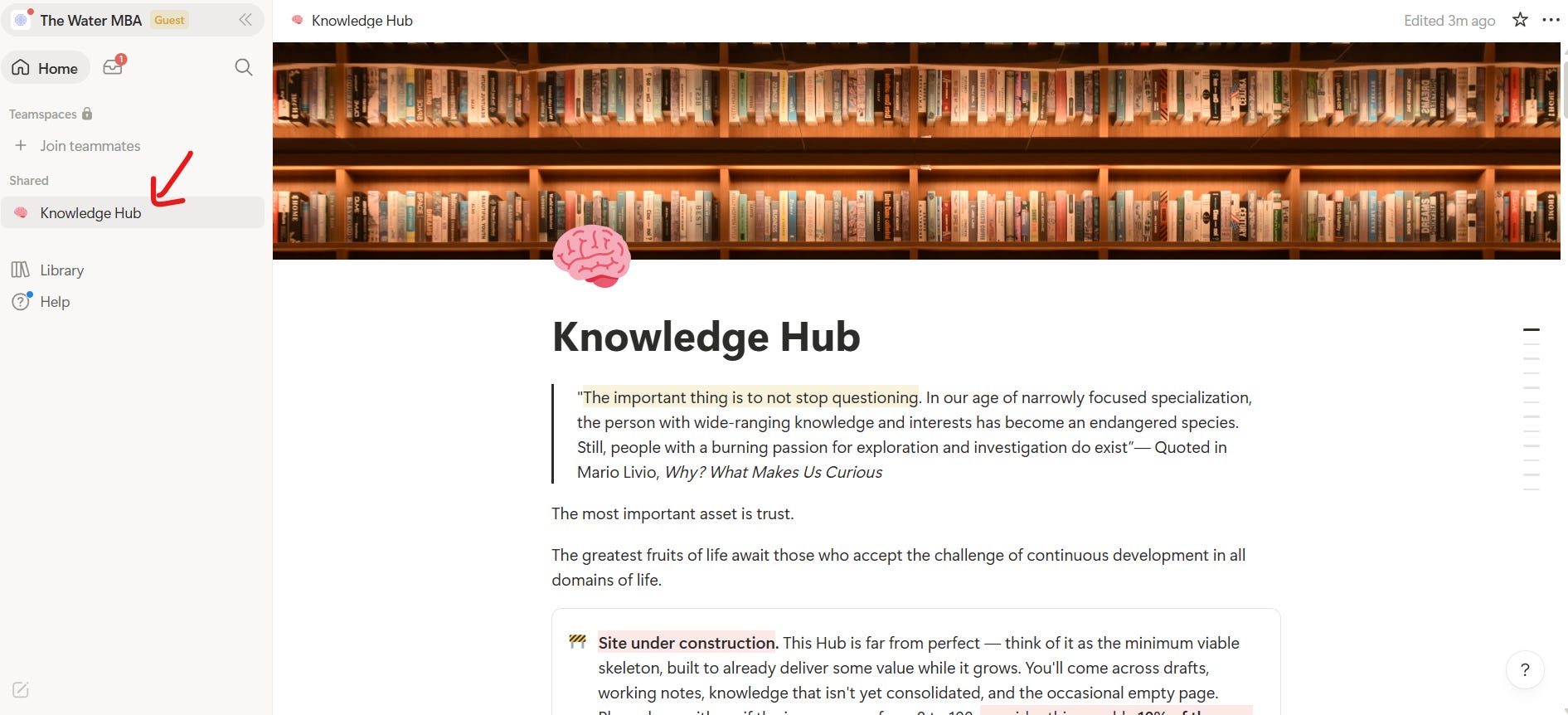
Save the Knowledge Hub as a bookmark/favourite in your browser for direct access.
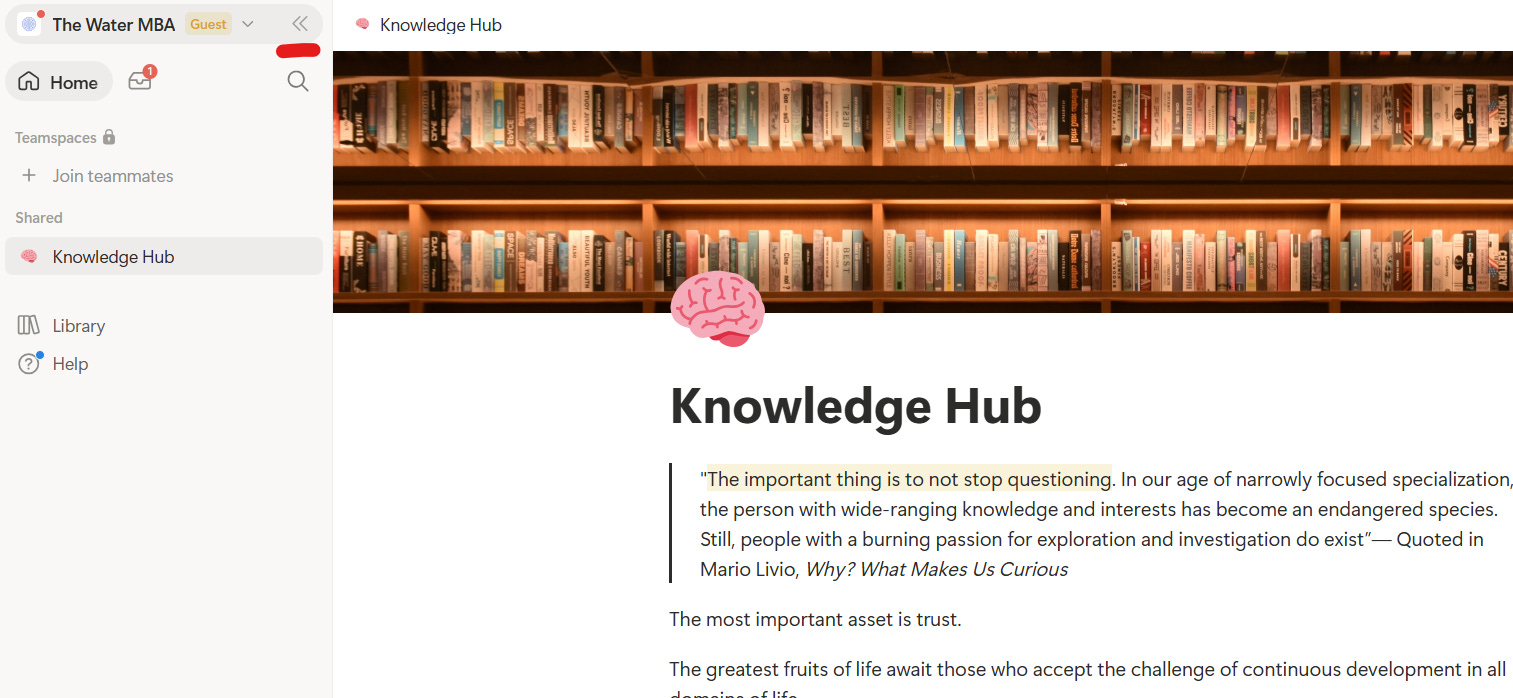
Close the sidebar for a cleaner, better experience.
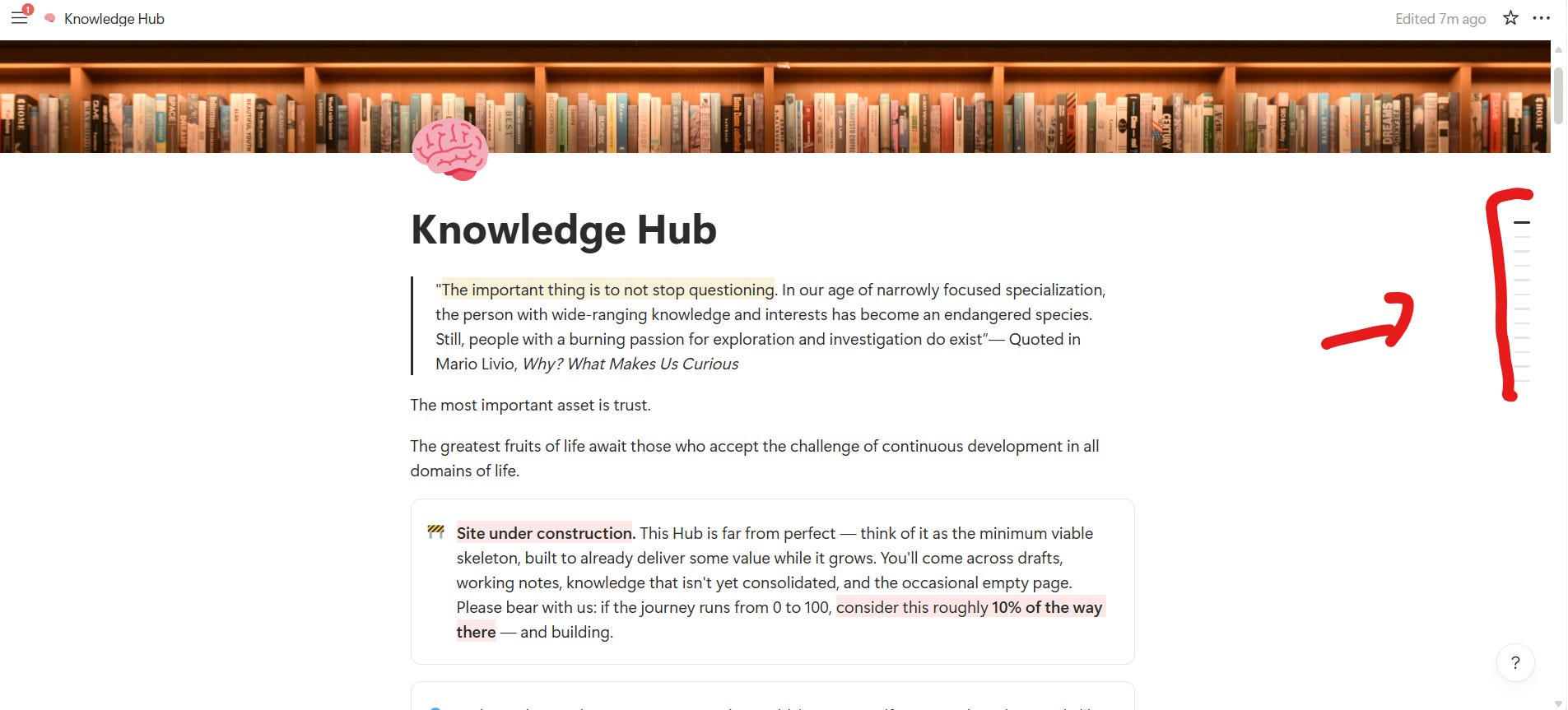
Use the navigation on the right to move between sections.
Scroll down and explore freely through the Knowledge Hub.
One of my favourite ways to use it? The search tool. 🔎
If a word or topic is mentioned anywhere in this water universe, you can search for it and find it instantly.
This is just the foundation. Now the work is to polish and improve it, expand it and keep building the knowledge universe.
Add at least one instructor per field where possible.
Bring real-world business expertise into each area.
Build and refine the learning framework around practical industry reality.
Develop a clearer mental map of the water business as the Hub grows.
Experiment with different formats and gradually consolidate what works best.
The idea is not to have everything perfect from day on, it is to build it, use it, learn from it, and evolve it together.
This is just the beginning.
Of course, I also have other topics very much on my radar: utility transformation, geopolitics, regulation, drinking and waste water treatment, biosolids, emerging contaminants, flood management, financing, water tech, dams, business models…
Hundreds of thousands of utilities around the world, each with their own particularities, that’s quite a field to explore and help with! 😄
So I’ll keep bringing interesting reflections throughout our journey, always looking at the water business from a wide perspective.
I’ll keep progressing as I am now, not too high, not too low.
We know what we have to do, we know how we can help, so let’s just enjoy the journey, day by day.


