

A few weeks ago, our colleagues at Aqua Membranes were named finalists for the EDS Miriam Balaban Innovation Award.
Among the finalists was also one of our community members, Alexander from SeaQual, who ultimately won the award, you’ll get to know him soon…!
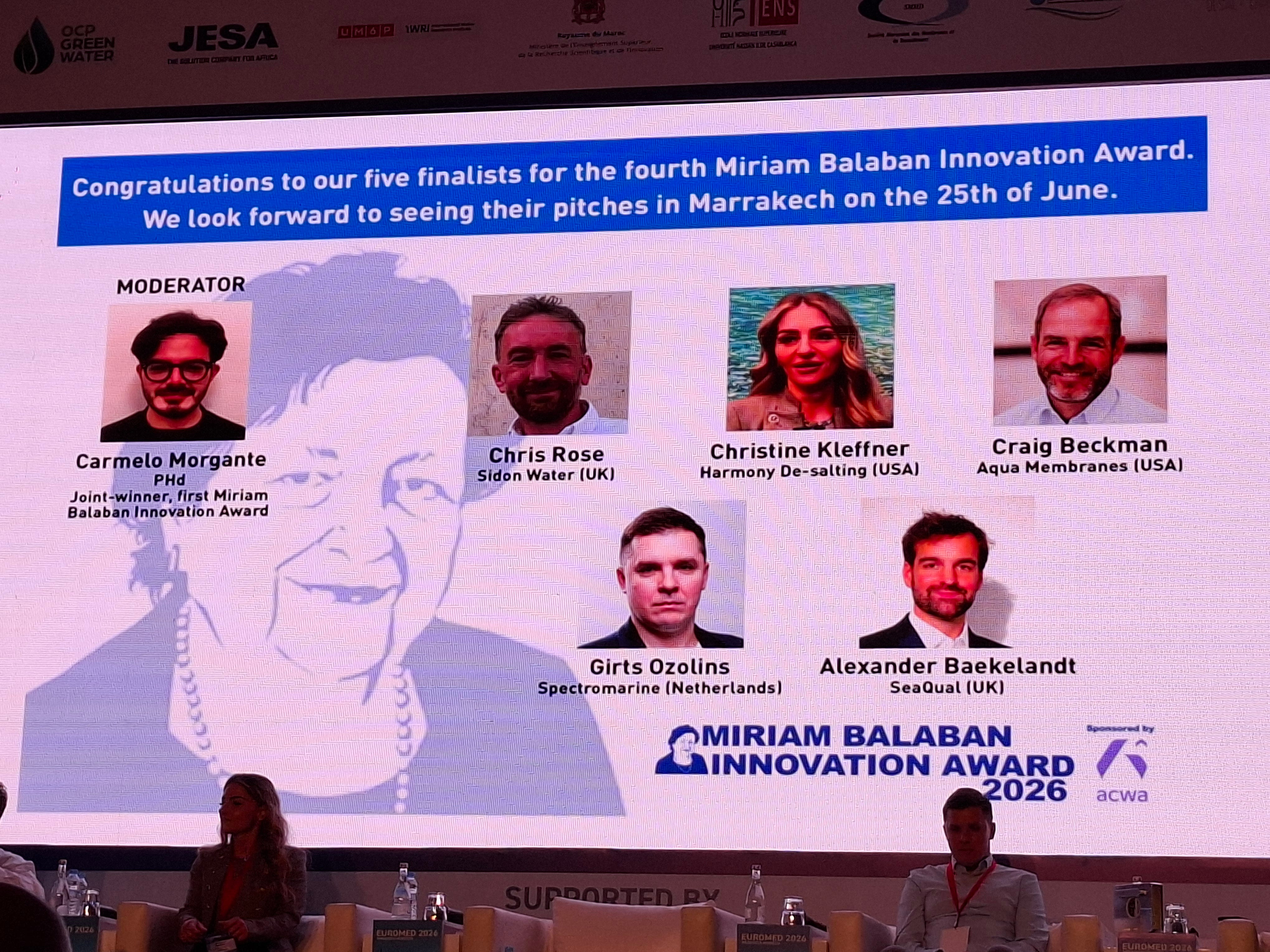
I had the chance to meet Craig in person and talk with him.
As usual, Craig performed a great pitch.
In one of the questions share to all candidates, he replied something interesting…
He mentioned on stage that one of their key current challenges was the chicken-and-egg problem
This is one of the best analogies for why innovation often struggles to scale, as I explain later.
A few months ago, this workshop was shared within our community in the old format, so I take the opportunity to share above now fully open.
One of our fellow members, Guadalupe, asked me if this innovation is deployed in seawater, beyond the brackish water and Craig told me on Marrakech they are working on it and we may see soon results.
This member also shared with me a video in which one of the most experienced professionals in this field makes a reference to Aqua Membranes, explaining that 3D printed spacers once consolidated may mean the new frontier, dissapearing probably the current mesh spacing.
I share the link at the end of the essay in case you wanna watch.
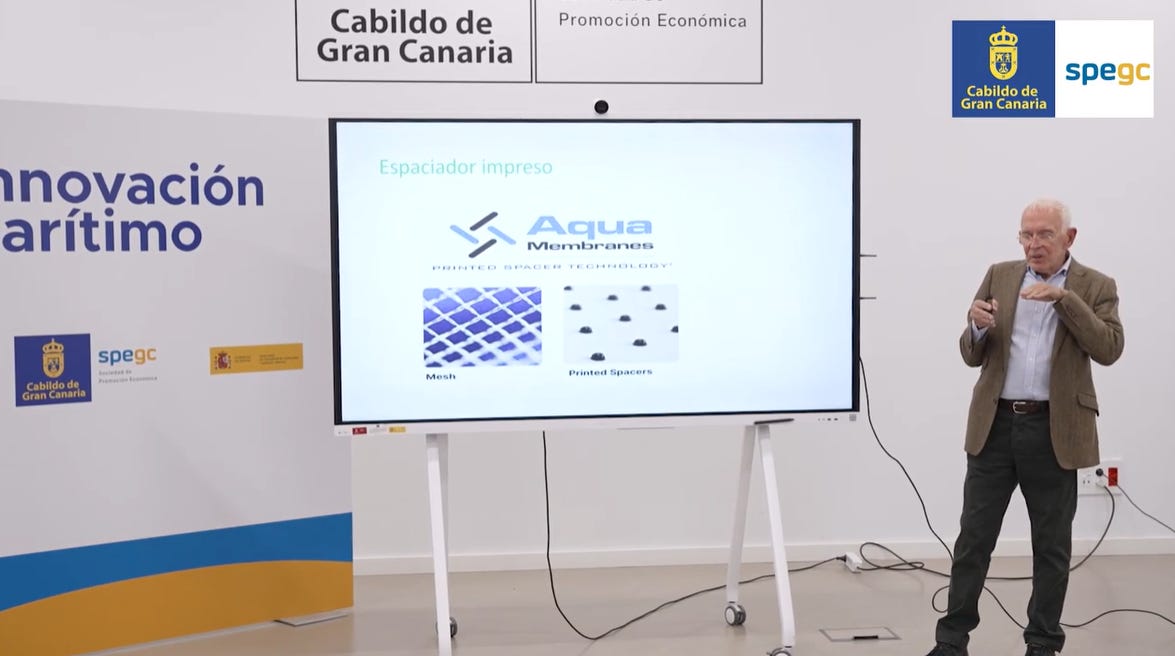
So I think it is a good timing for many of you to take a look and share your thoughts or questions through our networking chat.
Chicken egg problem mentioned by Craig
Here’s the cycle:
Customers say: “We’ll buy it once it has been proven elsewhere.”
Investors say: “We’ll invest once customers start buying it.”
Partners say: “We’ll support it once there’s funding.”
Regulators say: “We’ll adapt once the technology is deployed.”
Everyone is waiting for someone else to move first.
The result is a classic coordination failure. The technology may be technically superior, but adoption stalls because each stakeholder minimizes their own risk.
This is particularly visible in the water sector. Without someone willing to absorb the first risk, nothing happens.
This is why many breakthrough technologies lose because they never escape the first few deployments.
A useful way to frame it is:
Innovation rarely fails because of technology. It fails because trust arrives too late.
Or:
Everyone wants proof before committing. But proof only exists after someone commits.
The companies that eventually scale usually solve this paradox by finding a stakeholder willing to break the loop:
an early adopter willing to take calculated risk,
a government providing demonstration funding,
an investor betting on potential instead of traction,
or a visionary customer who values first-mover advantage.
In many ways, scaling innovation is about orchestrating trust.
Probably many of you are facing this, have already overcome it, or have witnessed many startups and great initiatives tackling the same challenge.
I’d love to hear your thoughts in the comments, or just send me a message so we can keep track of practical actions and share them with more members.
What they actually do
Aqua Membranes does not manufacture the membrane.
They buy commodity flat sheet from DuPont, LG Chem, Toray, Nitto Denko — and then compete with those same companies for the end-user sale.
It’s one of those strange supplier-competitor relationships that only exist in industries where one layer has been perfected and another has been ignored.
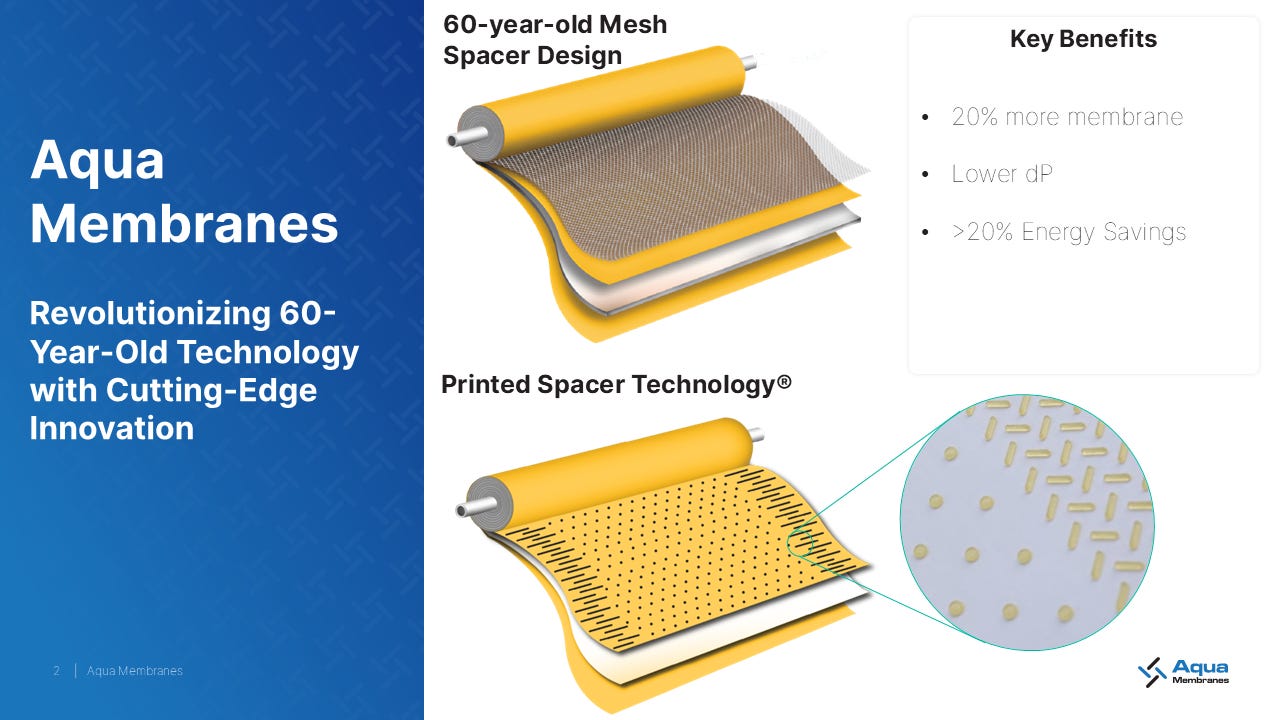
The layer they attack is the feed spacer: the extruded polypropylene mesh that sits between the membrane wraps and channels water across the membrane surface.
In a standard element it’s just that, mesh.
They rips it out and, using an additive manufacturing process, prints a pattern directly onto the membrane surface instead.
When the element is rolled into its final form, that printed geometry decides how the water travels down its length: with a designed level of turbulence and mixing, and not a joule more than needed.
That’s it.
The flat-sheet membrane, he said, has been engineered close to its theoretical limits over thirty or forty years — rejection, flux, fouling resistance, all of it.
But how you flow water over that membrane has never really been improved.
Think about what that means.
For four decades the industry poured its optimization energy into the glamorous layer — the one with the physics and the Nobel-adjacent chemistry — and left the plumbing as a piece of extruded plastic nobody had rethought since the beginning.
If you want to find the next step change in a mature process, don’t stare at the component that’s already been polished a thousand times. You may look at the boring part next to it.
The superpower
They put more membrane area in every element — 505 square feet where the standard is 400 — and runs it at lower operating pressure.
Every process engineer I know would tell you that’s impossible.
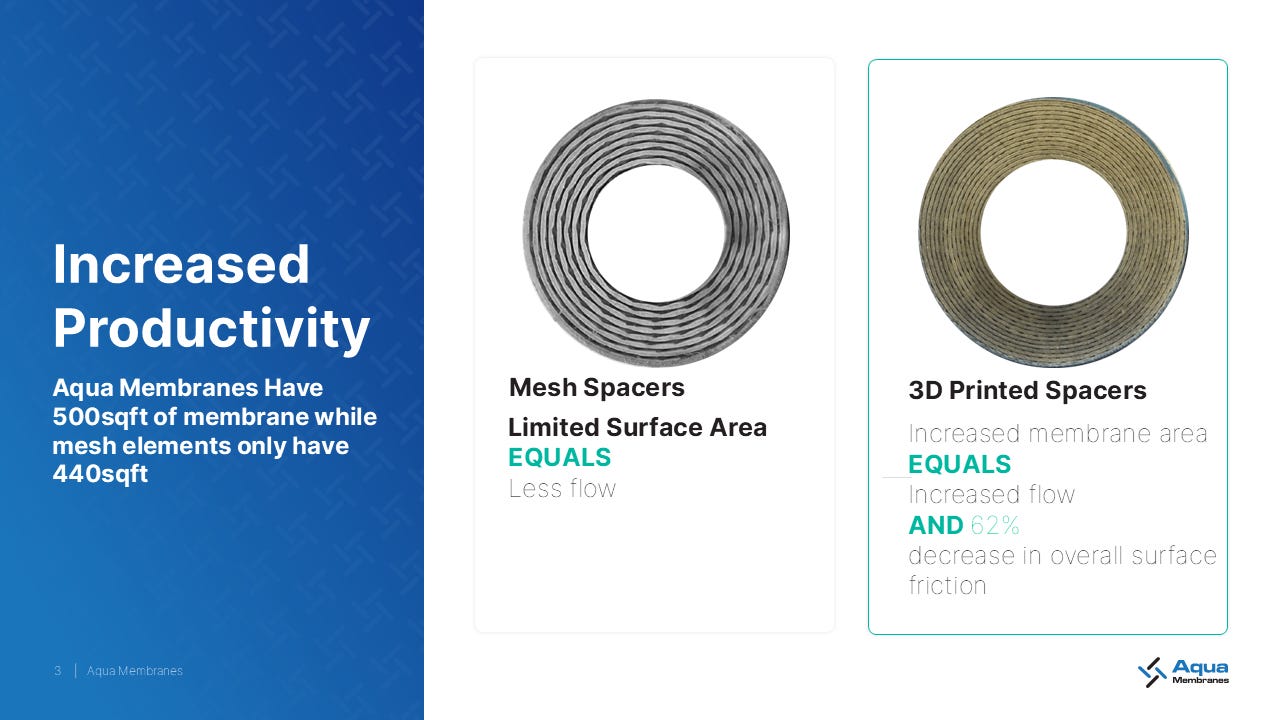
More membrane in the same shell means a tighter channel, and a tighter channel means more pressure drop and more energy.
And they’d be right — if the channel geometry were fixed. It isn’t.
Once you can design the flow path, you can decouple area from energy cost. That decoupling is the entire trick.
The numbers back it up.
In a two-train installation at a Micron fab, they pulled membranes from both sides at the same time back in April 2023 and have been running the comparison ever since.
Their side draws meaningfully less pressure than the competitor’s meshed element, up to a 29% energy reduction at the top end — which is essentially the theoretical floor of the process.
The differential pressure across the system tells the same story: it starts far lower, and where the competitor’s line climbs as the elements scale, theirs stays flat.
Less scaling, fewer cleanings, fewer chemicals discharged.
The kind of secondary benefit that shows up on nobody’s spec sheet and everybody’s operating budget.
A reality check for those of us in desal
That 29% is the ceiling, and it lives in high-pressure industrial reuse.
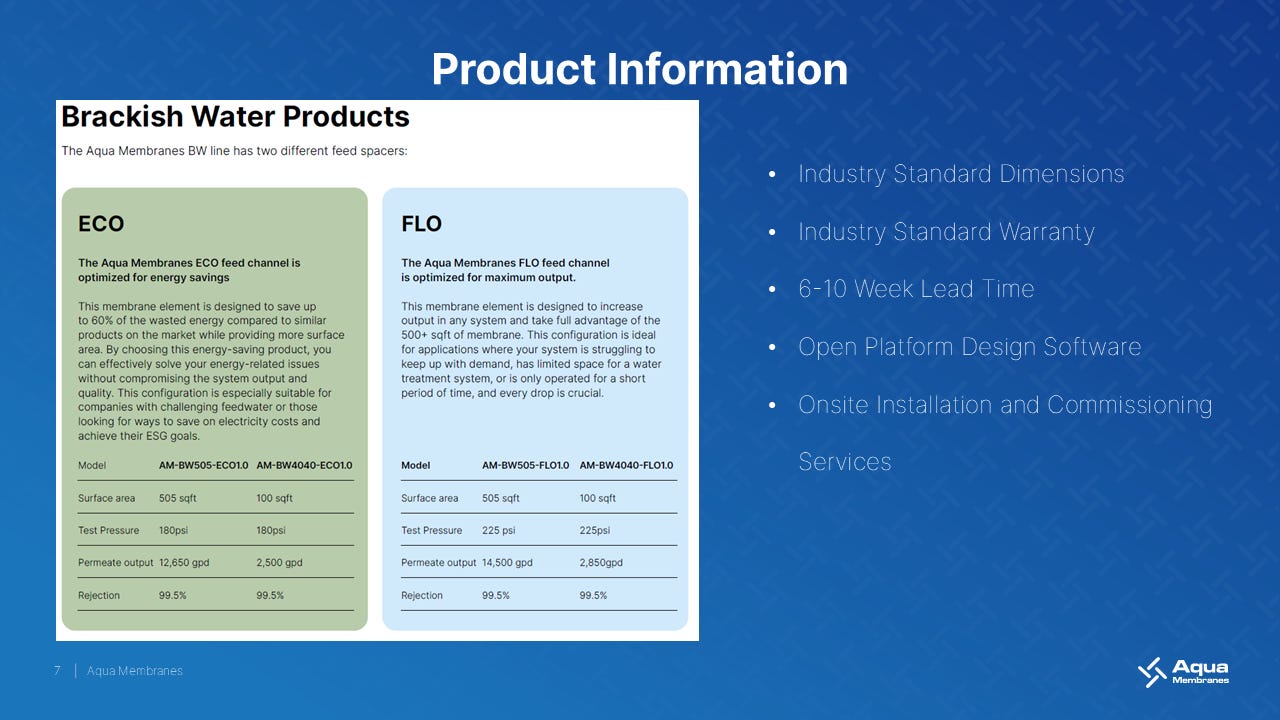
In seawater desalination the honest number is 4 to 5%, because we’ve already squeezed the process to the bone with energy recovery devices and high-efficiency pumps.
But anyone who listened to our episode with Rolando Bosleman fom energy recovery (below), knows exactly what 4 to 5% means at scale.
We fought for years to break 3 kWh/m³.
We win and lose contracts on half-percentages, because a fraction of a point on a plant that runs for 25 years is millions of dollars — money that ultimately belongs to everyone connected to that network.
A component that looks incremental in isolation but moves the entire market, because of where it sits and how much water flows through it.
The uncomfortable part
Their elements cost more. More area, a harder manufacturing process — of course they cost more upfront.
And the EPC reflex, the one our procurement processes are built to reward, is to optimize the purchase price.
Craig put the counterargument plainly: a membrane element in a high-pressure application will consume four to five times its purchase price in electricity over its life.
Fighting over twenty or fifty dollars on the buy while ignoring the lifecycle bill is not shrewd procurement. It’s the wrong mental model, applied rigorously.
We win on capex and on guarantees. The party carrying the 25-year O&M responsibility is the one with a real incentive to try something like this — and that party is usually not the one submitting the lowest-capex bid.
This is the same misalignment I keep circling back to in almost everything I write: the value is real, but it lands on a different line of a different party’s ledger than the one making the decision.
It’s a contract-structure problem, and it belongs to us.
Why the retrofit model
Their entry point is an existing plant at the end of its membrane life — the moment the replacement budget already exists.
Same housings, swap the elements, adjust setpoints that can be reverted.
If you don’t like it, put the old membranes back at the next cycle. No hardware changes, nothing burned, nothing you can’t undo.
Compare that to every innovation that dies in pilot purgatory because trialing it means going all-in with no way back.
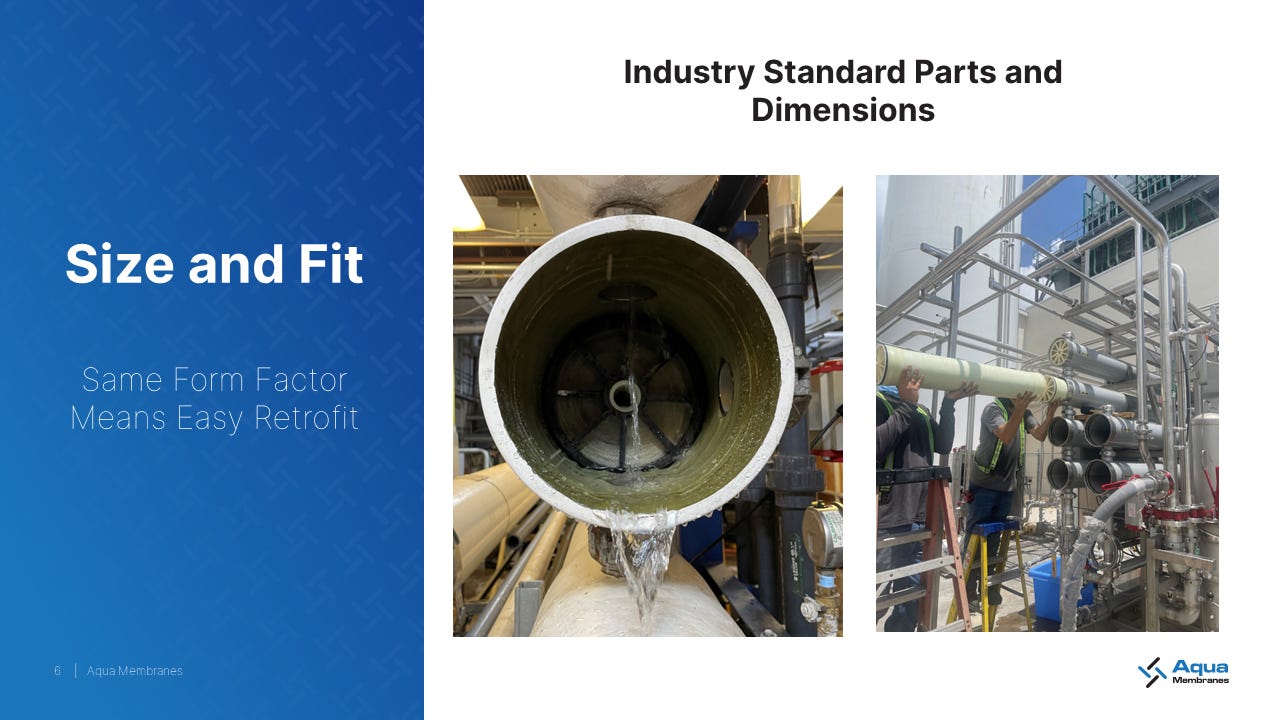
The New Mexico power plant Craig described makes the point: a 15-year-old high-purity system stuck in a basement they couldn’t fit a new unit into, suddenly needing more output to supply steam to a local hospital.
They retrofitted more active area into the same footprint, got roughly 30% more water out of it, and ran a full year without a single cleaning.
The part that made me think
The printed pattern is digital. You upload an image; you print it.
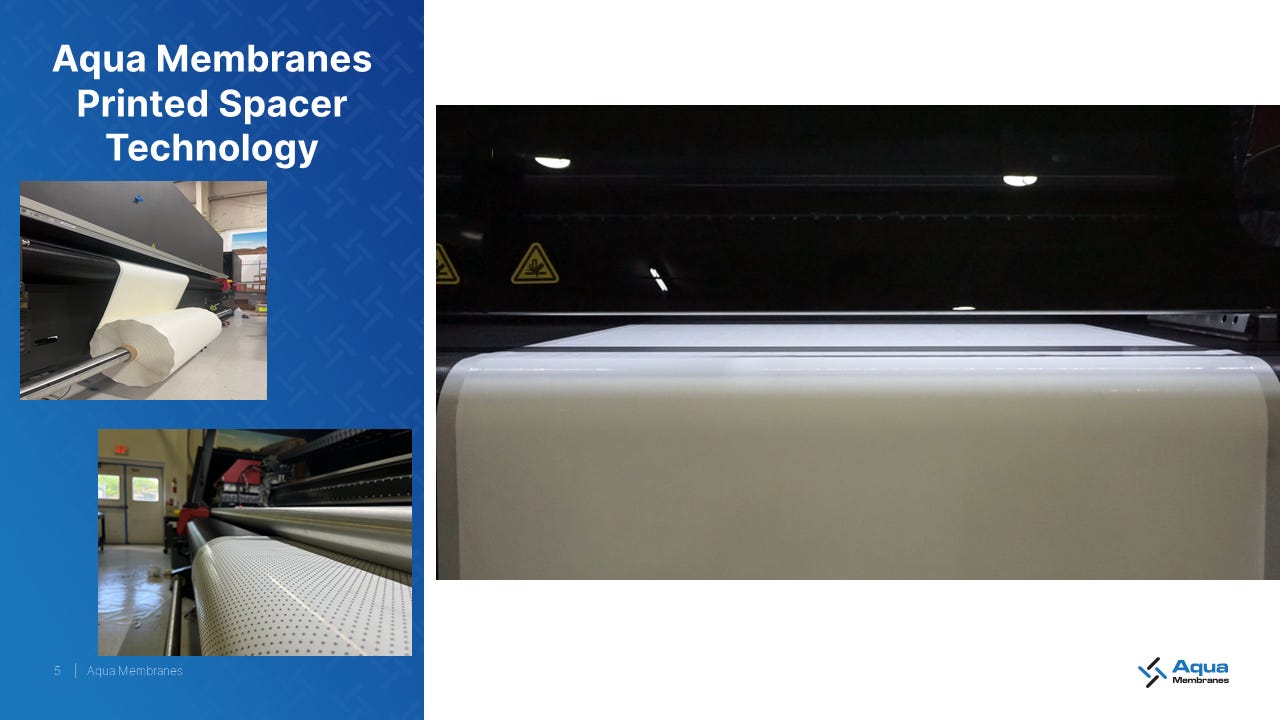
Behind it sits CFD modeling and machine learning trading off exactly the mixing you need against the energy you waste getting it — marshmallow, column, barbell, triangle, aspect ratio after aspect ratio.
Today it’s a couple dozen installations. Craig sees hundreds, then thousands, each streaming back feedwater chemistry, temperatures, pressures.
Once that dataset is big enough for AI to chew on, the pattern stops being a fixed product and becomes something you tune.
A different geometry for a mine in Argentina than for a fab in Austin. Bespoke membrane elements.
The membrane element as configurable software you happen to print onto plastic.
Where the trick is
So I’ll go back to my office and ask my commissioning guys where the catch is.
Half the problem, he admitted, is just getting people to pay attention for thirty minutes.
He’s right, and it’s the entire reason this community exists. The best design in the world dies in obscurity if nobody sits still long enough to understand it.
When they finally do, the reaction is always the same: oh — that makes sense.
It’s an old layer nobody bothered to optimize, printed instead of extruded, sold into the replacement cycle at almost no risk.
I’d rather try it than assume it’s too good to be true. So far, Craig tells me, nobody has sent the membranes back.
Here the video I mentioned at the beginning:
A few quotes as usual
On landing in water
“I often tell people I ended up in the water business kind of by mistake. But I’ve loved it, because the water business is kind of every business — it literally drives economies.”
On complexity
“One of our CEOs came over from the aircraft engine business assuming water would be simpler. After a couple of months he said, my gosh, water is so much more complex — in jet engines you have fuel and air, that’s it. In water you have countless inputs and outputs to manage.”
On the layer nobody optimized
“The membrane’s been engineered close to its theoretical limits over the last thirty, forty years. But how you take that membrane and put water over it and through it has never really been improved.”
On the superpower
“This is our superpower: we put more area in every membrane element and lower its operating cost — because we can engineer that flow channel.”
On ‘too good to be true’
“People say that’s too good to be true, it doesn’t pass a reasonability test. So we just point at our installations and say — if you don’t believe us, try it. If it doesn’t work, we’ll take them back. We haven’t taken any back yet.”
On desalination
“You’re not going to get anywhere near 29% in seawater desal — it’s already so optimized. We’ll be happy with four to five percent. But that’s a really big number for people who design and build seawater plants. They’re engineering for half a percent.”
On small percentages (the ERI lesson)
“A small percentage, especially in big design plants, can play a huge difference.”
— Ramón
On lifecycle cost
“This isn’t about lowering cost. It’s about improving performance and lowering lifecycle cost. Over an eight-year life, that membrane element consumes four to five times in electricity what you paid for it upfront. Trying to save twenty or fifty dollars on the buy is not how you should be thinking.”
On putting everything on the table
“Everything has to be on the table, big or small — because a benefit is a benefit.”
— Ramón
On low-risk adoption
“We don’t change anything on the existing system. If you want to go back to what you used before, just take ours out next time and put the others back in again.”
On what Micron said
“You made the same quality, the same quantity, and saved us enormous energy.”
— quoting the customer
On bespoke membranes
“We’ve started to use the term bespoke membrane elements. How many patterns can we make? It’s infinite — it’s digital. We literally upload an image and print it down.”
On AI and data
“We don’t have a big dataset yet for AI to chew on. But as soon as we do, we see some interesting opportunities to iterate and optimize those patterns with big data.”
On the ERI parallel
“I love that energy recovery idea. And I think we’re right on the heels of that next big step change — the one that gets really close to the theoretical limit.”
On the real bottleneck
“Half of the problem is just getting people’s attention. When they actually sit down and understand what it is, they’re like — oh yeah, that makes sense.”
On the mission
“Our vision is to become the standard. Even though we’re still a small player in a big industry — we want to become the standard, because it’s just a better design.


