I’m back from a highly intense week in Marrakech at EuroMed 2026, an insane event with a deep focus on innovation, water tech, desalination, and reuse.
A lot of you in our community have been reaching out as startup founders. With your recent influx of queries and feedback, I can feel how challenging the journey is.
To support this, I’m organizing a joint session with a few of you to spotlight your initiatives, visions, struggles, and current needs with our broader audience.
I’m also adding these to our knowledge hub to keep track of compelling projects moving forward (though we aren’t trying to become a dedicated tech hub).
With so many of you looking up to Paul as a global benchmark for water innovation, this feels like the right time to reshare this conversation. I know it will inspire you.
Beyond that, remember you can always lean on the BlueTech Research team for your specific cases and gain some actionable intelligence. They have an amazing crew (links at the end of the essay), who are exactly the kind of professionals you want in your corner.
I’m also sharing a couple of interesting job openings BlueTech posted a few weeks back. Check them out if you’re looking for your next step!
I recently came across an email from David Serna, and I loved his approach of compiling a section with his favourite ideas from a conversation. So, I have adopted a similar format for this case and included it at the end of the essay. I feel it is also a great way to reflect on and capture the essence of our episodes, especially for those who may want to dive deeper into the full video, which is available above as usual.
Every person in water has a water story
Paul O’Callaghan’s begins on a small island off the coast of Cork, where he swam in a body of water clean enough to build rafts on, until, in the mid-1980s, it wasn’t.
Ireland had no wastewater treatment to speak of, and a kid who had grown up trusting that water decided to do something about it.
That instinct took him through the rainforests of Malaysia with a machete and a botanist (I was thinking of generating an AI picture about this, but I’ll leave it to your imagination ;), into a biochemistry degree, and eventually into the greenhouse of a Body Shop wastewater plant, where a “living machine” of plants treated the runoff of shampoos and body washes.
He still remembers the smell. Earthy, sulfurous, perfumed. He calls it the alchemy of water, and says he never fell out from under its spell.
I bring up the origin story because it explains everything that follows.
The founder of BlueTech Research is, before anything else, a practitioner who climbed down into the tanks.
And when a practitioner spends two decades watching water technologies try to make it from a jar on a lab bench to a line item in an EPC contract, he learns something the rest of us need to hear: there are no shortcuts. There are only fewer mistakes.
The S-curve nobody can cheat
Ask Paul how long it takes to commercialise a water technology and he walks you through the stages with the patience of someone who has watched it happen a hundred times, and I learnt in detail in his latest book that I absolutely loved.
It starts with someone in a lab, a small jar, a test, a measurement.
Then comes the rig — a few lengths of PVC pipe and some valves — taken out to be tested in real-world conditions.
That alone can eat two or three years before usable data comes back.
Then you build a full-scale unit. Then another.
By roughly the third full-scale installation, you’re finally ready to standardise; generation four is usually the one that works the way the brochure promised.
He likes the builder’s proverb: the third house you build is the house of your dreams, never the first.
And even after you have a proven, standardised technology, you wait again — another six, seven, eight years — for consulting engineers and EPC contractors to trust it enough to write it into a tender.
Trust, very important.
As someone who sits on the EPC side, this landed hard for me.
I’ve turned away good technologies at my own table, not because they didn’t work, but because they weren’t on the approved vendor list or didn’t have the references.
Paul’s point is that this isn’t dysfunction. It’s physics.
You cannot compress the learning a market needs to do.
What you can do is make fewer mistakes, because every mistake adds to the timeline and burns money and time you don’t have.
That is the entire value proposition of being a careful operator in this industry. Speed is mostly an illusion. Discipline is real.
You simply cannot force a natural process to move faster than it can. That’s why time is the ultimate moat, it creates a natural barrier that protects those who are willing to keep compounding over the long haul.
Why more money doesn’t buy more speed
The corollary is the part investors least want to hear.
Paul puts it bluntly: you can create real value in water — leak less, reuse more, recover resources — so capital should be able to go in, do good work, and earn a return.
The thesis is sound. The execution fails on timing.
If you opened the black-box flight recorders of enough crashed water-tech companies, he says, you’d find the same pattern again and again: a misalignment between the investor’s expectations and the technology’s reality, on both valuation and timeline.
A company raises at a great valuation on a great story, revenue-positive in four years, easy.
Four years later it’s revenue-generating but not revenue-positive, the next round reprices it, and the original investor either gets diluted or walks.
The deeper trap is believing that more money buys proportional speed. It doesn’t.
You need capital to survive, but there are rate-limiting steps in scaling physical water infrastructure that simply don’t care how much is in the bank.
Triple the funding and you might go fifteen or twenty percent faster, not twice as fast.
So the two qualities that actually matter, Paul argues, are patient money and smart money.
And when a VC pulls the plug at year seven or eight, that’s often not the end of the story, the founder is usually so committed that they carry the IP onward into the next vehicle.
Companies die; the technology and the people frequently survive.
The market is consolidating and quietly opening up
The water wheel is always turning. Over twenty years, Paul has watched the number of water-tech startups stay roughly constant while the quality climbed sharply, they’re smarter and better than they used to be.
At the same time, consolidation has reshaped the top of the market, with the big platforms rolling up membrane and solutions businesses, while a stubborn gap persists in the mid-market.
Two shifts stand out.
First, the move from single-technology vendors to integrated solutions providers, increasingly bundled with operational, service contracts.
The logic is the complexity of water itself: selling someone an end-of-pipe wastewater plant is one thing; helping them reuse that water for clean-in-place, boiler demineralisation, and rinse loops is a holistic problem that pushes buyers toward integrated partners.
Second, large industrial corporates are now willing to sidestep the big players to work directly with startups on moonshots.
We didn’t see this before; the old world was framework agreements, three approved vendors, an RFP, an EPC contract.
But when a company needs to do something genuinely new, the appetite changes.
That collaboration between corporates and startups, around capabilities the conglomerates don’t yet hold, may be the most interesting trend in the sector right now.
Kill your darlings early
The hardest lesson in the conversation came from Brave Blue World, the documentary Paul produced.
The first shoot, in Singapore, felt great, and then they reviewed the footage and realised it wasn’t going to scale. It had the feel of a television interview, not a story people would carry with them.
This is the sunk-cost fallacy (we can list endless examples probably in our daily jobs) in its purest form: you’ve come so far, what do you do?
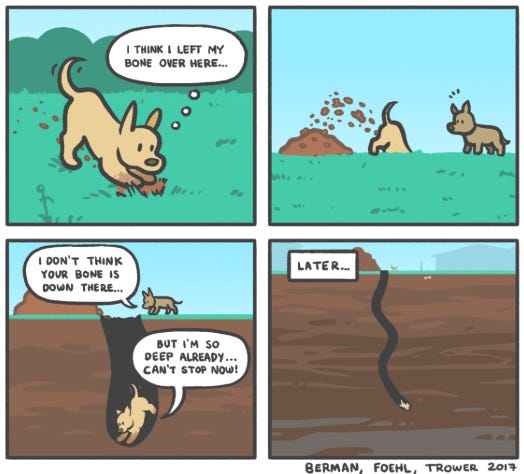
They chose to throw a great deal of that material away, go back, and redesign the project from the ground up, and they made that call early.
That decisiveness is why the film eventually worked, why it found a director who took them to Kenya, India, and Mexico, and why it ended up on Netflix with Matt Damon and Liam Neeson.
The lesson is that the most expensive thing you can do is keep funding a flawed design because you’ve already paid for it.
By the way, I have a direct message from Matt Damon to all of you.
Just kidding!
In all seriousness, though, every single one of us can help. If you aren’t ready to invest $5 a month in a premium subscription to The Water MBA, that’s completely fine, but consider donating that same amount to Water.org instead.
You, too, can make a meaningful difference.
Anything is possible
When I asked what corporates most need to learn, he gave me a sentence: anything is possible.
L’Oréal didn’t believe a water-loop dry factory was achievable until they built one — and now every L’Oréal factory will be one.
Intel set audacious 2030 water goals and hit them ahead of schedule.
When Microsoft presented its progress recently, jaws dropped at the pace.
They came from people arriving with a fresh outlook and refusing to accept the assumed timeline.
That, in the end, is what keeps a man surprised after twenty-five years in a sector he supposedly knows cold.
Paul started as a wastewater and biosolids specialist; with every move his aperture widened, until he arrived at a genuinely radical reframe of the whole practice.
Our job, he argues, is to leave water in nature.
Reduce leaks, capture industrial water, explore atmospheric water capture, and you leave more in the green water cycle, where it slows down, purifies, and regenerates. Invert the equation and the engineering looks different.
The thread running through all of it is a beginner’s mind. Paul owns a library of books on water and still, by his own account, gets surprised all the time.
For a platform built on the conviction that we always have something left to learn, I can’t think of a better note to end on.
Never be afraid of being challenged, he told me, and never hang on too tightly to your beliefs.
That’s the whole curriculum, really.
My favorite ideas from the conversation with Paul O’Callaghan
On the Alchemy of Water
I was fascinated with the alchemy of water and the sensory nature of it — you’re feeling the humidity on your skin, you’re smelling it, but you’re also looking at science in action.
I fell under the spell, and I’ve never fallen out of it.
On Working With Good People
If you work with good people, good things happen. That’s an immutable law.
If you’re working with smart people who share that passion and know why you’re doing the work, you have fun doing the work.
On Why Water Innovation Can’t Be Rushed
The third house you build is the house of your dreams — not the first one.
I don’t believe you can shorten it. What you can do is make fewer mistakes.
A mistake is adding to the timeline. It’s a waste of money, it’s a waste of time.
On Not Being Left Behind
I don’t want to be left behind. I don’t want to be the last person selling a PVDF membrane when PFAS compounds have been outlawed and everyone’s moved over to ceramics.
That’s our role — getting your binoculars so you can see a little further over the horizon, maybe see around a corner to any potential disaster, and avoid making a mistake.
On Patient Money and Smart Money
There’s patient money, and there’s smart money.
It doesn’t go twice as fast because you have twice as much money.
When you see failed companies, it correlates with a misalignment between the expectations of the investor — both in valuation and in timeline.
On the Sunk Cost Fallacy
There’s a thing called the sunk cost fallacy. You’ve gone so far — what do you do?
We were prepared to lose a lot of that material, because we were going to go back, redesign, and rethink the project. And I’m glad we did.
On Anything Being Possible
They came in with a fresh outlook and said: anything is possible. And before you know it, there’s half a dozen projects.
On Leaving Water in Nature
Our fundamental job is not to take water from nature — it’s to leave water in nature.
If you leave water in nature, nature creates water. If you leave water in nature, nature slows water down.
We’re not running out of water. We can create water abundance.
On Staying Surprised
What keeps me motivated is continually being surprised.
I’ve got a lot of books on water, but I continue to be surprised all the time.
Have a beginner’s mind. Never be afraid of being challenged, and never hang on to your beliefs.
Meet and follow-up closely Bluetech Research Team:
Lily Chen, I like the conversations she brings to the table in Blue Notes Pod.
Saurabh Singh, he’s one of the few that I activated a ring bell in LinkedIn to make sure I receive notifications when he publishes something, because among all the stuff out there, I feel it is authentic and valuable for me.
Paul O’Callaghan, no need much more introduction.
Interesting career opportunities for Research Analyst and Key Account Manager.