

If you could automate the routine parts of your daily operation, what complex problem would you finally have the time to solve?
I open with this reflection because AI is a topic we must cover. But we need to cover it and take it very seriously.
In this episode, we have the honor of conversing with Dragan Savic.
Dragan is a civil engineer who has spent over 40 years in the water sector. He currently serves as a global advisor at the KWR Water Research Institute and is a professor at the University of Exeter.
Dragan has been working with AI since his PhD in 1991. I wanted to understand how a veteran engineer sees this technology evolving and why it actually matters for those of us managing physical assets.
What’s next for AI?
Before sharing the key learning points from our conversation, I want to share about the revolution our world is undergoing: a smooth, exponential process rather than a single point in time when everything changes.
Experts predict AI will be smarter than humans at almost everything within the next few years, certainly within the 2020s.
This could lead to a country of geniuses in the data center, where millions of AI systems possess intelligence exceeding that of Nobel Prize winners.
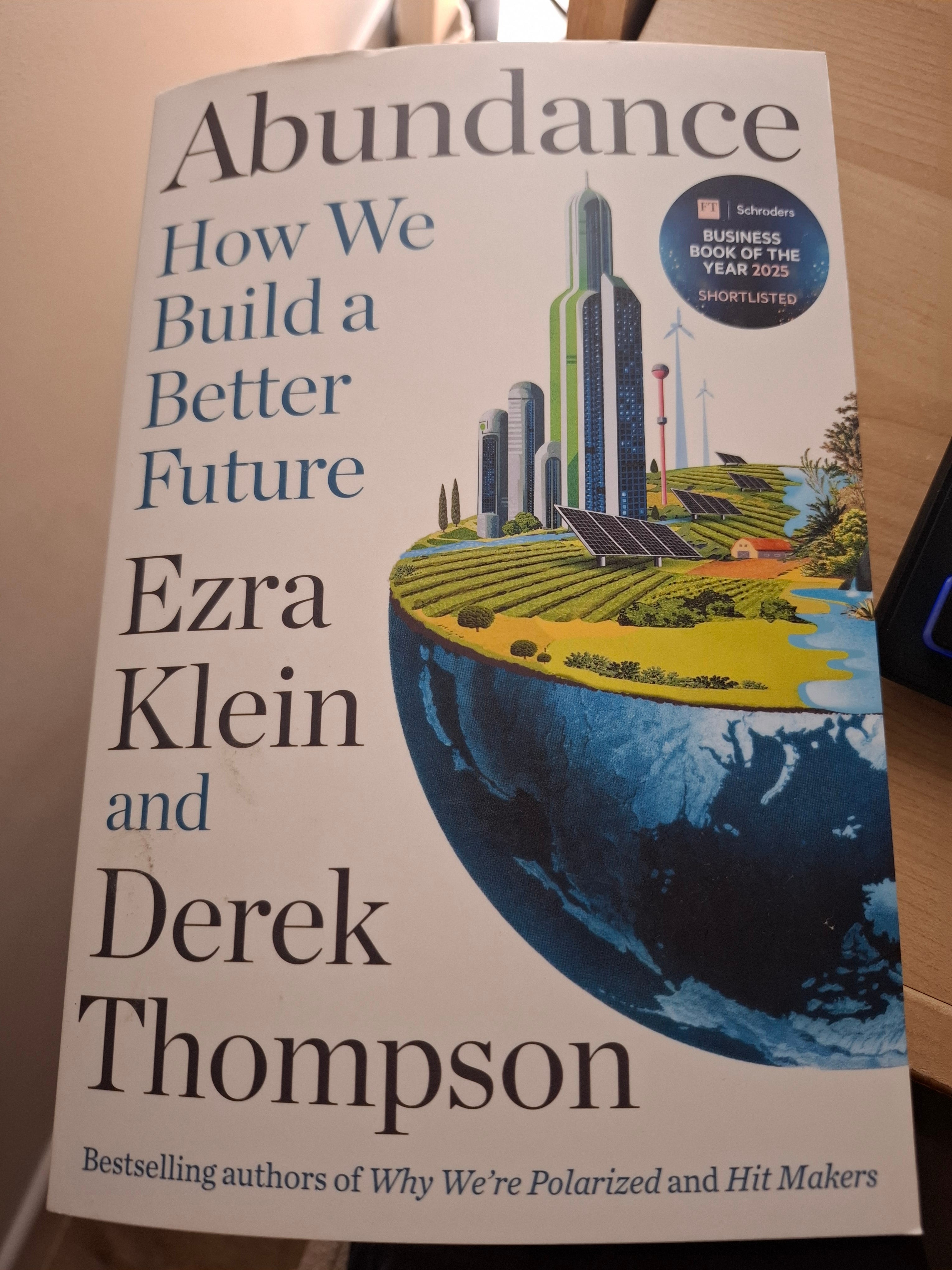
We are entering an era of sustainable abundance (I have bought the book and will read it next month) driven by AI and robotics.
In a “benign scenario,” humanoid robots could meet all human needs, creating an expansion of the global economy that is beyond all precedent.
This may eventually lead to a post-scarcity world where AI helps solve fundamental problems like clean energy (e.g., fusion) and new materials.
I’m sure you use ChatGPT or Gemini as a usual tool nowadays. But the revolution is not this.
AI may be shifting from being a tool we use to an “agent” that can make decisions and perform tasks autonomously. Yes, autonomously!
This includes “agentic commerce,” where AI handles shopping and research directly within chat interfaces, and “physical AI,” where robots understand the physical world to perform useful tasks reliably (this may be useful for me nowadays with three kids at home…).
View AI not as a tool, but as a non-organic species being introduced to Earth. Yes, a new species.
The first species that will be smarter than Homo sapiens. Is this a natural transition?
You know what happens when one species is smarter than another, right?
Elon Musk has shared his vision that humanity, or more broadly, any form of “consciousness”, should leave Earth (which is why he founded SpaceX) and expand beyond our planet as a matter of survival. In other words, if life remains confined to Earth, it is only a matter of time before it disappears, whether because the Sun, which has a finite lifetime, eventually dies, or due to external accidents such as meteorite collisions or even unknown external threats.
So I am not entirely surprised when people talk about life expectancy increasing exponentially, or even about immortality, if a new species or advanced AI systems can understand and manipulate proteins and cells at a fundamental level.
I feel the health sector is probably one of those that will face major breakthroughs in the coming years.
This challenges human identity, as AI may become more creative and better at thinking than we are. It could even lead to AI-created financial systems so complex that no human can understand or regulate them.
Ok Ramon, so what should I do? Is it all over?
Maintain “Human in the Loop,” as Dragan said. To avoid AI biased storytelling, we must ensure humans remain central to the creative process, using AI as a tool to enhance craft rather than replace it entirely.
Prepare for economic disruption. Governments may need macroeconomic interventions, such as taxation or wealth distribution, to handle the potential for high GDP growth alongside high unemployment or inequality. This may be unique in history; usually, economic crises come with unemployment. Here, we may face economic growth and high unemployment, along with much greater inequality. Social disruption will be a tough transition.
And my favorite: focus on adaptability and education. For individuals, the most important skill will be “learning to learn” and becoming “AI native,” as AI is the easiest software to use in history. Everyone can now be a “programmer” by learning how to prompt and manage AI.
So here we are, learning to learn and adapting ourselves in our business, with humans in the loop.
We don’t necessarily need fewer people because of AI; we need people who are trained differently. And that’s what we try to do in The Water MBA.
Our talk with Dragan
We often talk about water scarcity as an environmental fate, but Dragan pointed out that it is largely man-made.
We have enough water, but our demand is outstripping our supply. He sees AI as a critical tool to change our mindset from being reactive to being proactive.
Instead of fixing things when they break or responding to shortages as they happen, AI helps us forecast demand and optimize operations.
It is interesting to note that while AI helps save water, the technology itself is quite water-hungry due to the cooling needs of data centers. But actually, in my opinion, I think the cooling demand will reduce significantly due to ongoing innovation, as will the energy required to power it.
Because AI has five layers, let’s say, and the base is energy.
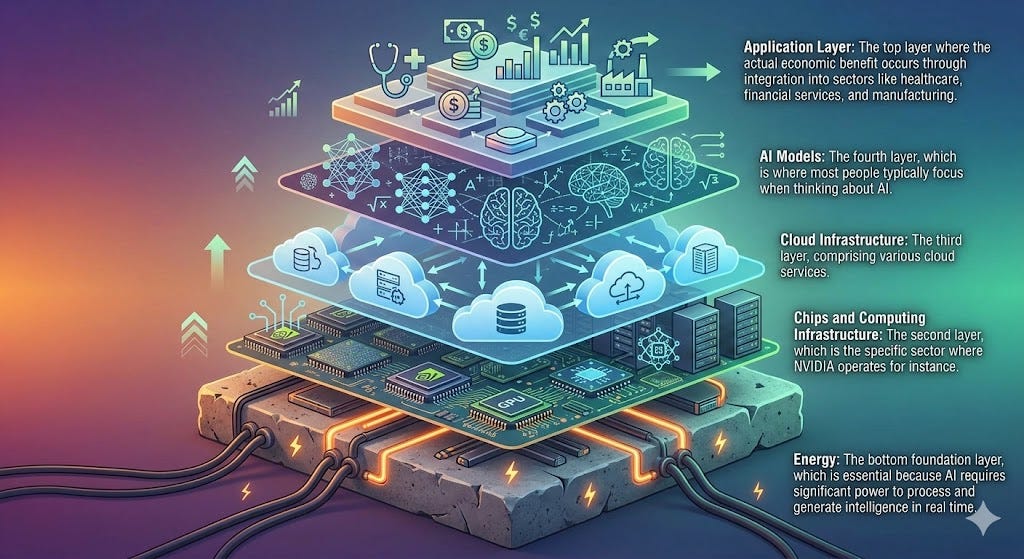
I am not surprised many professionals might choose energy instead of water as a career path. Water is important, but we need to understand that energy is now a very powerful sector to engage in—private capital, growth, unlocking the biggest step in the progress of humanity. It is not a bad purpose either.
Looking beyond the water utility silo
One of the most insightful parts of our talk was about how we organize our work.
We usually look at water, energy, and food in separate silos.
Dragan suggests that the biggest gains for AI and informatics will happen when we look at the entire system jointly.
While individual utilities can use AI to reduce energy consumption in wastewater treatment or track pollutants like microplastics and PFAS, the real transformation lies in the “nexus.”
When we connect the water layer with the energy layer, we find efficiencies that aren’t visible when looking at a single pipe or plant.
Building trust through the human in the loop
A common fear is that AI will replace human accountability.
Dragan was very clear on this: full automation of large, complex systems is not happening anytime soon.
Our water systems are full of unpredictable variables and “stochasticity” that a black box cannot always handle.
He shared an example of a utility that ran AI recommendations in parallel with a human operator for a full year. This wasn’t about the AI being slow; it was about the human gaining trust in the system.
For the foreseeable future, the human remains in the loop to press the final button.
The risk of vendor lock-in and security
As we integrate more digital tools, we face the practical risk of becoming too dependent on specific software vendors.
If all your data and historical knowledge are trapped in one proprietary system, it becomes very hard to switch.
Dragan advocates for openness and interoperability to prevent this.
We also touched on cybersecurity. As we connect our physical infrastructure to the internet, the threat surface grows. However, this is not a new problem; it is an evolving one.
Just as we have used AI to create more sophisticated threats, we are using it to build more robust defenses. It is a cost of doing business in a digital age that we must include in the life-cycle planning of our assets.
Ok, let’s move forward
Well, maybe it is too much to digest, but take your time and reflect. If you want to grow and understand our business (and actually how your life is evolving without you noticing), try to reflect on what we’ve discussed and share your questions or opinions within our Networking Chat or comment on this post directly.
This AI topic will be a recurring one we’ll cover in The Water MBA because it is simply essential to transform the type of professionals we need in our business.
Thanks for reading and watching! See you next week!


