
Probably some of you reading this would say, hell yeah.
Biofouling, maybe the most addressed word in desalination (after energy consumption).
I wanted to attack this topic from different angles, one of them is today with Harry Polman from H2O Biofouling Solutions.
Harry has spent over 30 years studying how marine life interacts with industrial infrastructure.
We talk a lot about membranes, but we rarely focus on the very beginning of the process.
Harry’s perspective is refreshing because he looks at the biology of the ocean to solve engineering problems.
We are working with nature, not just against it.
The hidden biology of our pipes
Seawater intakes are perfect habitats for marine life. Organisms like mussels, oysters, and barnacles enter our systems as tiny larvae. Once they find a surface with a good flow of water, they attach and grow rapidly.
I am aware of a real-world case where seawater did not reach the intake pump station at the expected flow rate.
Why?
Because inside the intake pipe, instead of having the intended internal diameter (let’s say 1600 mm), the effective diameter was much smaller due to marine growth.
As a result, head losses became so significant that the water did not arrive as expected.
Consequently, the desalination plant could not produce the expected amount of water.
In just a few weeks, these larvae become hard-shelled organisms.
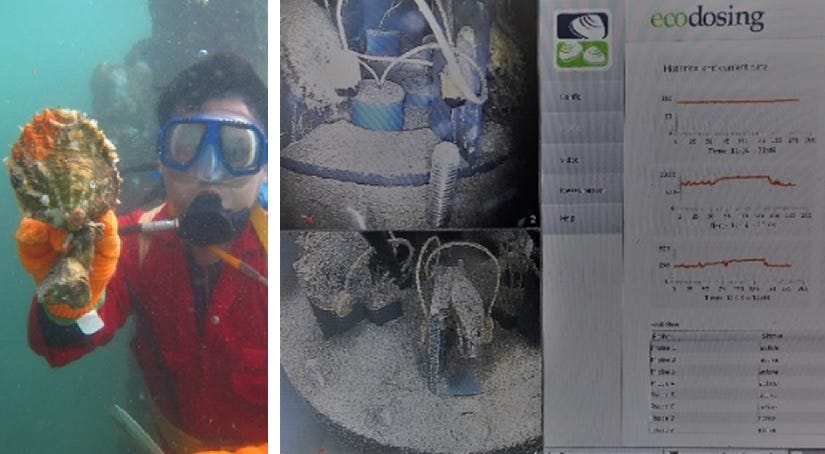
This increases the “wall roughness” of the pipe, creating resistance and head loss.
Cases where the effective diameter of a pipe was reduced by 30%.
When you can’t get enough water into the plant, you simply cannot meet your production targets. It is a physical bottleneck that starts long before the water reaches a single membrane.
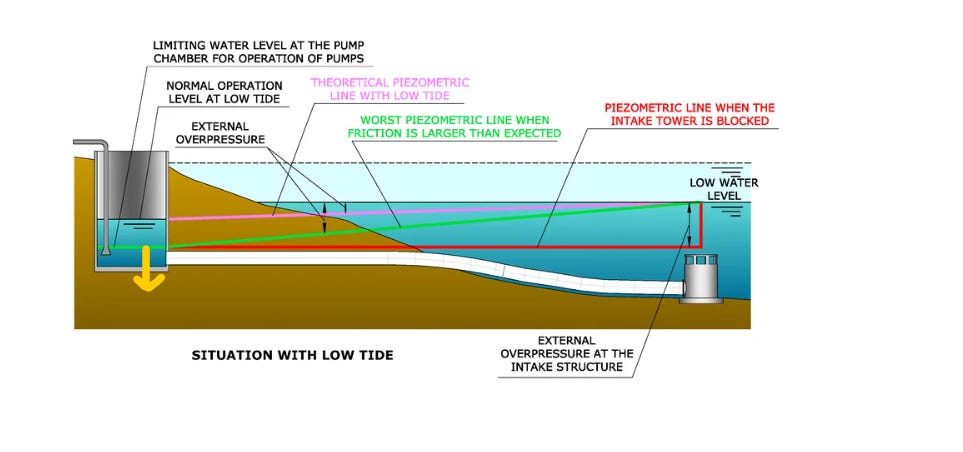
As illustrated in the sketch below by one of the world’s leading experts in intakes & outfalls (remember our course ;)), Eloy Pita from Increa, the scenario suggests that the piezometric level (shown in green, representing the worst-case condition) is actually lower than expected. As a result, water would either not flow (or would flow at a reduced capacity) from the intake riser to the lifting pump station.
The unintended consequences of chlorination
A loyal member of our community, Ms. Guadalupe, who operates a desalination plant in Spain, once told me they had serious biofouling issues in their membranes.
Interestingly, the problem disappeared when they stopped applying shock chlorination at the intake, which had originally been used to control marine fouling inside the intake pipe.
Instead, they chose to invest in divers and frequent mechanical maintenance, as they found it to be the most cost-effective life cycle solution.
However, Harry shared a perspective that many operators struggle with: the balance between the intake and the membranes.
If you have an intake already full of marine life and you start a heavy chlorination program, you end up killing that organic material and releasing it into the water.
This dead organic matter often causes more fouling downstream on the RO membranes.
It shouldn’t be a choice between a clean pipe or a clean membrane.
The goal is to understand the local biology well enough to maintain a clean system from the very start without overloading the downstream process.
The previous case made me curious, as I was not entirely sure about the relationship between chlorination and membrane biofouling.
So, I asked our friend Arian Edalat, and he told me:
“In short, chlorination of seawater as a pre-treatment not only creates byproducts that can potentially serve as nutrients for bio-organisms, but studies have also shown that these organisms develop immunity over time. Their sensory systems are far more advanced than we generally think.”
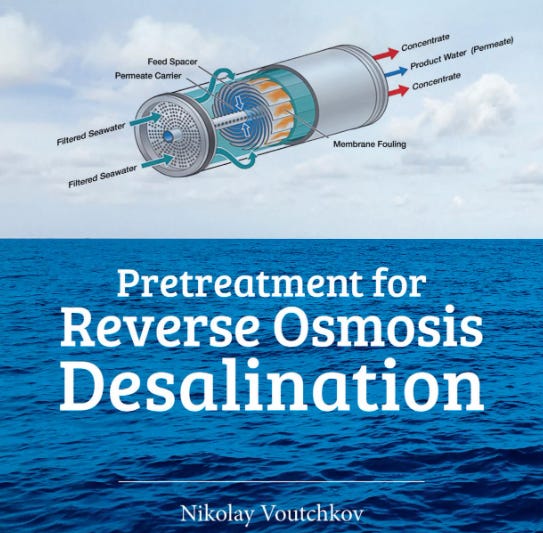
He also recommended a book by what is probably one of the world’s leading experts on the subject, Nikolay Voutchkov (and, by the way, I was honored to receive a LinkedIn connection invitation from him a few days ago!).
Moving beyond “copy and paste” engineering
One of the biggest hurdles we discussed is how we design these plants.
I remember asking a process engineer in a previous project:
“How do you size chlorination dosing in different projects?”
He replied:
“It is mostly standard practice, based on common industry norms. In many cases, it is directly requested by the end users in the RFP.”
So, we simply request the equipment from approved vendors, sometimes for projects where the investment reaches the scale of millions. I remember thinking: what a great business for those companies…
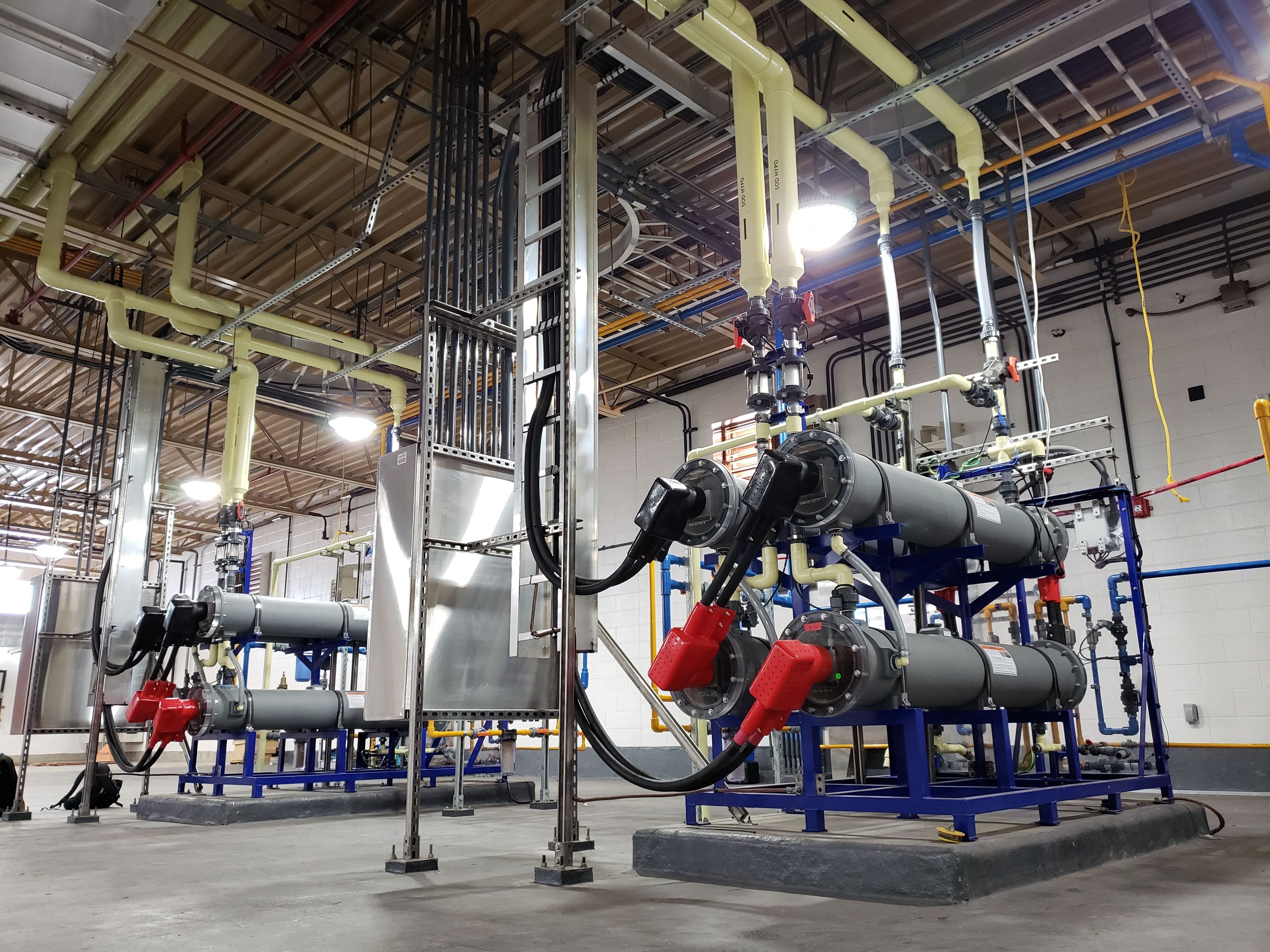
Typically, a developer or utility follows a standard template: they buy a large electro-chlorination unit and hope for the best.
We spend millions on equipment without knowing if it will actually prevent the specific biofouling at that site.
Harry advocates for studying local conditions during the feasibility or environmental study phase.
By understanding the specific species and their breeding cycles, we can design dosing systems that are much smaller and more efficient.
This saves on CAPEX and prevents the scaling issues often caused by over-dosing.
We need to stop seeing biofouling prevention as an “add-on” and start seeing it as a core part of the design.
Anyway, as the current reality is that many of us are—and will continue to be—facing the design, procurement, installation, and testing of these systems, I leave you here with a webinar where you can take a look at what these systems actually look like:
The human barrier to innovation
When I asked Harry about the biggest barriers to better solutions, he didn’t point to technology. He pointed to human behavior (what else…).
Many people in our sector are resistant to change because “this is how we have always done it.” There is also a fear of admitting that a current system isn’t working.
Working as a consultant in this space requires a lot of “emotional intelligence.”
You have to show operators and owners that there is a better way without making them feel at fault for the current situation.
It is about creating a win-win scenario where the plant runs more reliably and the operator has fewer headaches.
Whether it is a project in Saudi Arabia or Spain, the technical challenge is often easier to solve than the cultural one.
European Desalination Society
Harry and I will be in Marrakech on June 2026 in Euromed, he has a couple of sessions, so I look forward to meeting him, as well as any other reading this and may be there, write me in!
Desalination Plant in Barcelona
Last year at the AEDyR (Spanish Desalination and Reuse Association Congress), there was a very interesting technical session on this topic.
One case presented described a plant that experienced a massive proliferation of organisms—specifically mussels—within its intake system.
The accumulation of biological material caused occasional pumping shutdowns due to the reduction of the water passage section, reaching critical safety levels for the pumps.
Approximately one ton of biological material has been removed every 3.8 days from the intake system. During major cleaning operations following technical shutdowns, up to 85.7 tons of material were extracted!!
These are gregarious organisms (they accumulate on top of one another), resistant to chlorination, and their growth is favored by a constant flow rich in nutrients and oxygen.
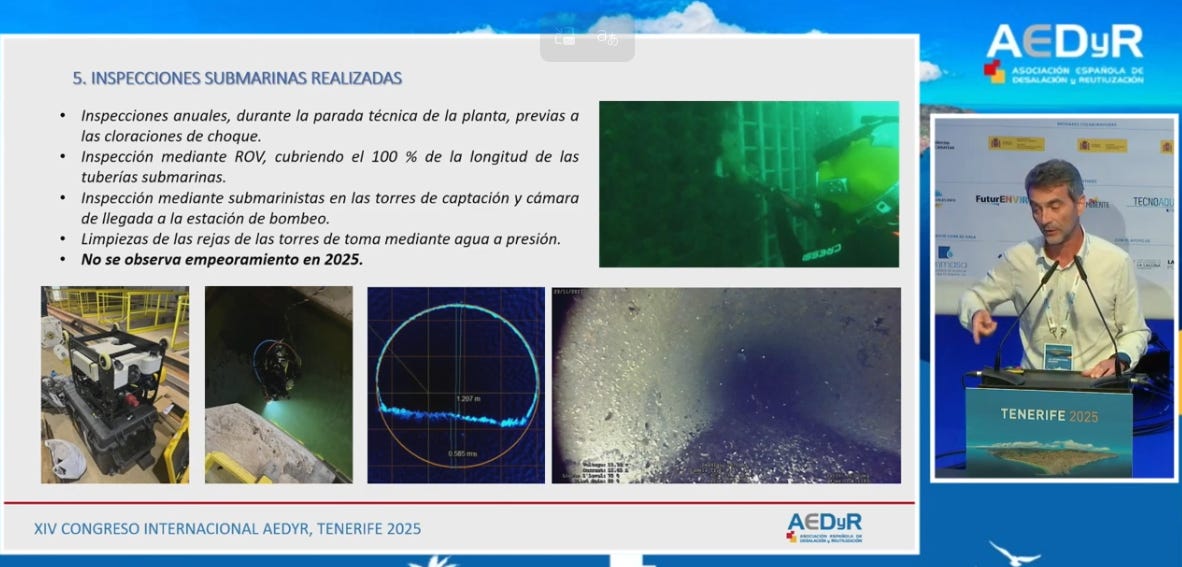
Various strategies were described to combat fouling in the intake pipelines:
The use of divers.
pigging systems (internal mechanical cleaning, next Tuesday specific episode about this).
the use of ROVs (remotely operated vehicles) equipped with tools for inspection and pipe scrubbing.
Other preventive measures such as:
Dosing of sodium hypochlorite (chlorine) and air. Shock chlorination treatments of up to 15 ppm for 24 hours.
Application of anti-fouling coatings (rich in copper and nickel) on the intake windows and the first meters of the intake tower, where there is more light and a higher tendency for organisms to attach.
Microbubble screens around the intake to prevent contaminants and organisms from reaching the system, a technique imported from the salmon farming industry.
Ultraviolet light treatments at the intake system.
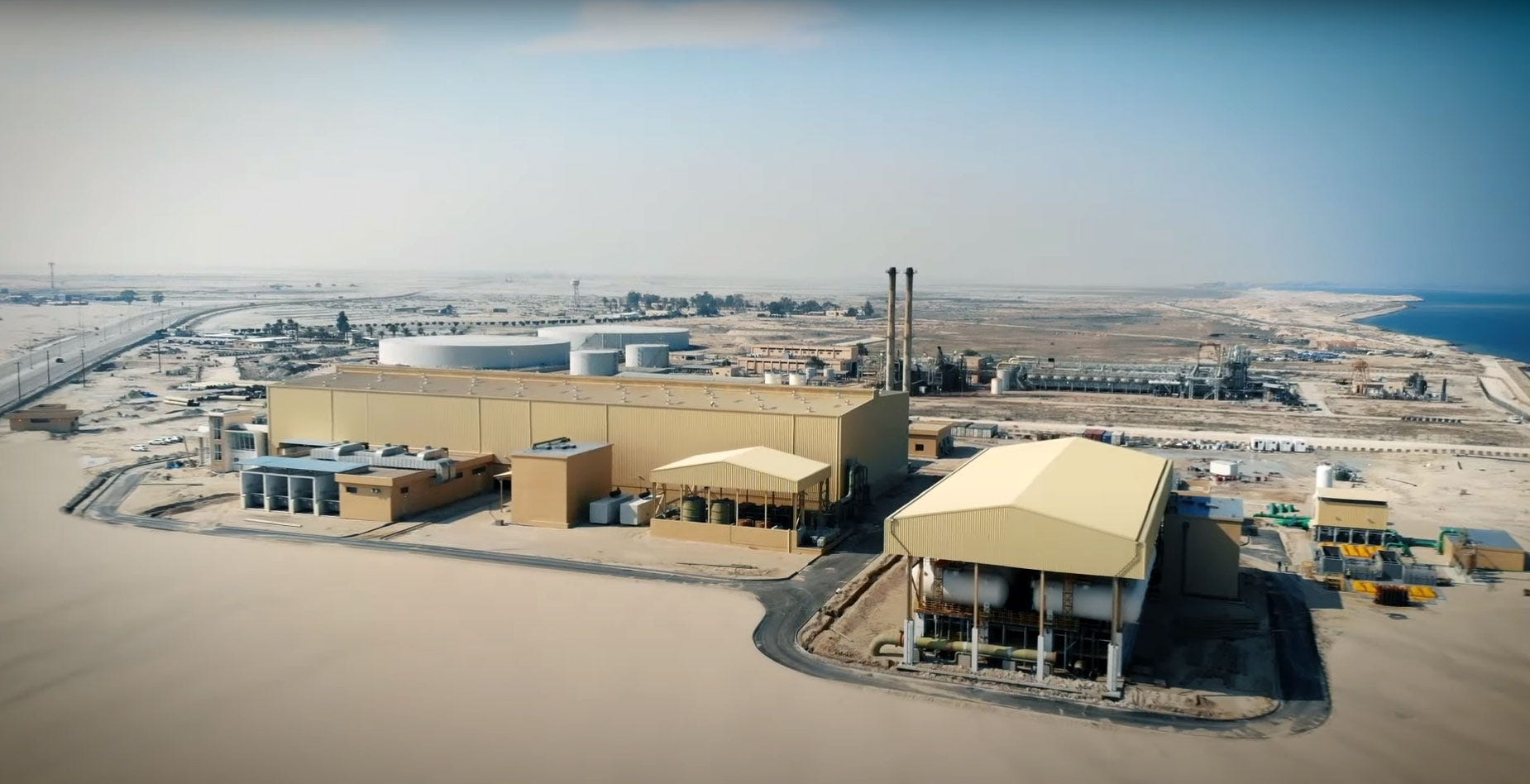
Al-Khafji Solar Desalination Plant
I talked to Harry about this plant that they have as project references to assess biofouling.
Back in 2014, the project came with requirements far beyond what we were used to—long intake and outfall pipelines, complex hydraulics, and demanding performance expectations, redundancy criterias, oversizing aspects, etc.
When we put the numbers together, the estimate reached around 120 million dollars for a 60 MLD plant.
My proposal manager looked at me and said, “120 m$ for 60 MLD? That rate is out of market! I prefer not submitting a bid, it will jeopardise our reputation!”
It felt like we were completely out of the game. And yet, we went ahead and submitted.
When the results came back, we were L1, by a significant margin.
Mmarkets don’t always behave as expected, and that sometimes what looks “too expensive” is simply a more realistic reflection of the challenge in front of you.
Thank you!
These past few weeks, the momentum has been real.
We’re seeing more and more interesting people joining the community, many of you actively sharing valuable insights, technical knowledge, and business perspectives.
I especially enjoy how the networking chat is evolving, real conversations, collaboration opportunities emerging, and even roles and career moves starting to flow organically.
This is exactly the kind of ecosystem we hoped to build: a place where water professionals from around the world can connect, learn, and create value together.
I’m genuinely excited about what we’re building, and even more about where it can go if we keep this energy and generosity.
Next Sunday, we shift gears into a key topic: DIGITALISATION.
Get ready!
Thank you to Harry, as well as to Patricia González and Catalina Iglesias, for helping me get this learning piece done.
*Note: Due to a cloud recording issue, from minute 18:00 onward you’ll notice no captions and lower audio quality, as I had to rely on a backup cloud file instead of the high-quality recording. Apologies for the inconvenience!


