
Manuel Hidalgo, Environmental Inspections Manager for the Royal Commission for Alula, visited our community to discuss what compliance actually look like on the ground.
Manuel has been one of our fellow supporters from the very beginning, we’ve been in touch periodically since beginning of 2024 exchanging feedback and ideas. He also introduced me to great people in the industry, one of them you’ll get to know during the month of May, it is one of the best conversations we have shaped so far in my opinion, so stay tuned.
AlUla is an ancient oasis city in northwestern Saudi Arabia, home to Nabataean tomb cities like Hegra, thousands of years of layered civilizations, and one of the most spectacular archaeological landscapes in the Arab world.
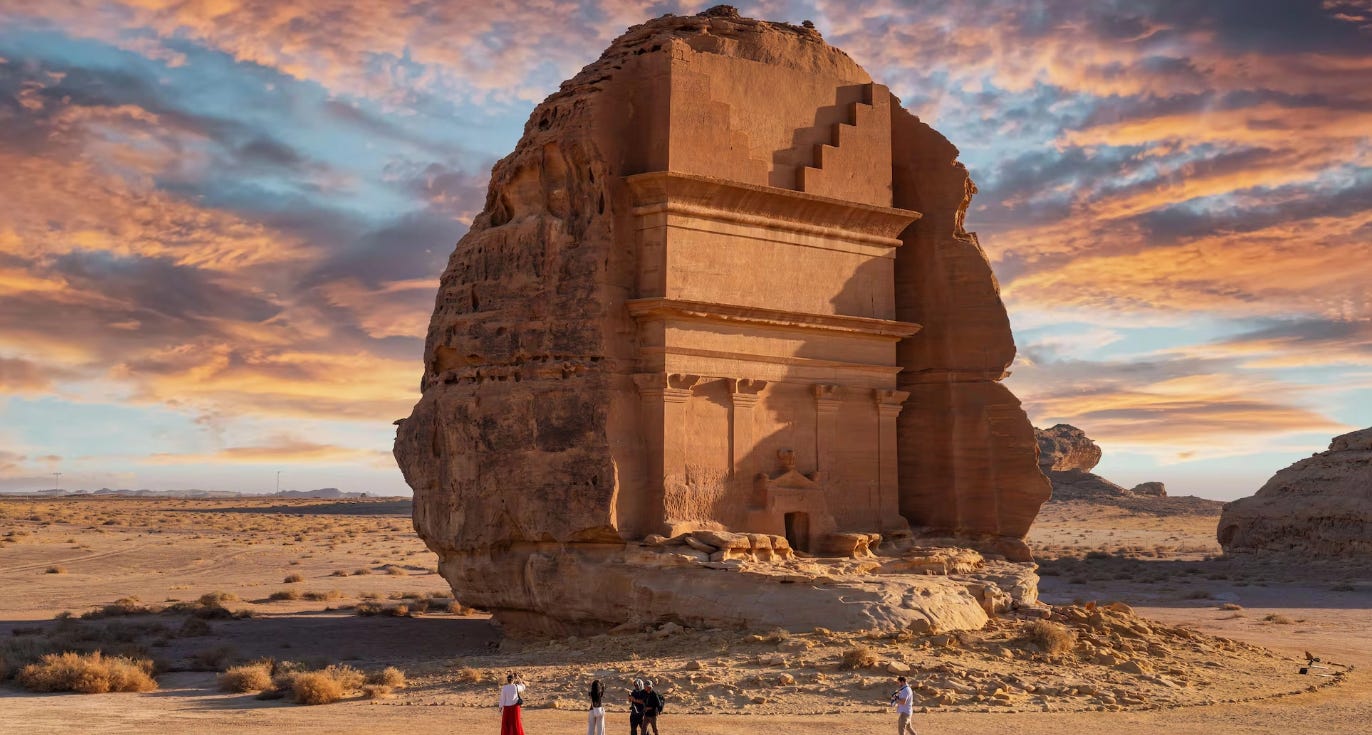
The Nabataeans were ancient Arab people who inhabited northern Arabia and the Southern Levant, famously known for building the rock-cut city of Petra and controlling vast incense trade routes.
I first came to know about this region when I started to work in projects in the new developments on Red Sea, actually they signed an agreement to foster tourism in this area not long time ago.
Red Sea Global partners with Alula to drive collaboration in Saudi Arabian tourism sector
In our industry, we often treat environmental regulations as a hurdle to overcome. But Manuel sees proves differently.
I recognize that when you face such environmental requirements (I’ve experienced this firsthand in developments in the Red Sea), it can feel overwhelming—mainly because they demand time, and during project tenders, time often feels like a luxury amid all the “urgent” priorities.
Compliance is the bridge between a massive engineering project and the long-term survival of the ecosystem it sits in.
It is about moving from “doing no harm” to actively creating a water-positive footprint.
As Saudi Arabia develops its giga-projects under Vision 2030, the scale of construction is unprecedented. In this environment, the stakes for the water sector are incredibly high.
Compliance is a legal requirement and also a management strategy to ensure that as we build the future, we don’t accidentally destroy the resources—like “blue gold”—that make that future possible.
The dream of the 800,000 cubic meters
Manuel tells a story that perfectly captures why people stay in this industry for decades.
Back in 2007, while working in Madrid, he read a press release about a project in Jubail, Saudi Arabia.
It was a massive undertaking: 800,000 cubic meters of desalinated water combined with 2.5 gigawatts of power.
He said that this news “blew his mind.”
He didn’t just want to read about it; he wanted to witness it.
It took five years of planning and international work, but by 2012, he was standing in front of that very plant.
The water business is built on these moments of awe, where the scale of human ingenuity meets a fundamental human need.
A weekend trip that changed a career
The second story Manuel shared felt almost like fate.
In 2021, while working in Yambu, he decided to visit Alula as a tourist.
He was struck by the landscape, a unique mix of historical heritage and archaeological wonders.
As he was driving around the ancient valley, he passed the building of the Royal Commission for Alula.
He looked at it and thought, “Why not try to work here?”
A little over a year later, he was hired.
This story highlights the personal connection we often have with the land we work on. To protect a resource like water, you first have to appreciate the environment it sustains.
Manuel went from a visitor admiring the scenery to the man responsible for ensuring its environmental integrity.
Those two stories probably give you a clear indication of the mindset many of us need as water professionals:
salary and income are variables, but what truly matters is engaging in projects that drive and inspire us, that’s the most important thing.
What compliance actually means
When we talk about environmental compliance, we are talking about accountability. Manuel explained that it is a combination of three pillars:
Governance and Regulation: The rules that set the standard for quality and safety.
Transparency: The ability to report data honestly so we can monitor consumption and quality.
Cross-agency Collaboration: Breaking down silos so that health, environment, and industry departments work as one unit.
Compliance is the mechanism that ensures the water we produce is fit for consumption, that we aren’t wasting a drop, and that we are using smart technology to optimize every liter.
It is the difference between a project that looks good on paper and one that actually works for the community.
Lessons from the inspection line
Manuel’s work involves taking these high-level plans and checking them against reality. He shared practical insights that every project manager should hear.
Often, the breakdown in compliance isn’t a lack of technology; it’s a lack of common sense.
He finds that simple habits—like a worker leaving a hose running or a farm using flood irrigation instead of drip systems—are the real enemies of sustainability.
His role is to instill a “compliance culture” where following the manual becomes a daily routine.
Yes because manuals and procedures are written guidelines, but we as human or professionals tend to not “use” them so much. It happens to me all the time, how many times your company internal procedure is simply not followed by almost anyone and the “chaos” and “improvisation” commands?
He has noticed a massive shift in the last decade; companies are now keeping detailed logs of water consumption and sewage generation not just to avoid fines, but because they realize that efficiency saves money and protects their reputation.
I remember projects back in 2017 where site control regarding water use and waste wasn’t really a priority, nobody paid much attention. Nowadays, it’s far more common to have clear records in place and a much stronger focus on monitoring and accountability.
Saudi water market trends
I had one last question prepared for Manuel. Since he’s been there since 2012, and I’ve seen the evolution myself since handling my first tender in the Middle East, I wanted his perspective.
So I asked him: “How do you see the market there nowadays? Do you feel the same way I do?”
Water market may be shifting fast. It’s no longer just about building desalination plants, success now depends on smart water management, efficiency, and reuse.
Opportunities may be emerging where few are looking.
The Saudi water sector is maturing, innovating, and transforming, and the most exciting opportunities may surprise even seasoned professionals, and he mentioned very clearly in our episode.
Thank you!
Environmental compliance is a human effort, not just a legal one.
If we viewed every regulation not as a restriction, but as a tool to protect the “blue gold” of our future, how much more efficient could our projects become?
Easier said than done… but that’s exactly where the real challenge, and the real value lies.
Thanks all of your for reading, sharing with your friends, and engaging. I appreciate the messages I receive with your opinions, feedback, corrections and even suggestions of what we should cover.


