

One year ago I was in my office working when, around midday, there was a blackout.
We had UPS systems, so a few minutes passed without major disruption.
Then I started hearing that there was no electricity in other cities from messages I was receiving.
The first person that came to mind was José Manuel. I opened LinkedIn and sent him a message, and he replied shortly after.

It was in Spanish, but interestingly, within just a few minutes, José Manuel already had a very clear idea of the origin of the blackout, while the media and political discussion took weeks of “we need to investigate” and “we are looking into it”.
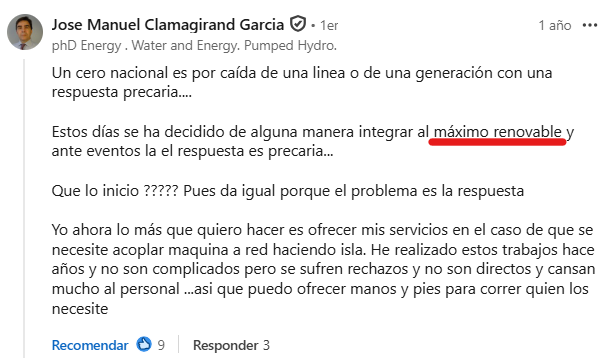
As José Manuel also pointed out, we are pro-renewable, pro-hydropower, pro-batteries, and pro-nuclear, but always with the understanding that each has its own role, mix, and constraints.
A national blackout is something you have to experience to fully understand.
The first instinct is not technical; it is practical: “Will I have running water in my tap?”
because in many areas it depends on electric pumps. In fact, many parts of the city were without water, and people were queuing in supermarkets to buy bottled water, without even asking the price…
Our workshop
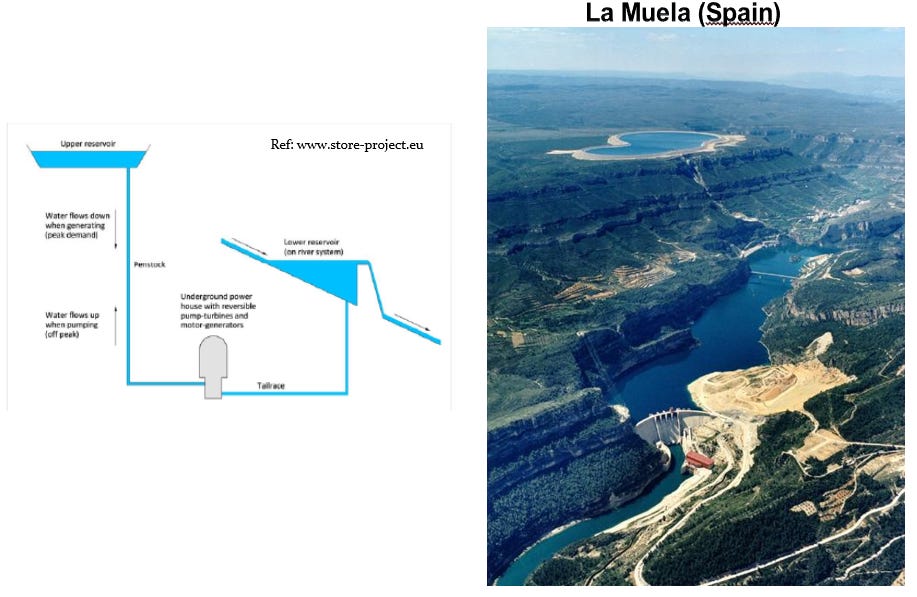
So, in the workshop we held with José Manuel and SENER, as one of the most reputable teams worldwide in hydropower and pumped storage (no doubt about this fact), we focused the discussion first on how the energy market actually works, what happens with high shares of renewables, and then on building a clear visual understanding of what that “giant battery” really is in a reverse pumped hydro system.
The energy transition is often framed through installed capacity targets and technological progress.
However, the real transformation is happening at a deeper level:
the way electricity systems must operate under increasing shares of variable renewable energy, particularly solar and wind.
What emerges is a system where the central challenge is no longer generation, but integration.
And within that challenge, hydropower, especially in its reversible pumped-storage form, is our player :)
The duck curve
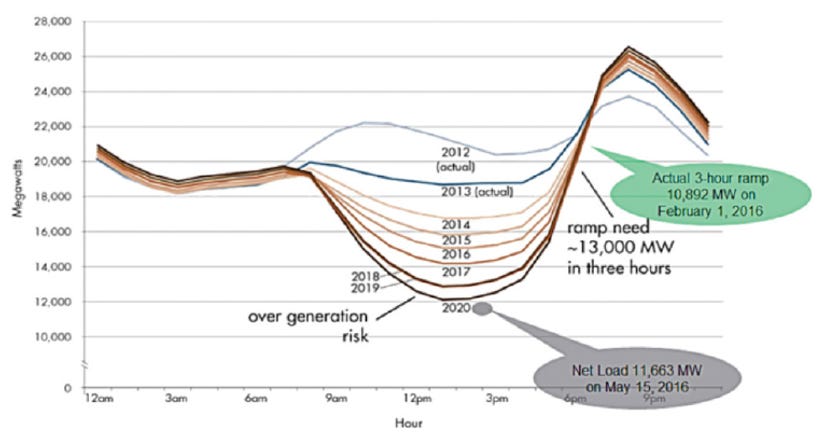
One of the most illustrative concepts in modern power systems is the “duck curve,” which describes the mismatch between solar generation and demand over a typical day.
At midday, solar PV floods the system with energy, often exceeding demand. This creates a deep valley of net demand.
Then, as the sun sets, solar generation collapses while consumption rises sharply, requiring fast and flexible ramping from other sources.
But as discussed in the sector, this curve is becoming more extreme. It is no longer just a “duck,” but something closer to a cliff.
The midday oversupply is increasingly accompanied by price collapses, while the evening ramp becomes steeper and more operationally stressful.
“Receiving the PV”
A key operational insight from system operators is that the challenge is not simply producing solar energy, but receiving it.
When photovoltaic production peaks, the system must have somewhere to send that energy.
If demand is insufficient and storage is unavailable, the system is forced into curtailment or near-zero pricing conditions.
In other words, solar generation is not limited by sunlight, but by the system’s ability to absorb it.
This is why flexible assets, pumped hydro, batteries, and responsive demand, are becoming essential. They are the infrastructure that allows PV to actually be integrated.
The economics of zero-price hours
A consequence of high solar penetration is the increasing frequency of hours with extremely low or even zero electricity prices.
In some scenarios, investors in renewable assets discover that a significant portion of future revenue is concentrated in fewer and fewer hours.
In extreme cases, a plant designed under traditional assumptions of 2,000 operating hours per year may find that a meaningful share of those hours are now worth zero euros per megawatt-hour.
This leads to a paradox: investment in renewable capacity continues, but the marginal value of energy during peak production periods declines sharply.
In practice, the system compresses value into narrower time windows, and profitability becomes increasingly dependent on flexibility and timing rather than volume.
This is why planning horizons matter so much.
A renewable investment today must account not only for technology costs, but for how the market will behave in five or ten years.
Without this foresight, assets risk entering a system where generation is abundant but poorly valued.
Hydropower and pumped storage
In this context, hydropower and pumped storage may act as the system’s natural stabiliser.
Pumped storage systems absorb excess energy when prices are low, often during midday solar peaks, and release it when the system is tight, typically in the evening.
This makes them the ideal complement to solar generation, which follows the opposite pattern.
Unlike batteries, which are typically limited to shorter durations, pumped hydro provides large-scale, long-duration storage.
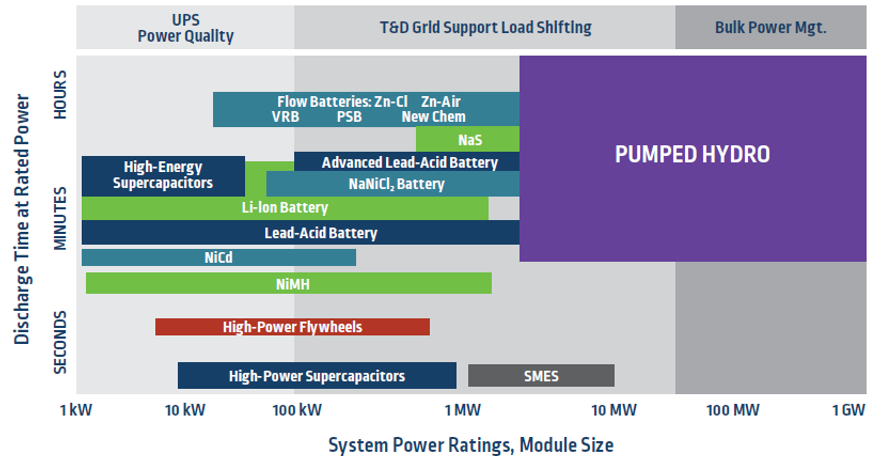
It is, in many ways, the only technology currently capable of shifting energy across daily and multi-hour cycles at system scale.
Spring is coming, when water becomes the competitor
Jose Manuel wrote a few weeks ago “spring is coming” as the renewable game of thrones.
During wet periods reservoir levels rise and natural inflows are abundant.
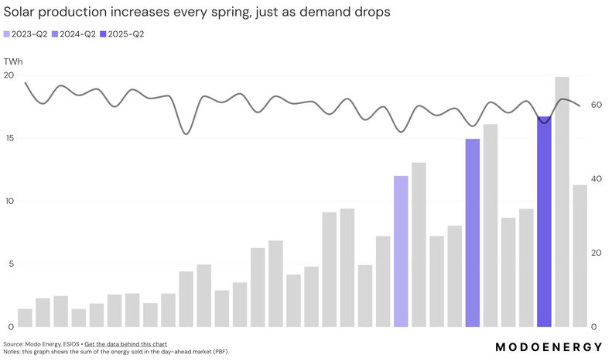
Over the past two springs, photovoltaic generation has been capturing significantly less value, and 2026 does not look set to improve.
Spring combines lower electricity demand with rapidly increasing solar production. Year after year, more PV capacity enters the system precisely when consumption is weakest, leading to midday oversupply.
The result is clear in the market: frequent zero or negative prices, increasing pressure on PPAs…
Average captured prices have dropped from €72/MWh in spring 2023 to just €17/MWh in spring 2025.
And high hydropower output in recent springs has added further supply, concentrating competition among renewables in the same hours.
In 2026, the system enters with an additional 8 GW of solar capacity installed in 2025.
The consequence is increasingly persistent: solar-hour prices tending towards zero for long periods during spring.
Around the world
China is not hesitating in investing heavily in this water infrastructure.
The Fengning Pumped Storage Power Station in Hebei Province, China, is the world’s largest pumped-storage hydroelectric plant, with a total installed capacity of 3,600 MW.
As of December 31, 2024, the facility became fully operational following the commissioning of its 12th and final turbine unit.
In US, Jose Manuel published a few days ago about this interesting project.
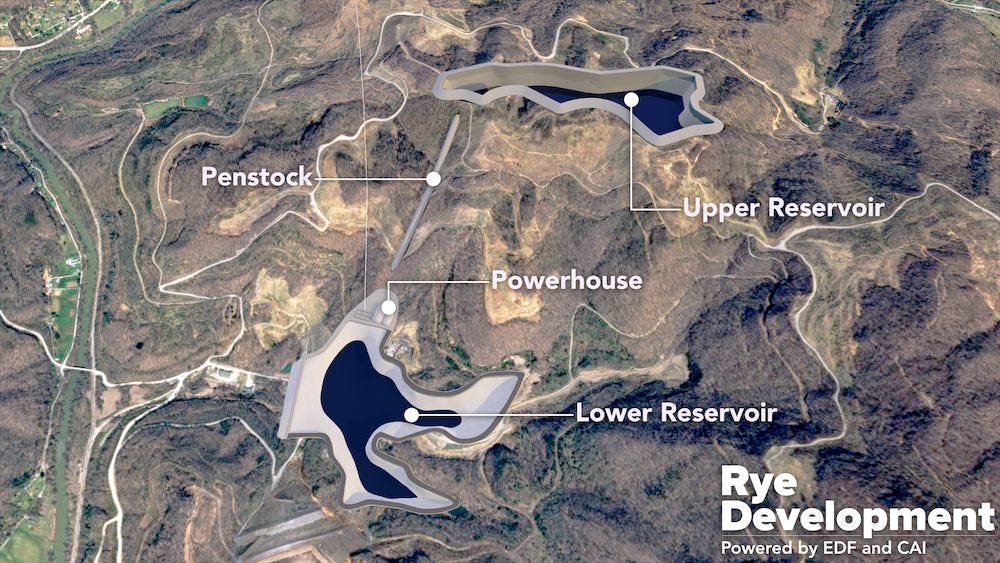
LG&E and KU Energy LLC, subsidiaries of PPL Corporation, have partnered with Rye Development to evaluate a 266MW pumped storage hydropower project in eastern Kentucky.
If completed, it would be the first pumped storage facility in Kentucky and among the first new projects of its type built in the US in more than three decades.
“Pumped storage hydro has been used for decades around the world, and we’re proud to be part of an effort that could introduce it here in Eastern Kentucky.”
The proposed facility would operate as an eight-hour storage system, generating up to 266MW of electricity by cycling water between two reservoirs at different elevations. The project is intended to provide dispatchable capacity during periods of peak demand.
“Large-scale energy storage systems like Lewis Ridge not only strengthen the grid; they are significant long-term investments, providing economic benefits to communities and stabilizing energy prices for decades,”
Rye Development estimates the project cost at $1.3bn, including $81m in funding from the US Department of Energy. Construction is expected to support approximately 2,300 jobs over four years and generate around $1.65m annually in local tax revenue once operational.
The project received a preliminary permit from the Federal Energy Regulatory Commission in 2022 and is currently progressing through the federal licensing process.
Construction could begin in 2027, with commercial operation targeted for 2031.
The utilities currently operate more than 7200MW of generation capacity across coal, natural gas, solar and hydro assets, including the Ohio Falls and Dix Dam hydro plants in Kentucky.
So…
I personally really value this type of infrastructure.
Water and hydropower are among the oldest renewable energy sources humans have developed, and they remain a fundamental part of any country’s energy portfolio.
In some countries such as Brazil, Venezuela, Ecuador, and Norway the water–energy nexus is especially evident.
In these cases, energy security is tightly linked to hydrological conditions: when rainfall is scarce, hydropower output drops, which can directly lead to energy shortages and even blackouts.
At the same time, in regions with strong solar and diversified renewable mixes, pumped-storage hydropower can act as the “giant battery” the system needs, storing excess electricity and releasing it when demand peaks or when solar and wind are not available.
Soon, I’ll also share a specific insight on the relationship between nuclear energy and water, another highly relevant and increasingly discussed topic.
Thanks for being there!


