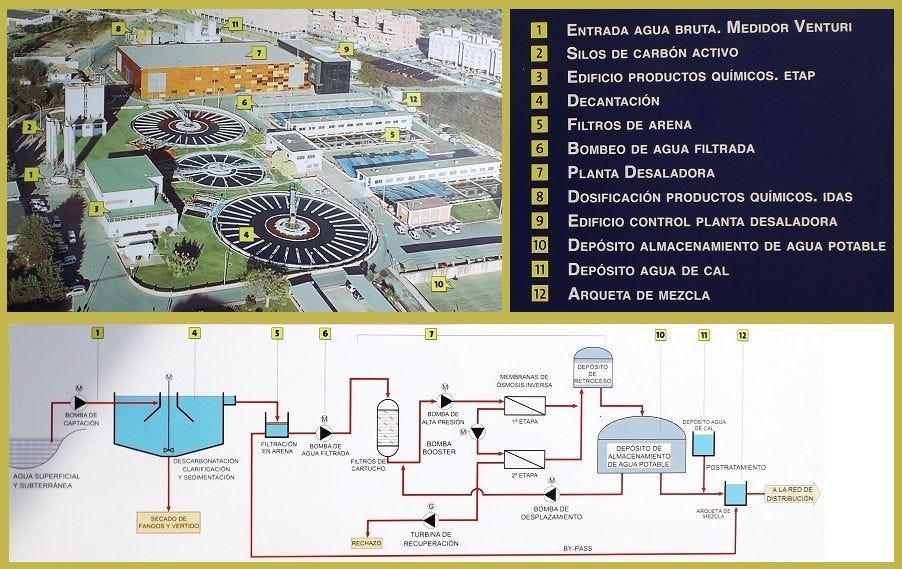
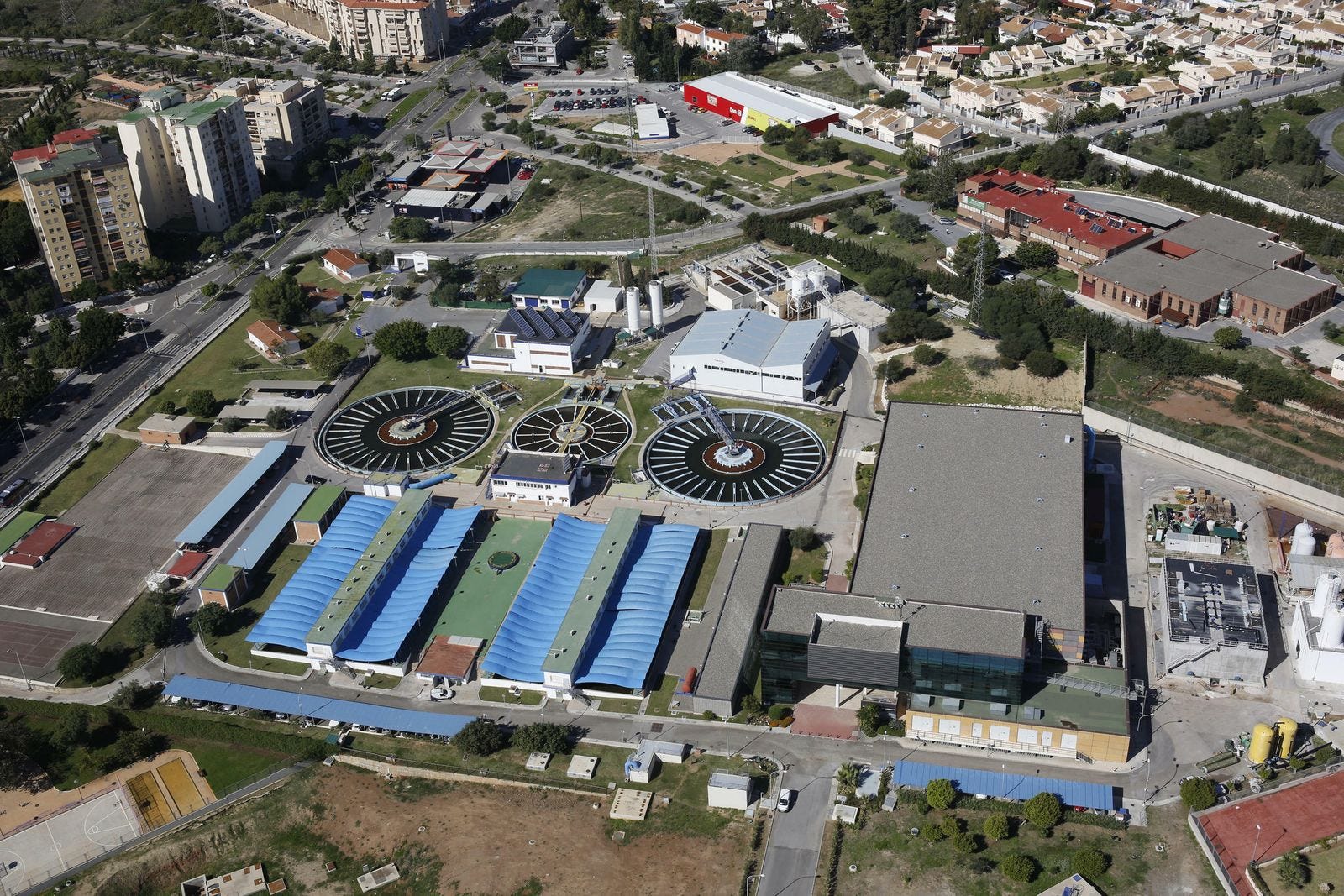
I had the pleasure of visiting the Atabal Brackish Water Treatment Plant, which supplies drinking water to the city of Málaga, Spain, one of the country’s major cities, both in terms of permanent population and tourism.
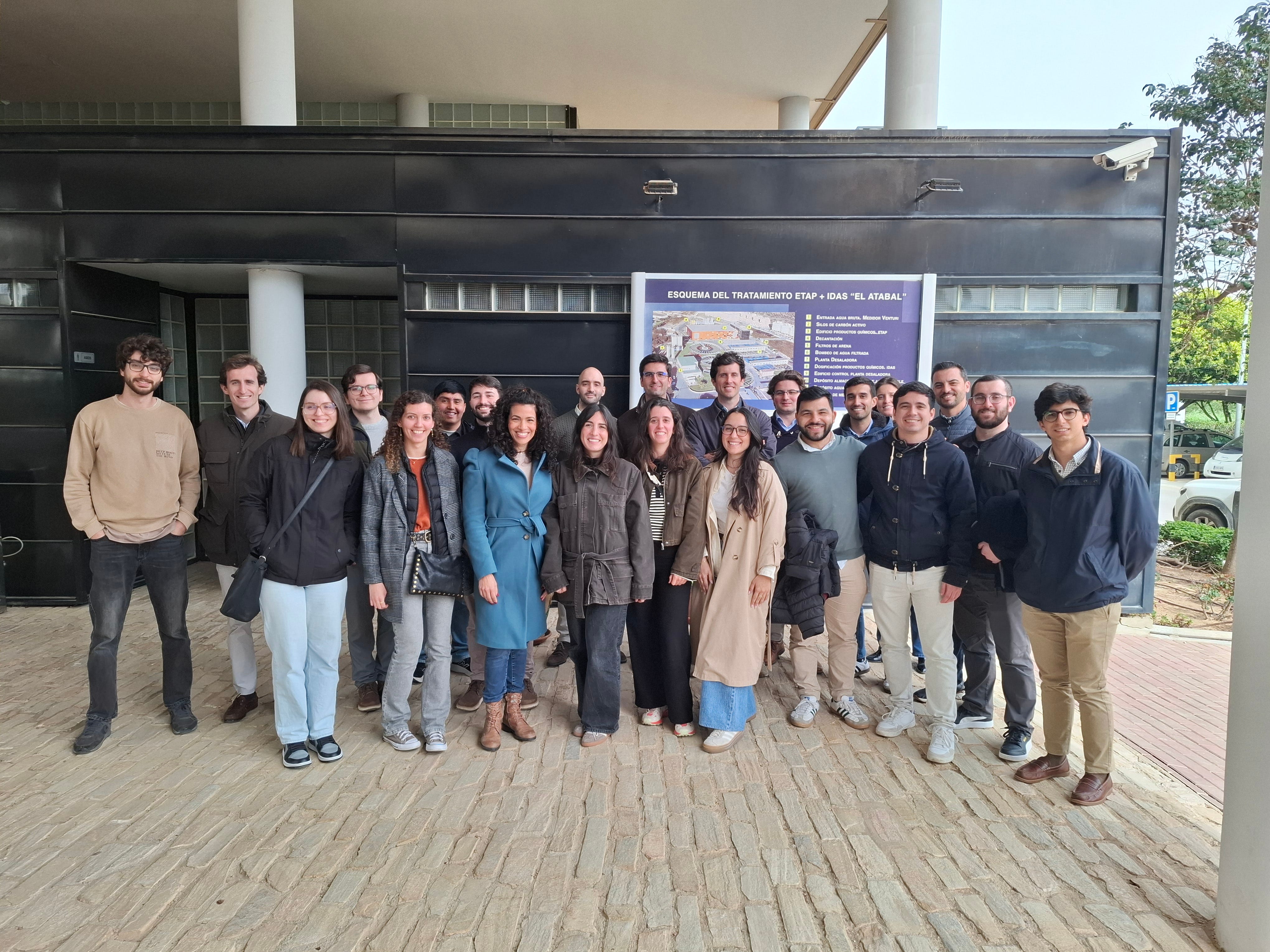
I organized the site visit through our regional chapter of Young Water Professionals Spain, and around 20 people attended.
Above, you can find a short video. Our host, Nicolas Urgoiti, commissioned the plant back in 2005 and has been involved in its operation ever since.
He is one of those professionals whose level of experience is hard to find anywhere in the world.
I asked him to wear a microphone so I could capture a few key takeaways from the visit.
It turned into three hours of a true masterclass, knowledge I’d like to share more broadly through this essay.
To really understand the plant, you first need to understand the story behind how the raw water reaches its inlet. So let’s start there.
Why brackish if it is surface water
It blew my mind:
how is it possible that a drinking water treatment plant is designed for an inlet of 6,500 mg/L TDS, when the water comes from surface reservoirs located 50 km inland from the coast?
To understand this, we need to go back to the 20th century.
As infrastructure developed alongside a demographic boom, Spain went through the Spanish Civil War (1936–1939), followed by a dictatorship that lasted until 1975. In its later years, major hydraulic programs were launched to build reservoirs and reduce reliance on fragmented and variable local sources.
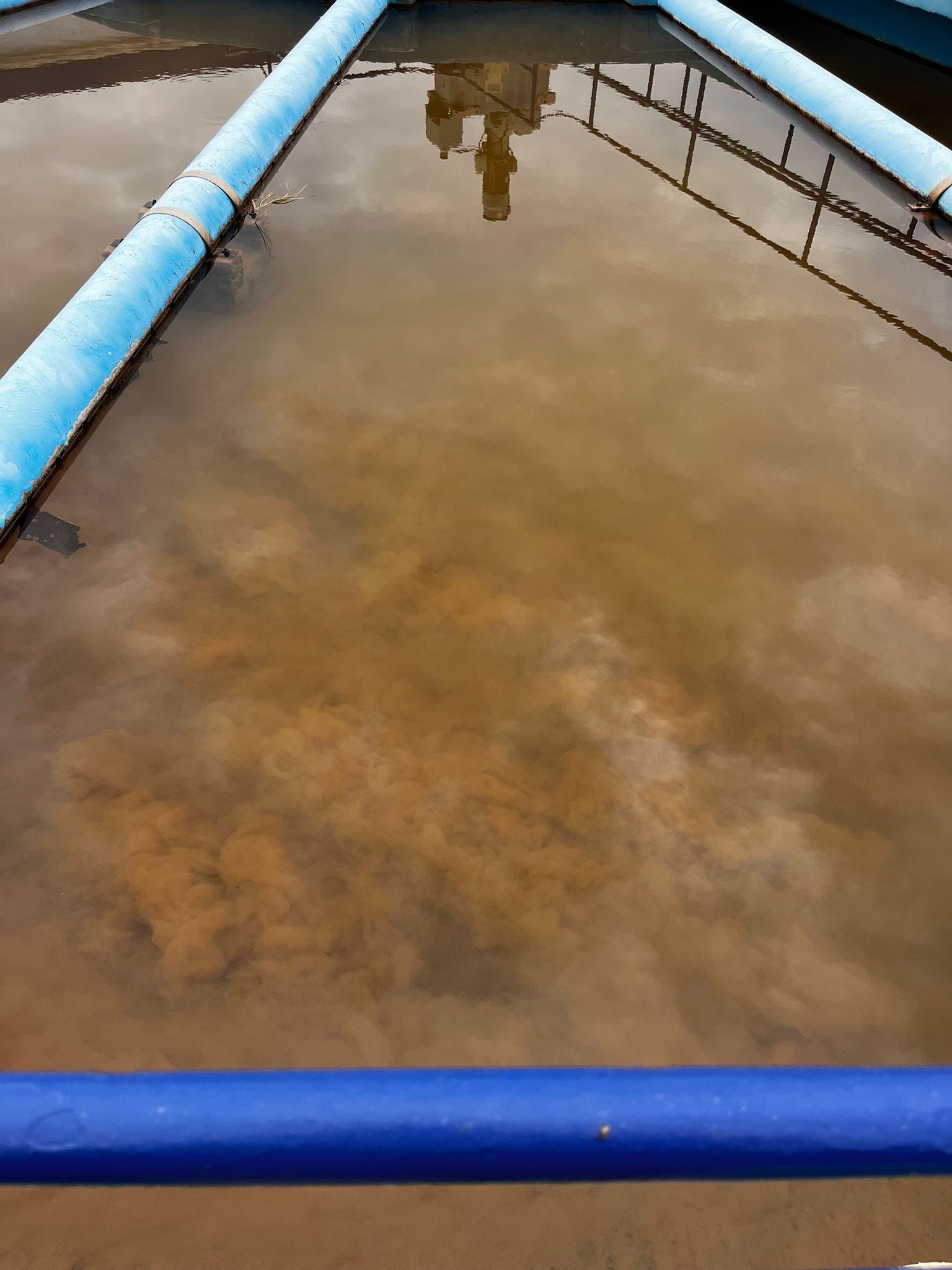
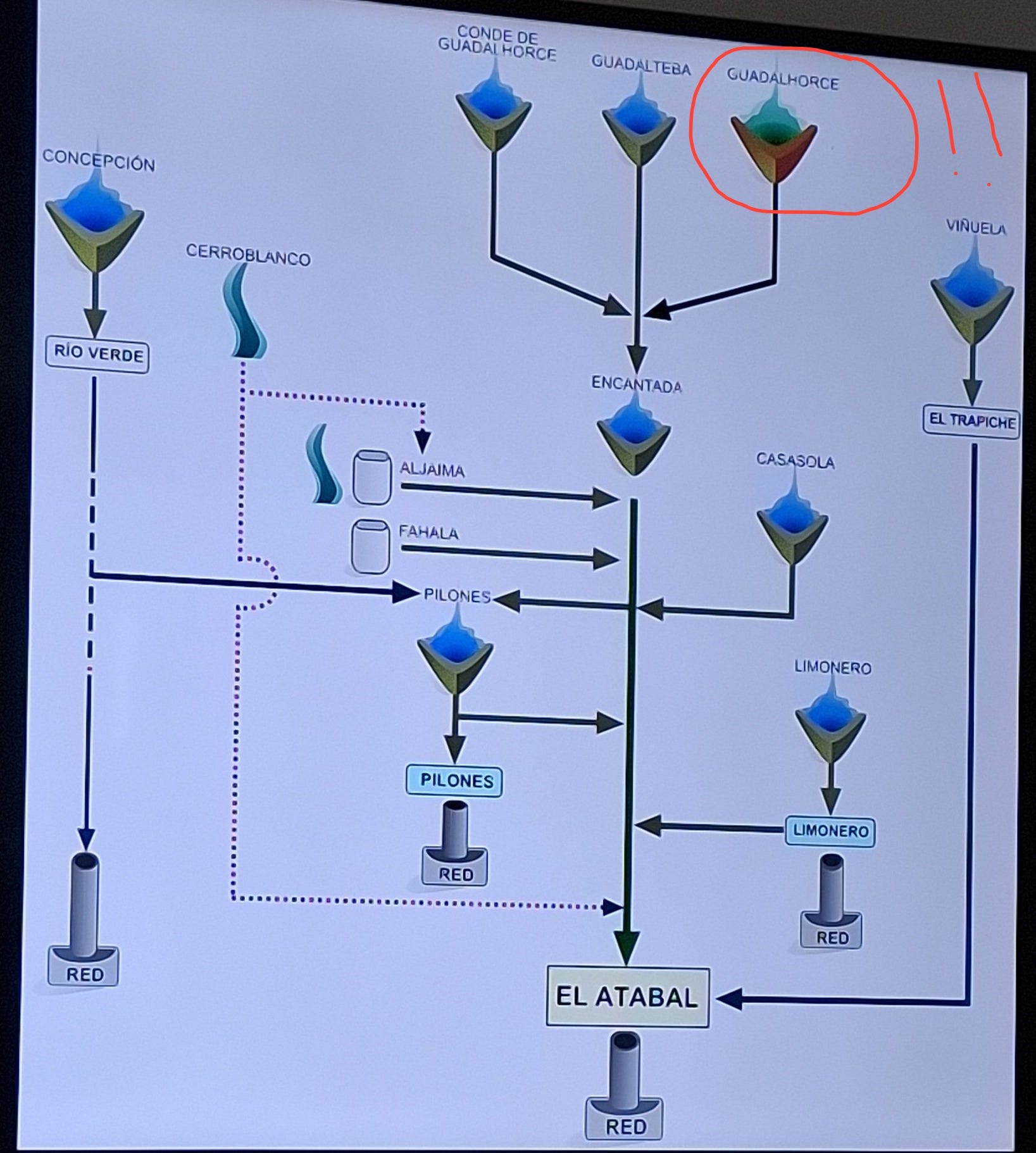
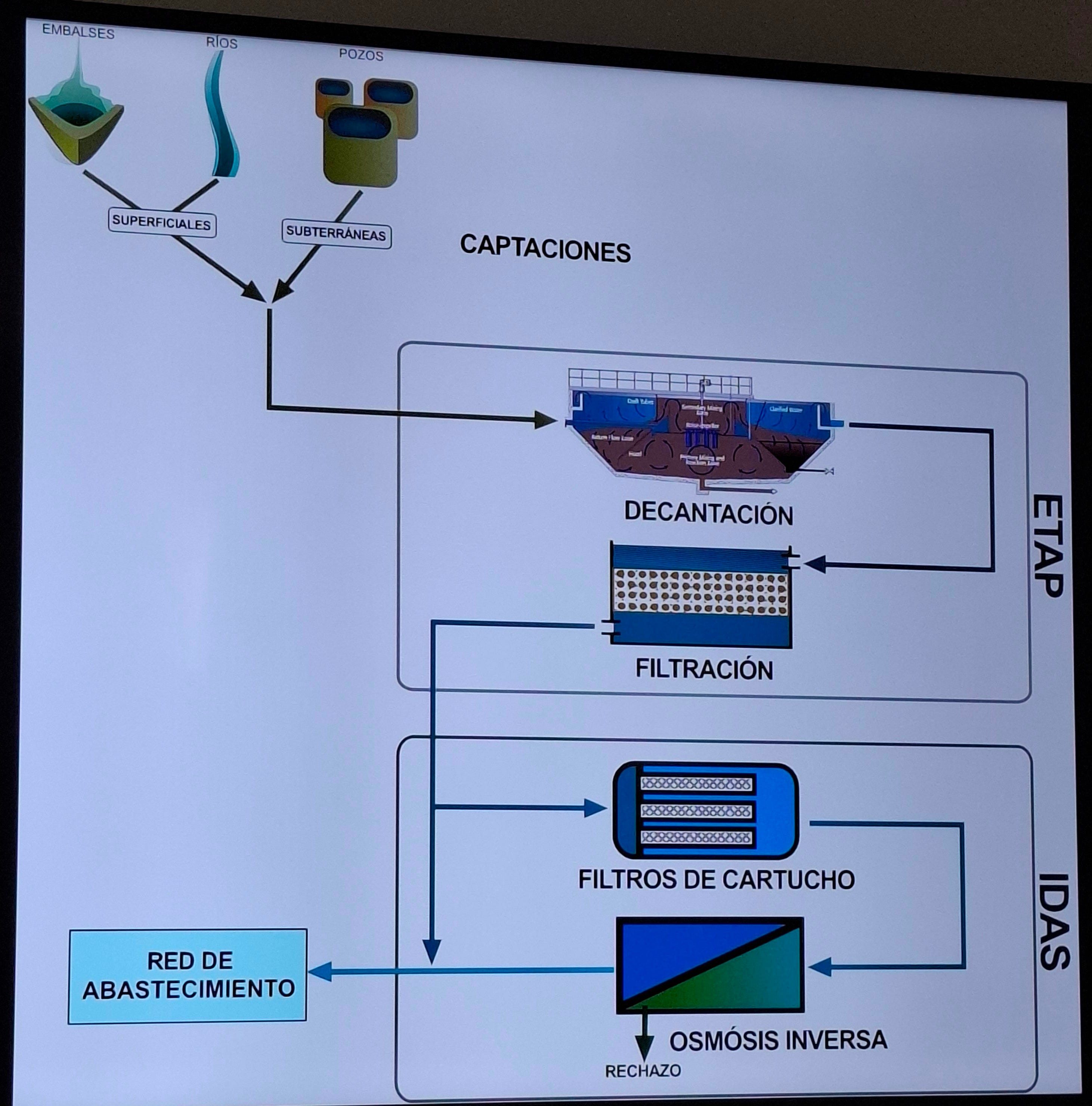
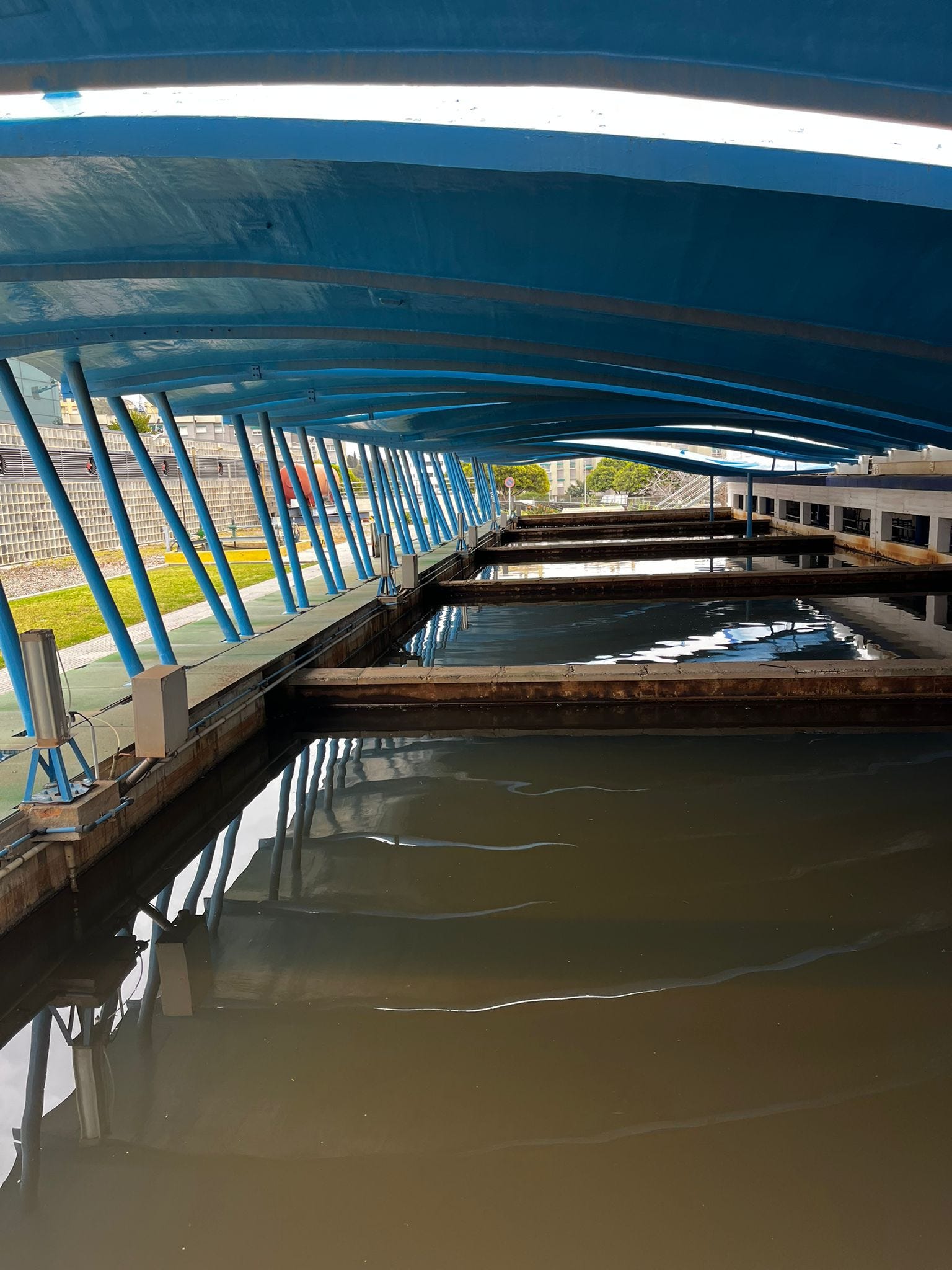
In this context, the Embalse del Guadalhorce system was developed to supply water to the growing city of Málaga. Alongside it, a conventional drinking water treatment plant—today known as “El Atabal”—was built in the 1970s, with typical processes: coagulation, settling (the picture below), and gravity filtration (explained later)..
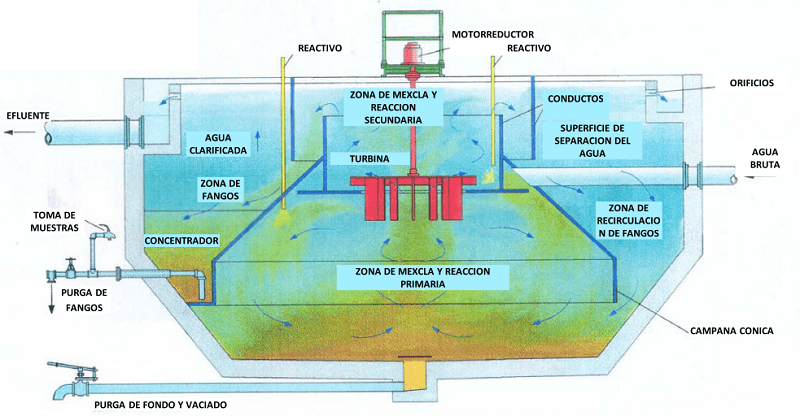
These are the “clouds” that Nicolas mentioned in the video.
So by the mid-1970s, the system was in place.
But here’s the twist.
This reservoir system is affected by natural saline springs emerging from the surrounding geology. These springs can reach salinity levels above 100,000 mg/L TDS—almost three times seawater.
Hard to believe, but true. Bad luck.
These waters come from an aquifer that flows through Triassic formations rich in salts and gypsum. As the water passes through these rocks, it dissolves the minerals and carries them directly into the reservoir.
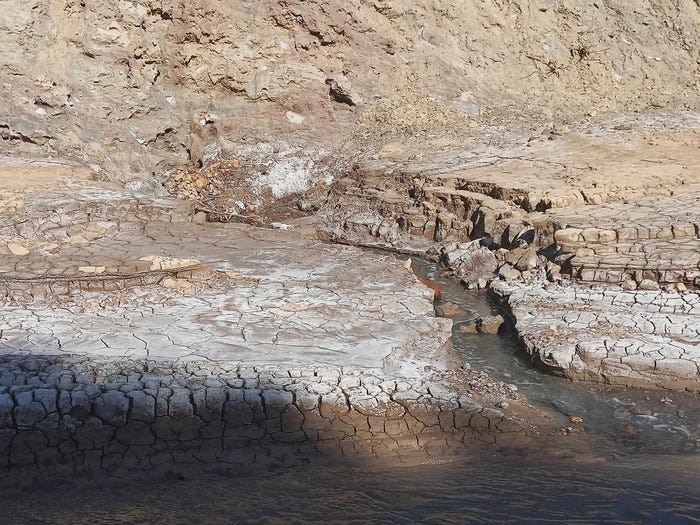
When the reservoir is at high capacity, this saline input is diluted and the blended water remains manageable.
However, during drought periods, when water levels drop, the relative impact of these saline inflows increases significantly, leading to much higher salinity in the raw water.
From the reservoir, water travels through a ~50 km open canal toward the treatment plant. Along the way:
Farmers abstract water for irrigation
When salinity rises, irrigation becomes unviable
There was even an attempt to solve the problem at the source:
A brine bypass pipeline was built to divert the saline spring directly to the sea
But the system ultimately failed for multiple reasons
So what do you do when your “freshwater” reservoir behaves like brackish water?
For years, up to around 2000, the system relied on:
Blending strategies
Operational adjustments
What operators would call… a bit of “alchemy”
At the same time, groundwater wells were developed during severe droughts. These proved highly valuable and are now a key component to balance both quality and quantity.
Another challenge: time and unpredictability.
Water takes a few hours to travel from the reservoir to the plant, so operator must anticipate what’s coming analyzing the water at the intake.
Events like landslides or storms along the canal can suddenly spike turbidity and suspended solids. And sometimes this is detected only when the water is already arriving at the plant.
The turning point came in the early 2000s.
Due to persistent complaints about water quality from the citizens, it was decided to upgrade the plant.
A brackish water desalination system was added (commissioned around 2005), designed to treat up to 6,500 mg/L TDS.
Simple mechanical solutions sometimes outperform digital systems
One particularly interesting feature was the flow regulation system in the sand filters.
Instead of automated control valves, the filters use hydraulic siphon regulation.
“Aquazur V” gravity rapid sand filters with siphon-based level control of Degremont, now Suez.
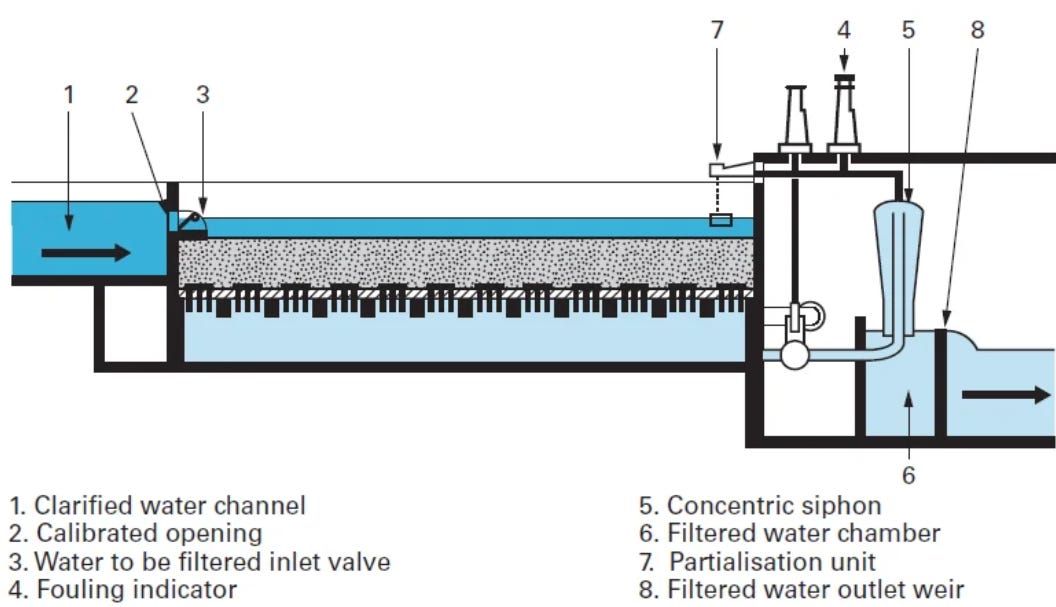
The principle is simple:
a siphon pipe removes water from the filter
air admission into the siphon is controlled by a float
by allowing more or less air, the flow rate changes.
As the filter clogs and head loss increases, the float adjusts the air intake and stabilizes the flow.
This system requires:
no electricity
minimal maintenance
simple mechanical parts.
Robust engineering solutions sometimes rely on physics rather than electronics.
Energy recovery matters even in brackish desalination
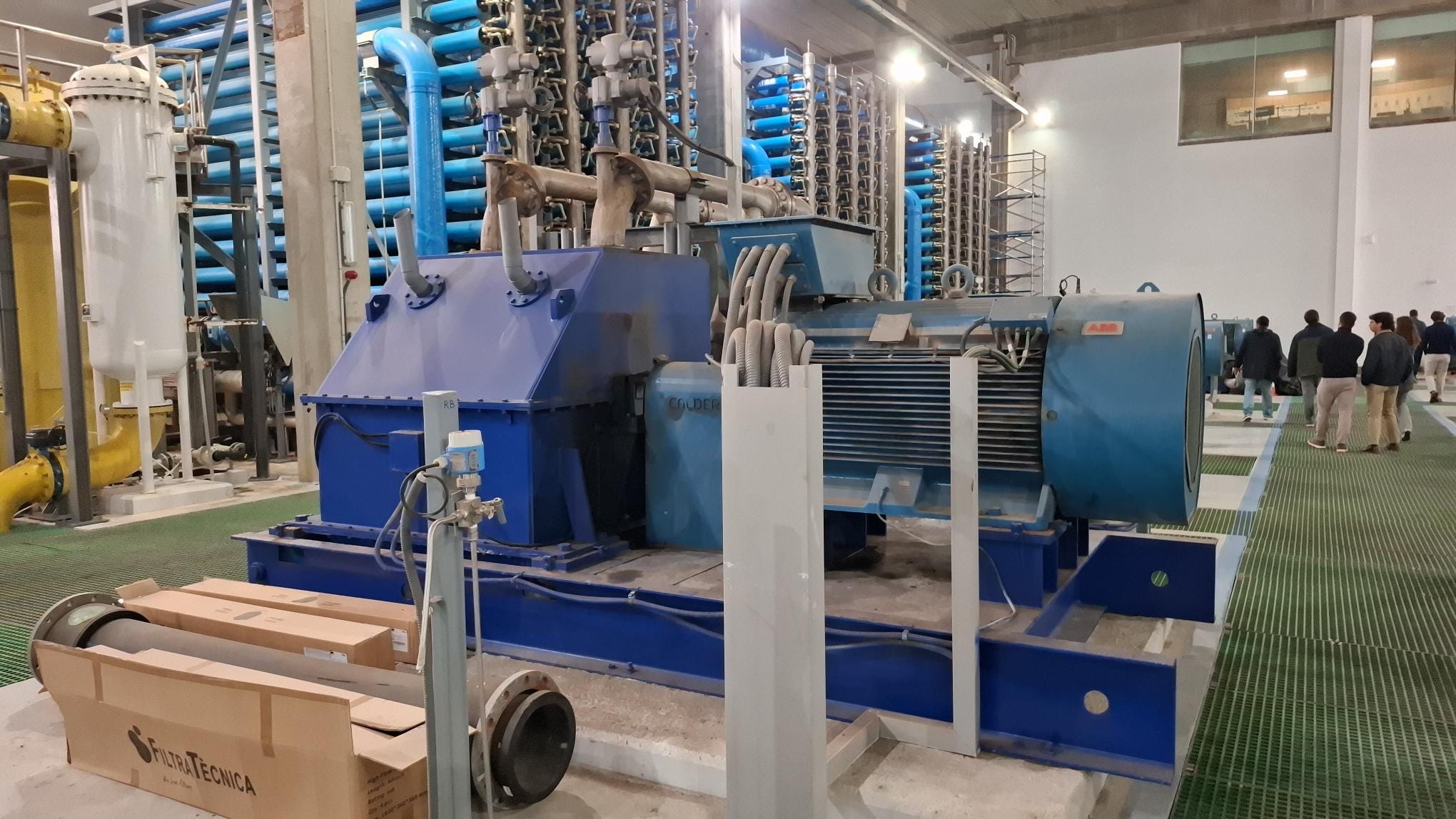
Although energy consumption is lower than in seawater desalination, the plant still incorporates energy recovery turbines.
The Pelton turbines installed with the desalination system:
recovered hydraulic energy from the reject stream
paid back their investment within the design period
continue to operate reliably decades later.
Their long-term performance highlights the value of simple and durable energy recovery systems.
Following our last piece on energy recovery innovation, I asked Nicolas why PX devices were not installed at the time.
The answer goes back to the early 2000s: PX technology was not yet fully proven or consolidated for brackish water applications, so a Pelton turbine from Calder (below picture) was selected instead.
Now the question is: after years of continued innovation, would PX devices perform better today and reduce OPEX?
Maybe yes, maybe not—it depends on the variable operating conditions.
However, when you factor in the current level of amortization and the additional costs of replacing the system, the existing turbines are still performing well. They’ve had no major maintenance issues.
It’s a good example of how, although our industry can change dramatically over 20 years, once infrastructure is built, it tends to stay.
Just like MSF plants in the Middle East, replacement often has to wait until the end of the asset’s lifetime, even if, if we were designing the plant today, the solution would likely be very different.
Smart hydraulics can reduce energy dependence
One of the usual design aspects of the plant is how much of the system works by gravity.
Before the desalination step:
water flows through most of the treatment process without pumping.
Only when entering the reverse osmosis section in the intermediate pump station does the system begin to consume electricity.
This philosophy reflects classical hydraulic engineering, where energy efficiency is achieved through elevation differences rather than mechanical systems.
The consumption of the plant is around 0,8-1,3 kwh/m3 approximately.
Infrastructure evolves incrementally
The desalination plant was built in 2004 and has since been expanded.
Each membrane rack originally had 100 pressure vessel positions, but space was intentionally left for expansion.
In 2022 the plant increased capacity by filling those remaining positions, reaching 117 vessels per rack.
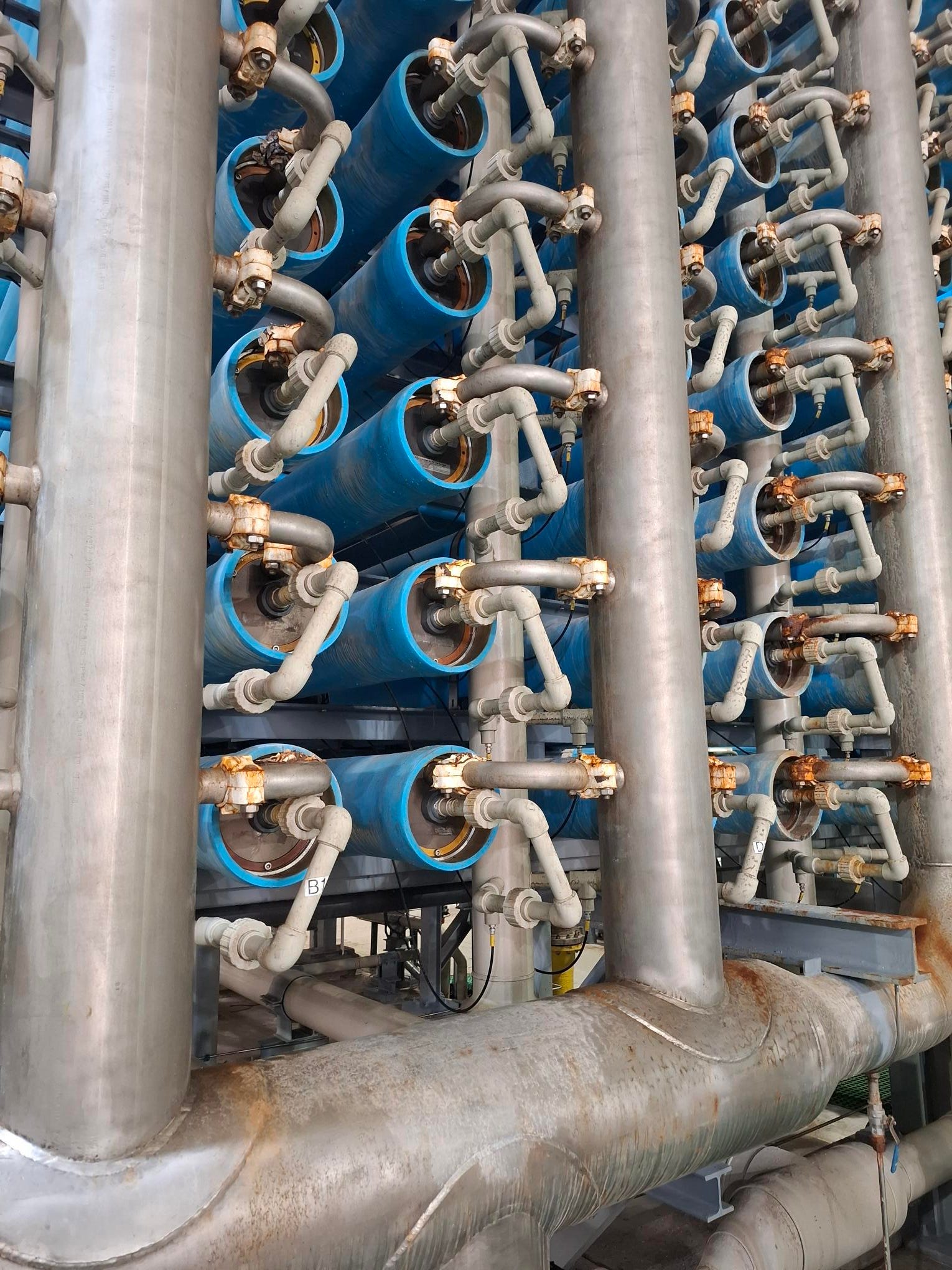
This expansion also required upgrading other equipment:
booster pumps
motors
variable frequency drives (below picture located in the Electrical Room)
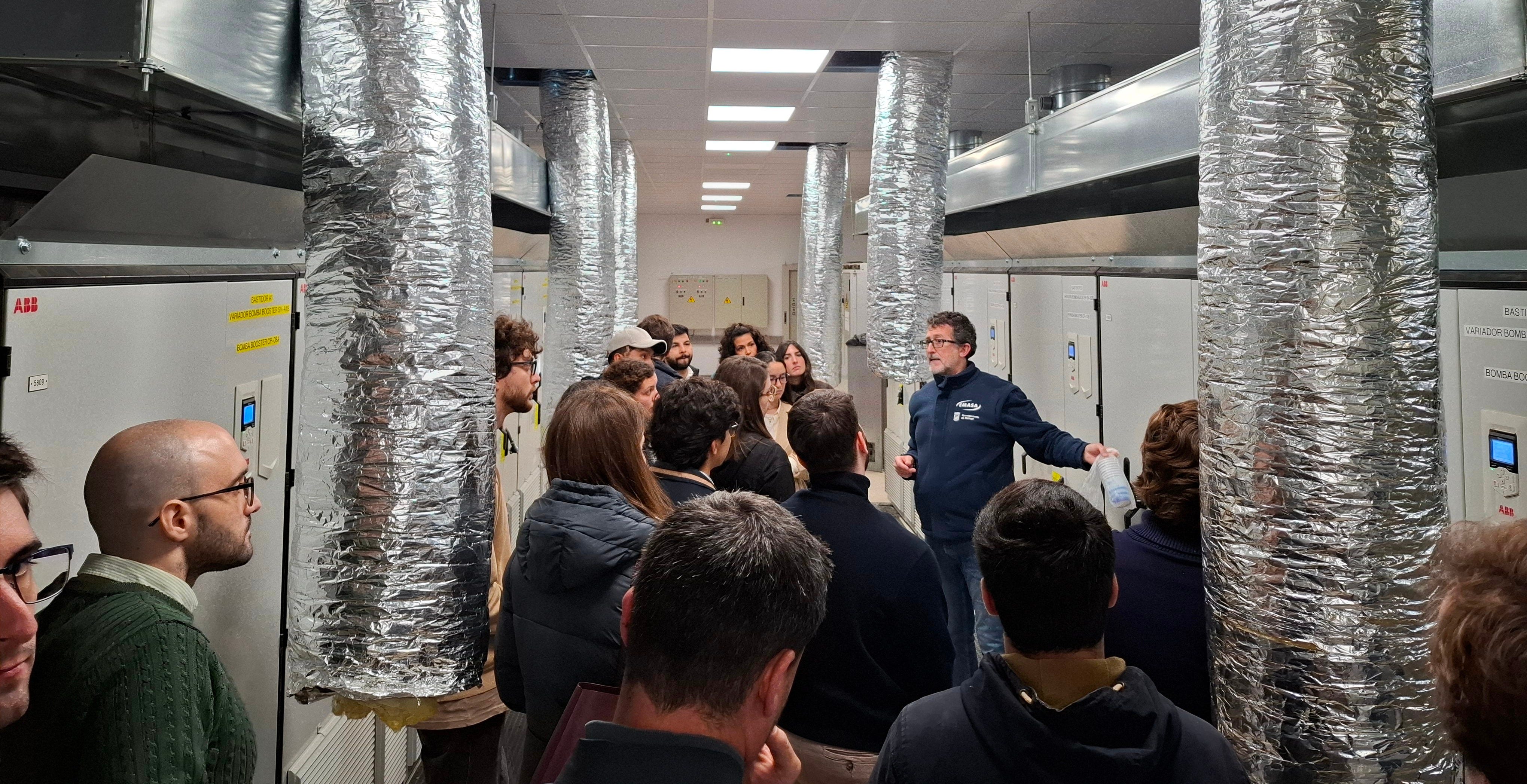
Many of us struggle with current projects where we need to leave reserve space, it becomes especially complicated when trying to integrate future capacity into present designs, but
designing infrastructure with future expansion in mind may reduce costs decades later.
Brackish desalination with surface water feed is one of the toughest scenarios
Nicolás described the plant in a memorable way in the video:
“This is a motocross plant.”
The analogy reflects the harsh operating conditions.
Compared with seawater desalination, this facility treats surface brackish water, which introduces several challenges simultaneously:
high turbidity variability
biological growth
seasonal changes in water quality
organic fouling risks.
While seawater is relatively stable, surface water brings dynamic and unpredictable loads.
As a result:
membrane cleaning is more frequent
pretreatment is critical
operational vigilance is constant.
Membrane lifetime therefore depends heavily on operating conditions. The comparison used by the operator was striking:
“How long do membranes last? It depends — like trousers.”
wedding trousers last decades
motocross trousers wear out quickly.
The point is clear: lifetime depends on how aggressively they are used and under what conditions.
The control room
A very interesting part of any plant is what you could call its “brain.” As Nicolás pointed out, each part of a facility can be compared to a function in the human body, and the control room is clearly the brain.
What really caught my attention was a simple post in the room, referencing Homer Simpson in his iconic role as a nuclear plant operator.
It read:
“To operate a plant, the first thing is to control your emotions. When every alarm is going off, stay calm above all.”
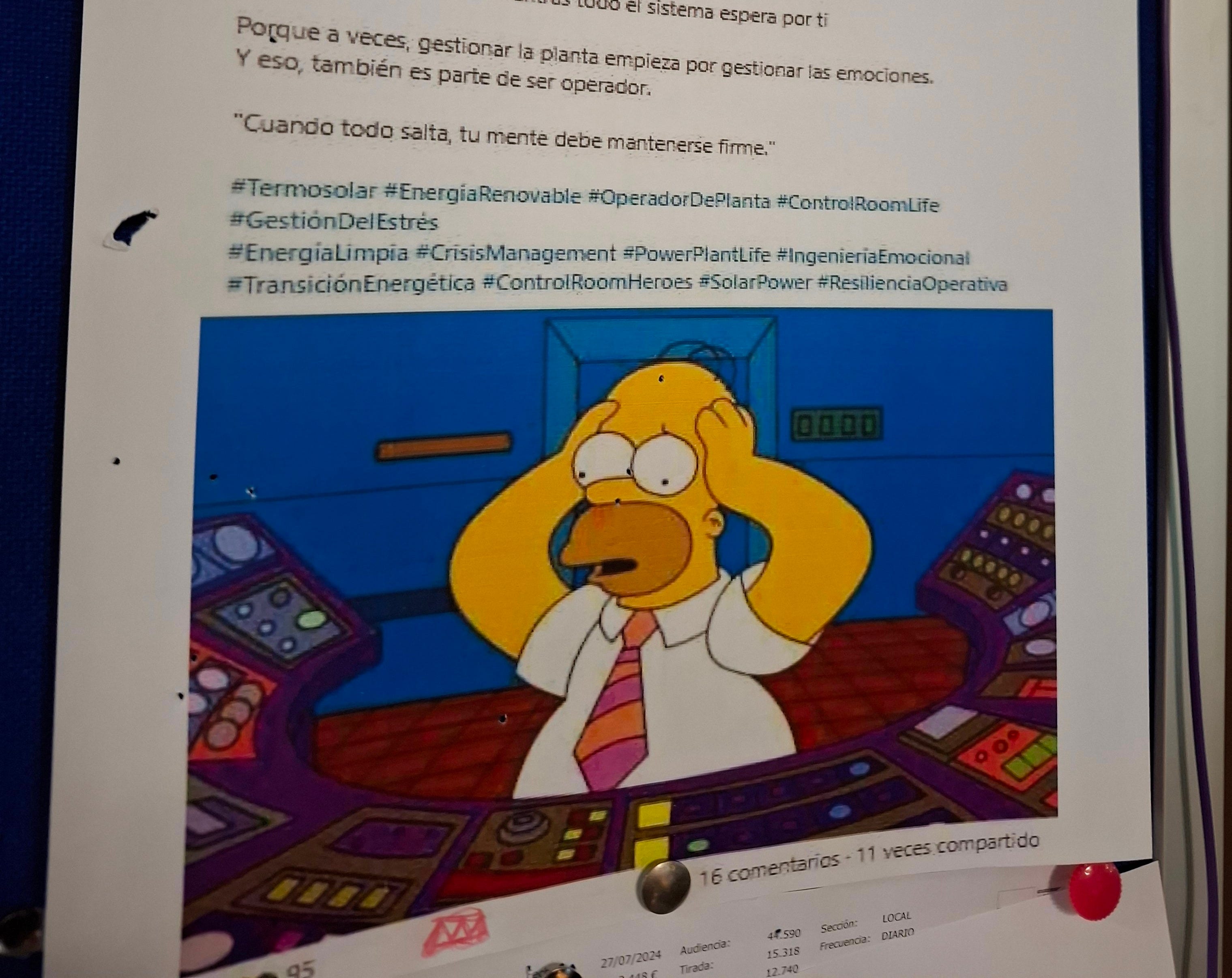
It may sound humorous at first, but it carries a truth. Technical skills are essential, of course, but composure under pressure is what truly defines great operators.
So cheers to all plant and facility operators around the world, the people behind the scenes who make complex systems work, day in and day out, no matter the circumstances.
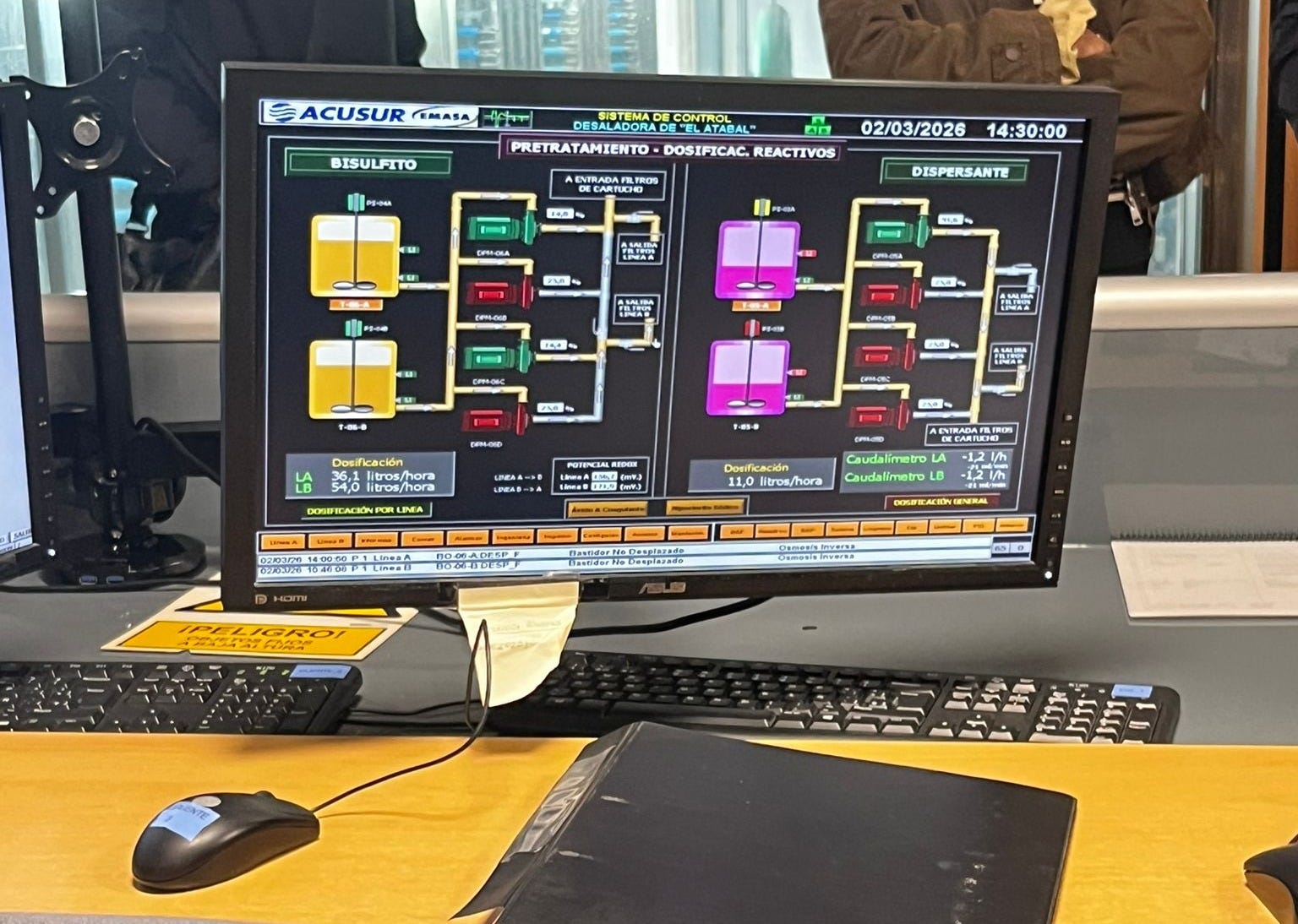
Remarks
You quickly realize that delivering water to your tap is a much bigger story than it seems.
Every case is different, and the more projects we study around the world, the more context we gain and the better prepared we are.
In this case, we see a mix of realities: infrastructure that failed due to unexpected salinity, alongside a hybrid plant (1970 + 2005) that continues to operate reliably despite far-from-ideal conditions.
Pressure on the system keeps increasing, and new plans for another desalination plant are already being considered—likely with a completely different design and equipment.
Although our industry is often seen as slow-moving, innovation always finds its way, consolidates, and ultimately shapes the future. Our role is to help guide both the renewal of existing assets and the development of new infrastructure.
Thanks to everyone who attended, and especially to Emasa and Nicolás for sharing such a valuable depth of knowledge.