

Imagine starting a conversation about water with someone whose birthday falls on Earth Day, someone for whom stewardship isn’t just a professional choice, but a personal calling.
That’s Alicia Dauth.
From growing up in California’s desert, learning about conservation from utility experts, to working across the U.S., Southern Africa, and the Middle East, Alicia has made understanding and protecting water resources her life’s work.
In our conversation, she took us through the full spectrum of water challenges: the risks, the strategies, and the assurance mechanisms that make sustainable management possible.
For Alicia, it all begins with water risk assessment, understanding physical, infrastructure, and reputational risks that can cascade if left unchecked.
Only then can organizations move confidently toward water stewardship, responsibly managing resources, replenishing them, and communicating transparently with stakeholders.
And finally, water assurance provides verification that these actions are effective and continuously improving.
Beyond frameworks, Alicia shared practical steps for organizations, from understanding water footprints and training staff to tracking progress and learning from others.
She also offered a glimpse into the future of water management: AI-powered monitoring, mandatory water quality standards, increased reuse and recycling, and standardized reporting that may one day include comprehensive water footprint disclosures.
For young professionals, Alicia’s advice is simple but powerful:
Get involved, ask questions, attend conferences, and embrace every role (even those less glamorous) to make a tangible impact.
The water sector, she reminds us, is not just a career, it’s a purpose-driven, sustainable field that offers long-term impact for communities and generations to come.
Hope you like it and learn something.
What would water say?
Alicia recently published one of the best posts I’ve ever read in LinkedIn, if water could call us, what would it ask?
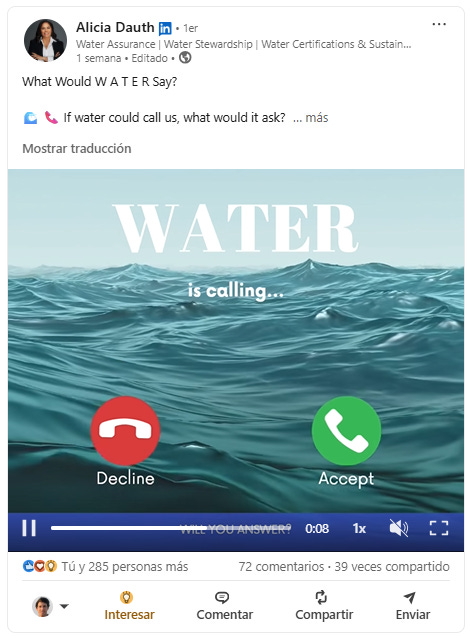
I’m not sure what water would ask, but our questions were clearly focused on understanding the context of all these words that many of us have not much clear.
Who is Alicia Dauth, what is your background, and how did you specialize in environmental engineering and water stewardship?
How has working in diverse regions like South Africa and the Middle East shaped your approach to water issues, given their different challenges?
What is water stewardship, how do you define it, and what does it mean in your daily professional practice?
In your role, do you primarily work with utilities, private companies, or NGOs, and what does a typical day involve?
What are the main types of water risks that organizations are facing today, such as physical, infrastructure, or reputational risks?
What actionable steps can companies take to improve their water conservation or resilience strategies in practice?
What trends do you foresee in the water industry in the next 10 to 20 years, and what specializations might be important for new professionals?
Do you have any advice for someone recently joining the water industry or looking to make a positive impact beyond their job?
Do you recommend any specific water industry events or conferences that you have attended and enjoyed most?
What risks?
Alicia breaks water risks down into three main types.
First, there’s physical risk, which covers a wide range of issues, with water quality being a key factor.
Even if water is plentiful, if it isn’t suitable for its intended use, it’s still a problem.
Next comes infrastructure risk. This occurs when there isn’t the right infrastructure to manage or treat water quality issues.
For example, a site might have poor-quality water but lack the systems to treat it, creating a clear infrastructure risk.
Finally, there’s reputational risk, which can result from failing to address the first two.
If an organization can’t manage physical or infrastructure risks effectively, its reputation can suffer.
Alicia emphasizes that these risks are connected in a “cause and effect” chain, one can lead to another.
That’s why she says conducting a water risk assessment is the absolute first step before moving forward with stewardship or assurance efforts.
What is water stewardship?
To be honest, I used to have doubts.
Coming from designing and constructing large infrastructure, everything I read about stewardship sounded great on paper, but I couldn’t see how it actually played out in the daily work of a professional.
Now, after learning more, it’s much clearer.
According to Alicia Dauth, water stewardship is defined as:
“Water stewardship is when you are really looking to do something that’s going to benefit that resource responsibly. It’s about being responsible with a resource such as water, being aware of how you’re using it, and understanding the impact your actions have.”
She elaborates that, at its core, it’s about asking:
“Are you using that resource responsibly, or is it impacting others negatively? What can you do to help others who might be facing challenges that you can work on together? It’s about looking much broader than just your own use of water.”
Alicia also describes water stewardship as a framework that guides and challenges you to communicate with the right people, share information transparently, and act responsibly, because water is a resource that ultimately doesn’t belong to anyone individually.
What standards are available to help put all this into practice?
Alliance for Water Stewardship (AWS)
AWS is a global membership collaboration of businesses, NGOs, and public-sector organizations working to create a water-secure world.
It manages the International Water Stewardship Standard, a universal framework for the sustainable use of water.
The AWS Standard helps organizations, particularly those with major water-using sites, understand their water use and impacts, and collaborate transparently with local stakeholders for sustainable management within a wider catchment.
Its goal is to drive water stewardship that is socially and culturally equitable, environmentally sustainable, and economically beneficial, achieved through stakeholder-inclusive, site- and catchment-based actions.
Certification against the AWS Standard, verified by independent third parties, enables organizations to make credible claims about their water stewardship efforts.
SCS (SCS-116 Certification Standard for Water Stewardship and Resiliency)
SCS-116 is a third-party certification standard developed by SCS Standards, outlining requirements for site-specific water stewardship and resiliency practices.
It provides a structured approach with performance criteria for managing water- and climate-related risks, monitoring water quality, and promoting responsible water use.
Applicable globally across industries and organizational sizes, SCS-116 encourages the adoption of best practices in water stewardship and resiliency.
Organizations can pursue “Trailblazer” recognition for excellence in areas such as biodiversity impacts, nature-based solutions, innovative technologies, water circularity, net-zero or net-positive water use, and water quality improvement.
The standard supports organizations in reducing risks, managing costs, strengthening reputation, engaging communities, and promoting transparency.
Actionable steps for any organization
I asked Alicia what a team can do if they aren’t ready for a full certification but want to improve. Her advice was grounded and direct. The first step is always understanding your water footprint. This goes beyond the monthly bill.
Track the data: Where is every drop coming from and where is it going?
Identify the gaps: Where are we losing water or quality?
Train the staff: Is the team aware of how their daily actions affect the resource?
Look at “one water”: Treat wastewater and greywater as assets, not just waste.
She highlighted that the future of the sector lies in water quality and AI. As we reuse water more frequently, our ability to detect contaminants and predict shortages using technology will be our greatest strength.
Think about it
Alicia reminds us that “everyone belongs in the water discussion.” Whether you are an engineer, a student, or a citizen, you have a stake in how this resource is managed.
My takeaway from our talk is that we should never be afraid to ask the simple questions. Often, it is the simplest question that reveals the most significant risk or the best opportunity for improvement.
How much do you actually know about the water that enters and leaves your workplace or home?
Thanks for reading, watching and engaging!


