

This week, a special focus on Chile due to the upcoming gathering of ACADES 2026.
We have 36 professionals in Chile actively engaged with our community. I know most of them behind the scenes, and believe me, they are truly top.
I hope this busy week will be useful, and that you’ll be able to catch these episodes.
We’re publishing the best of the best of what we’ve learned about Chile and water during last 3 years, starting today with our episode featuring Carlos Rubilar.
Throughout the week, you’ll also find conversations with:
Carlos Goitia from Aguas Nuevas
Alberto Kresse from ACADES
Important note: no specific essay will be sent to your inbox. The episodes will be available directly on our website and on Spotify.
In this episode, Carlos Rubilar Camurri, a journalist with an MBA and deep experience in the Chilean public water sector.
We often focus on the engineering or the chemistry of water, but we neglect how we explain these challenges to the public.
Carlos brings a unique perspective from his time at the General Directorate of Water (DGA) in Chile, a country that has faced over a decade of intense drought.
Understanding how to bridge the gap between technical reality and public perception is more relevant than ever as we face global climate uncertainty.
Context
The water sector faces a recurring paradox: when the service works perfectly, it becomes invisible.
In Chile, as in many other places, people can open their taps and receive high-quality water even in the middle of a severe drought.
This “success” of the industry sometimes creates a lack of urgency in the general population.
We discussed the challenge of managing water in a country with extreme geographical diversity, from the arid Atacama Desert to the frozen south, and why effective communication is the only way to build a sustainable water culture.
What is not communicated does not exist
Carlos shared a phrase that stayed with us:
what is not communicated does not exist.
In the water business, this is a constant struggle.
During his time in the government, Chile was going through a “mega-drought,” yet in cities like Santiago, the parks stayed green and the taps stayed on.
Without a clear communication strategy, it is impossible for a citizen to understand that the resource is at risk.
We reflected on the fact that communication is not just about giving news, but about educating the public so they can support the difficult decisions and investments needed for the future.
The challenge of managing water by the basin
Chile has 101 water basins, each with its own climate and reality.
Carlos explained that the new Water Code now mandates strategic plans for each basin.
This is a significant shift toward a more local and organized governance.
However, we also discussed the “permisology” or the excessive bureaucracy that often stalls projects.
While environmental protection is essential, we agreed that a balance is needed so that infrastructure, such as small reservoirs or desalination plants, can be built before the next crisis hits.
Desalination and its public perception
A very interesting part of our talk centered on desalination.
In northern Chile, cities like Antofagasta already depend entirely on desalted water.
Curiously, that same city has the highest consumption of bottled water per capita.
This shows a clear failure in communication; the water is high quality, but the people do not trust it yet.
Carlos believes desalination is a key tool for many regions, but it needs better “PR” to explain its safety and environmental safeguards to avoid being used as a political weapon.
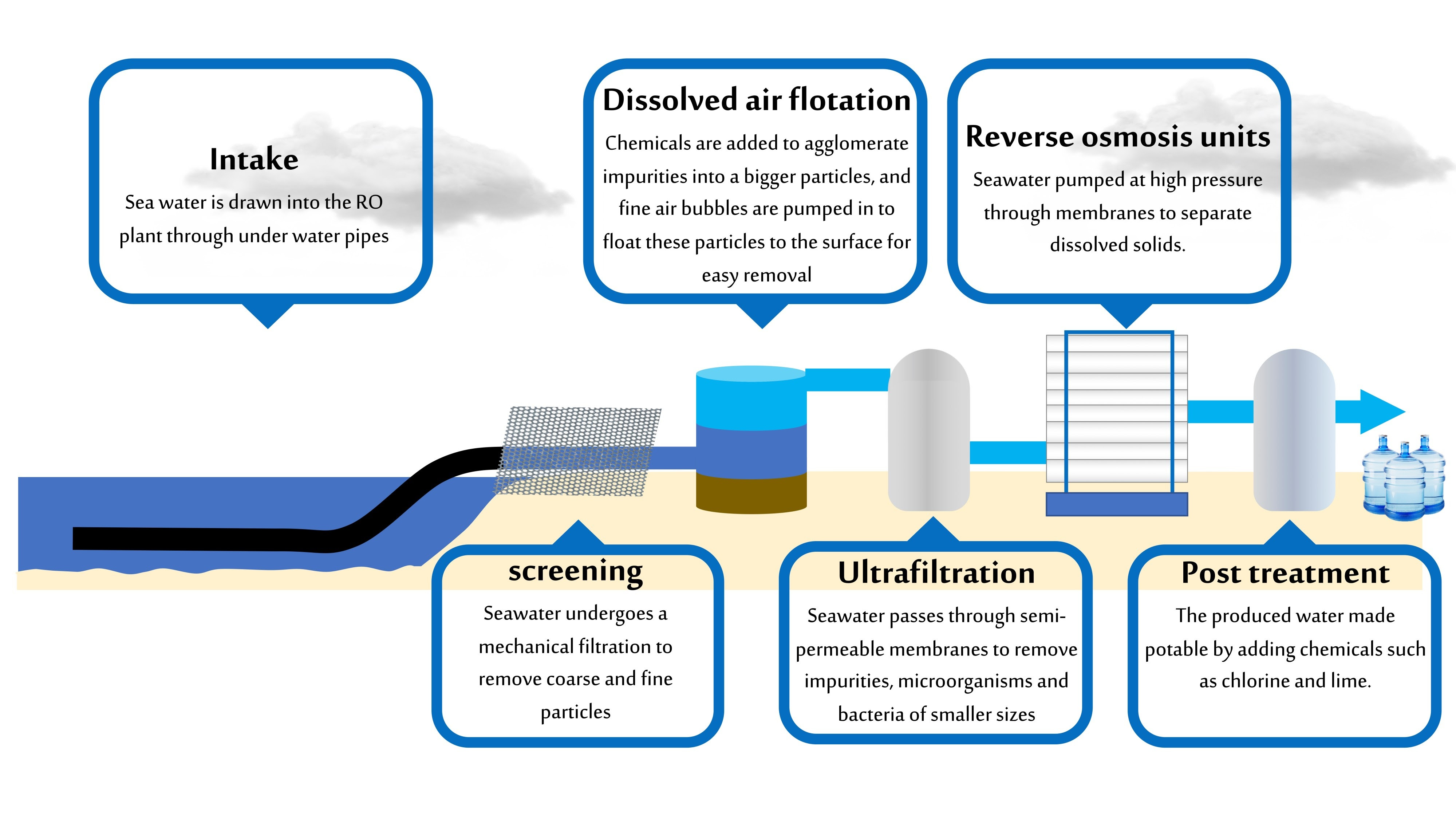
Check below high-level diagram :) Pre-treatment is very variable, we can find media filtration, cartridge filter and ultrafiltration,…
Ownership and the reality of water rights
We touched on the often-misunderstood topic of water rights in Chile.
There is a common narrative that water is “private,” but Carlos clarified the legal reality.
In Chile, water is a national good for public use. The state grants rights to use it, but it also has the power to limit those rights to prioritize human consumption.
He explained that communication is vital here to dispel myths and explain how the system actually balances the needs of agriculture, mining, and the citizens.
I’m preparing a very special episode about Water Rights, so stay tuned.
Closing reflection
My main takeaway from this talk is that technical excellence is not enough.
We can build the best plants and the most efficient networks, but if we do not learn to speak the language of the people, our work will always be underappreciated or misunderstood.


