

I wanted to talk directly with someone on the front line of water management, someone who sees first-hand how efficiency through reuse is evolving across both agriculture and industry.
Reserved place for future sponsors…more info here.
I was curious to understand what trends are emerging from client demands: which aspects they prioritize most, what challenges they face, and how innovation is reshaping the way water is valued and reused in practice.
So I called and had a conversation with Pablo Ruiz, from Azud, a company based in Murcia—the heart of Europe’s driest water basin.
The company has established itself as a leader in efficient water management solutions, a reputation built on Murcia’s culture of water management, where 98% to 99% of treated wastewater is regenerated, far surpassing the 10% rate in the rest of Spain and 3% in Europe.
I’m from Spain, so I already knew what Azud represents within our industry.
But for those who don’t, it’s one of the most reputable teams to collaborate with in their field of expertise, with offices in several parts of the world.
Pablo, beyond being a great person, is one of those rare experts you don’t often come across twice.
I had the chance to have lunch with him at the last Aquatech in Amsterdam a few months ago, and he’s always open to thoughtful conversation — approaching every topic from different angles, explaining, and suggesting better ways whenever he sees them.
Our dialogue centered on three pillars: reuse in industry, efficiency in agriculture, and the growing trend for decentralized solutions.
1. Water Reuse in the Industrial Sector
Industrial water management is inherently complex because every application demands a specific quality and quantity of water.
Today, industries are primarily seeking solutions that strike a balance between sustainability and profitability, typically demanding a return on investment (ROI) within two to three years.
A crucial driver for industrial water projects is the need for companies to become independent of municipal supply, as water is an essential input for their business continuity.
Pablo highlights that nowadays there is a high demand in sectors such as agro-food, automotive, mining, and increasingly, data centers that require significant amounts of cooling water.
As an example of an integrated solution, we discussed the reuse of water from washing baths in the agro-food industry (e.g., for tomatoes used in gazpacho or oranges).
Because high loads of organic matter, pulp, sand, and dirt rapidly contaminate this water, continuous replacement is costly (e.g., 50 cubic meters every 12 to 24 hours for a large facility).
Their solution involves a complete treatment train, beginning with air-assisted disc pre-filtration.
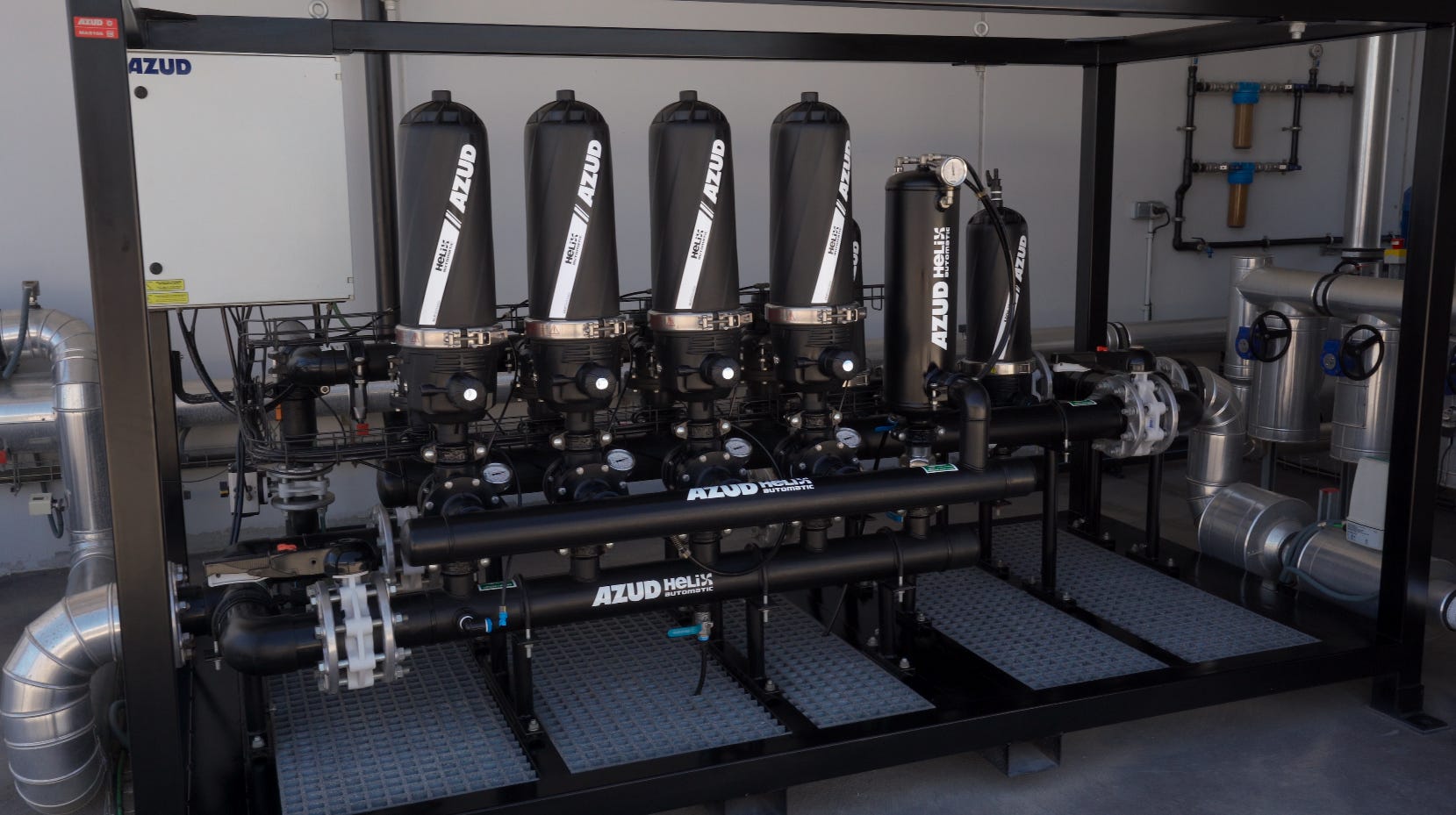
This technology is highly effective because it achieves significant water savings, rejecting only 10 liters of water during backwashing, which represents a 100 to 200 times reduction compared to a sand filter.
The combination of water and air performs a powerful “Karcher effect,” lifting sticky fiber and organic matter off the disc.
This pre-filtration is key to protecting subsequent advanced technologies like ultrafiltration (UF) and disinfection, ultimately producing water quality that meets or exceeds the new standards for reuse in food processes.
However, implementing these solutions sometimes faces barriers.
Customers often show reticence due to past experiences or simply because they are unfamiliar with the technology.
A major challenge is the lack of precise data on water parameters from the client (I know this resonates with some of you a lot…).
I don’t know how this continues to happen…Last week I was requested to estimate a budget for a desalination plant of 500,000 m3/day with just 1 water analytic from 2020 from a nearby area (20 km away…)
When faced with a new application lacking prior experience, the most effective solution is to install a pilot plant to collect real-world data, accurately dimension the system, and calculate the reliable ROI.
2. Water Reuse in Agriculture
In regions like Murcia and Almería, which are critical to Europe’s food supply (”the Garden of Europe”), water culture and efficiency are paramount due to low annual precipitation (250–300 mm).
Drip irrigation is central to efficiency, particularly subsurface drip irrigation, which avoids evaporation by delivering water directly to the plant’s roots.
Irrigation systems require robust protection at the irrigation head to prevent clogging of the small emitters.
Pablo and his team work usually with two main filtration types:
Mesh Filtration: Used for high flow rates and higher micron levels (typically above 100 microns).
Disc/Ring Filtration: More effective against organic particles and, due to its plastic composition, avoids corrosion when using reclaimed water. For protecting drip emitters, standard filtration levels are between 100 and 200 microns.
Modern agriculture is moving toward high levels of automation (5.0 or 6.0), employing sensors for humidity, wind, and conductivity.
This ensures the plant receives the exact amount of water and nutrients needed, optimizing both water usage and the increasing cost of fertilizers.
Regarding regulation, the European Directive 2020/741 governing reuse in irrigation did not fundamentally surprise Spain, given its extensive experience.
However, certain demands, such as achieving a specific quality A for E. coli count (less than 10), are highly restrictive and practically mandate the inclusion of ultrafiltration, which can act as a financial barrier to reuse.
3. Decentralized Solutions
The rise in civil works costs and the geographical dispersion of small municipalities, have driven the demand for decentralized solutions.
They meet this need by offering containerized plants for potabilization, purification, and desalination, designed for low maintenance.
In urban wastewater purification, the national “Plan Depura” is using European funds to modernize treatment plants in small towns (under 10,000 equivalent inhabitants).
Azud employs MBBR (Moving Bed Bioreactor) technology in these containers. MBBR uses fluidized plastic supports (”carriers”) that compact the process, reducing the plant’s footprint and making it highly adaptable to peaks in flow and load (common during tourist seasons or local festivals).
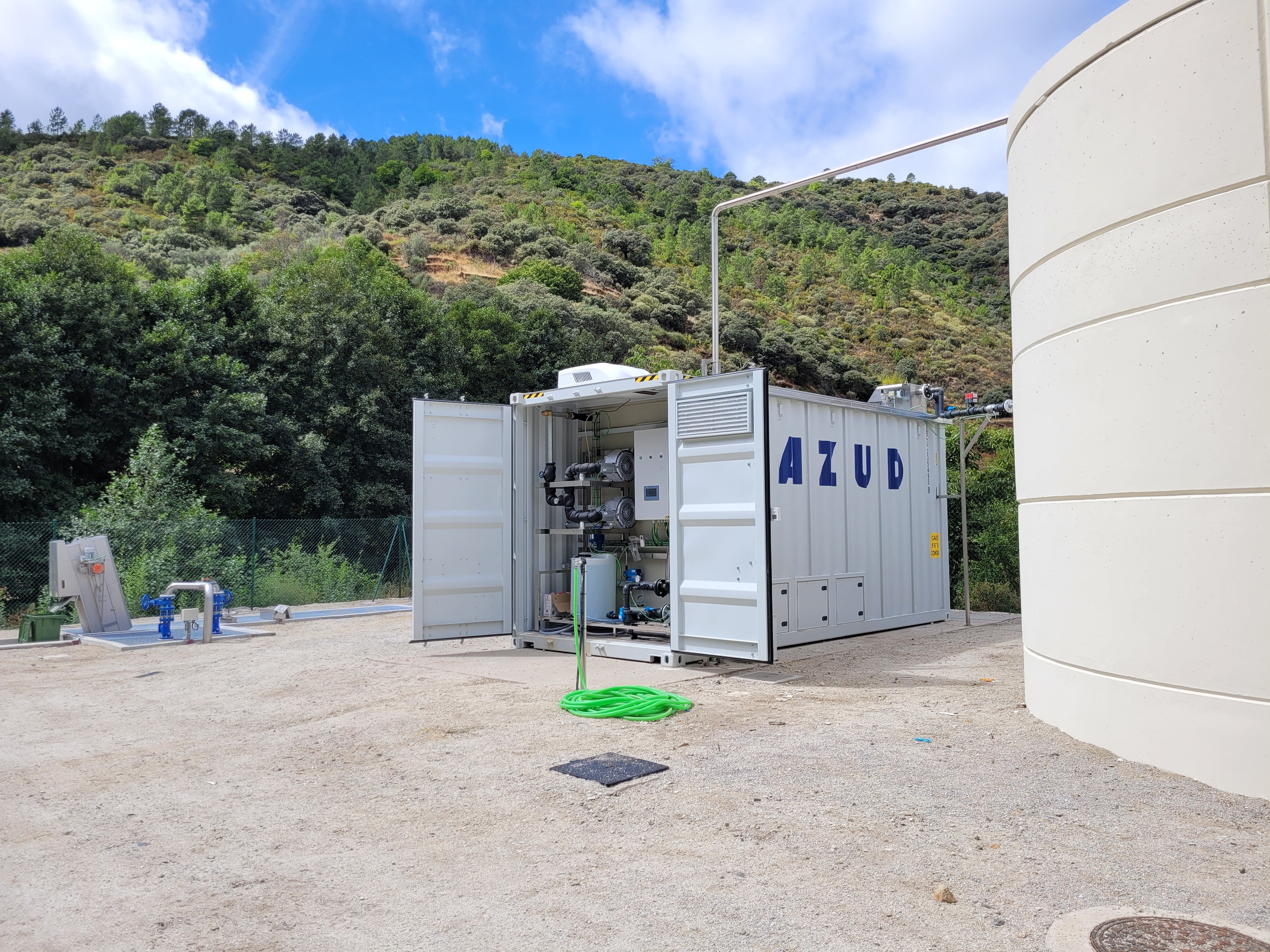
The core advantage is the speed and simplicity of installation: the container arrives, and you simply connect the raw water inlet, the discharge outlet, and the electrical power.
For urgent needs, such as during droughts or emergencies, Azud’s strategy of maintaining stock and pre-assembly is vital.
This allows them to manufacture containerized desalination or potabilization plants in a matter of weeks (e.g., 8–14 weeks), enabling quick responses where lengthy administrative procedures often cause the most delays.
Challenges of the sector
The water sector, despite being conservative and slow, is currently evolving.
We identified several ongoing challenges and necessary paths for improvement:
Legislative Complexity: The sheer volume of legislation (European, national, and regional) creates a framework that often confuses end-users regarding the exact procedures needed for water recycling or regeneration.
Talent Retention: It is difficult both to attract and retain specialized young talent—both engineers and technical vocation training technicians—who are essential for the operation and maintenance of these systems.
Communication and Uncertainty: A lack of clear communication and simplification leaves clients in doubt, hindering the adoption of new solutions.
For young professionals entering this field, the advice is clear: be perseverant, curious, and passionate, but most importantly, have patience, as opportunities will eventually arise in this essential and growing sector.
Solving a little problem in a small WWTP
Last summer, I visited the wastewater treatment plant near our beach house (well, technically it’s my wife’s, but you know — marriage comes with advantages…sometimes). The plant serves a small coastal community of around 1,600 households and a hotel.
What caught my attention is that the residents, not the municipality, are responsible for its operation — a result of “political” arrangements.
And when the plant fails to meet discharge limits, the regional authority steps in to inspect… and the fines are paid directly by the neighbors.
Over time, this has created a strange paradox:
it’s often easier to just pay the penalty than to achieve full compliance.
This small case perfectly illustrates a broader issue in our industry.
It’s the foundation for two of our upcoming episodes — one on countries where non-compliance can even lead to prison (therefore, tech adoption is non-negotiable by decision-makers), and another exploring the complex path toward achieving true regulatory compliance.
Now, I’m working on compiling the business model for installing an MBBR container, taking into account the amount we pay in penalties each year.
This is what I enjoy the most — analyzing real numbers, not just stories. It’s also the most challenging part, so it will take some time, but once I have the full analysis, I’ll share it with all of you.
Water and agriculture…
I’m starting to piece together more of the water–food nexus, which becomes especially clear when you realize that 70% of the world’s water is consumed by agriculture.
It’s curious that our industry doesn’t talk much about this, we talk about water scarcity and stress, but we do not analyse in depth how the water is being handled on real ground for agriculture.
In 2026, I have big plans to step into the agricultural world, and share with all of you the findings.
That’s what I love about water—it’s the perfect excuse to explore other fields, research, and understand what’s really going on.
See you next week!
And as you can sense, the context of our water world is evolving every day. It’s becoming clear that reuse and efficiency is the core of the water resilience strategy for next years, expanding the presence across the globe.
I hope you enjoyed this week’s edition and learned something new. And if not — no worries — there’s always next week for another chance to make you rethink how we see our business.