

Over the last few days, many friends and colleagues have been messaging me.
Whenever desalination or water infrastructure appears in the news cycle, people in my circle tend to send it my way, and I genuinely appreciate that. It means that when people see a headline about water, they think about the work we do at The Water MBA and the conversations we’ve been building around this sector.
With the latest escalation involving Iran, one topic suddenly started trending:
the vulnerability of desalination plants in the Middle East and whether they could become targets in a war scenario.
I’ve seen a lot of confusion, and frankly, a lot of misinformation. So I decided to record a quick video for friends and colleagues (in Spanish) to clarify a few things and share how people inside the sector think about these risks.
This essay is essentially the written english version so we can all know be aware of it.
The technology that allowed the Middle East to flourish
To understand why desalination matters so much in this region, we need to step back a little.
Imagine the Middle East around the 1950s.

Large parts of the region were essentially desert. Water resources were extremely limited. Traditional groundwater and oasis systems could only support small populations.
Then two things changed everything:
Oil and gas
Desalination
Modern desalination technologies began scaling around the mid-20th century. Early installations relied on thermal desalination processes, particularly multi-stage flash distillation, which started appearing across Gulf countries in the 1950s and 1960s.
Kuwait was one of the earliest adopters, building some of the first large-scale plants.
Later, another technological revolution arrived: membrane desalination, the technology that underpins modern reverse osmosis plants.
There’s a famous speech by U.S. President John F. Kennedy in the early 1960s where he spoke about desalination as a breakthrough that could allow arid regions of the world to “bloom”. In many ways, that prediction turned out to be remarkably accurate.
From the 1970s onward:
pilot projects expanded
technology improved
costs gradually decreased
By the 1990s, desalination had become economically viable at scale.
By the 2000s, it was exploding.
Today, desalination is not just part of the Middle East’s water supply, it is the backbone of it.
A region built on desalinated water
Several Gulf countries rely overwhelmingly on desalinated water for their municipal supply.
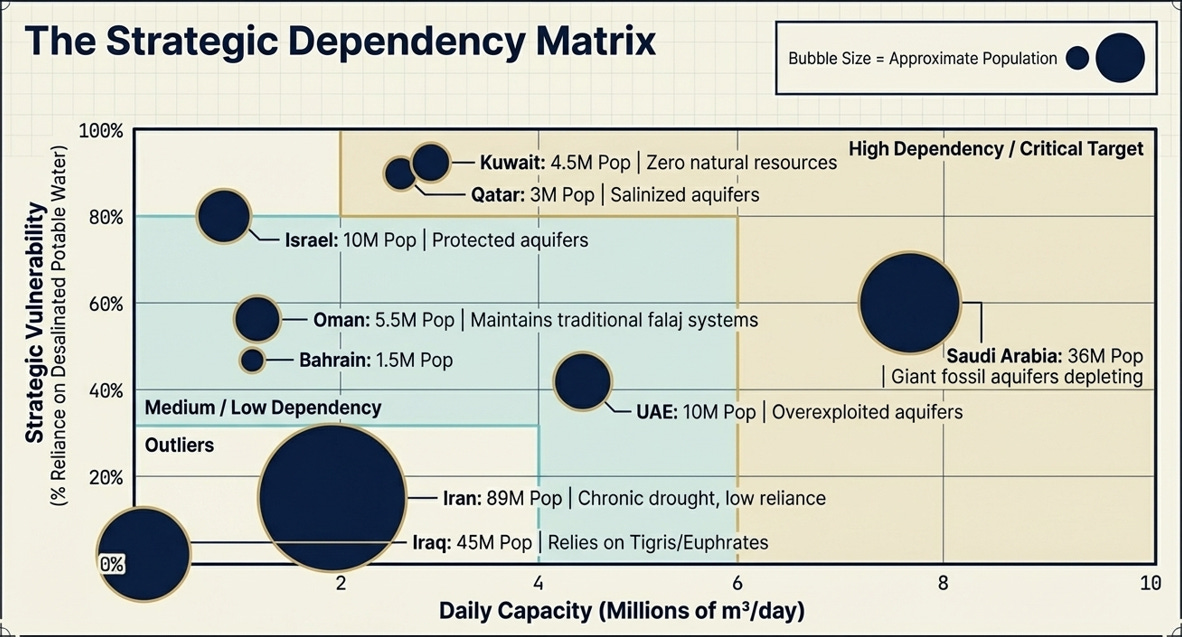
Desalinated seawater supplies most of the drinking water.
Geography explains why. Nearly all of these countries sit along the Persian Gulf coastline, facing Iran across a relatively narrow body of water.
Saudi Arabia also operates massive desalination capacity, both on the Gulf and along the Red Sea coast, where many plants supply inland cities through long transmission pipelines.
If desalination disappeared tomorrow, much of the region would simply not be able to sustain its current population or economic activity.
This is why desalination is often described as strategic infrastructure.
Water has always been a weapon
The idea that water infrastructure could become a military target is not new.
Historically, armies have always tried to control water sources:
destroying wells
poisoning rivers
cutting supply routes
targeting dams or reservoirs
Water has always been a lever of power in conflict.
What’s different in the Middle East today is that desalination plants are the key nodes of the water system.
In previous centuries, the critical asset might have been a river crossing or an irrigation canal.
Today, it might be a desalination plant.
In fact, even before current tensions, some desalination facilities — especially those along the Red Sea — have already faced security concerns related to drone warfare and regional conflicts such as the Yemen war.
So the idea that desalination plants could become targets is not shocking to anyone in the industry.
They have long been treated as critical infrastructure.
But desalination is not the only line of defense
Here’s where much of the public discussion goes wrong.
Many people imagine that if a desalination plant were hit, a country would run out of water almost immediately.
That’s simply not how water systems are designed.
Water infrastructure — especially in regions dependent on desalination — is built with multiple layers of contingency (we already learnt in the UAE Case Study)
1. Massive strategic storage
If you travel across the Gulf, you’ll see enormous water tanks everywhere.
Not small tanks.
Gigantic ones.
Many desalination projects include two or three days of storage directly integrated with the plant. On top of that, many countries maintain strategic reserves of weeks or even months.
Qatar, for example, invested heavily in what are often called mega-reservoir projects, designed to store large quantities of desalinated water across the country.
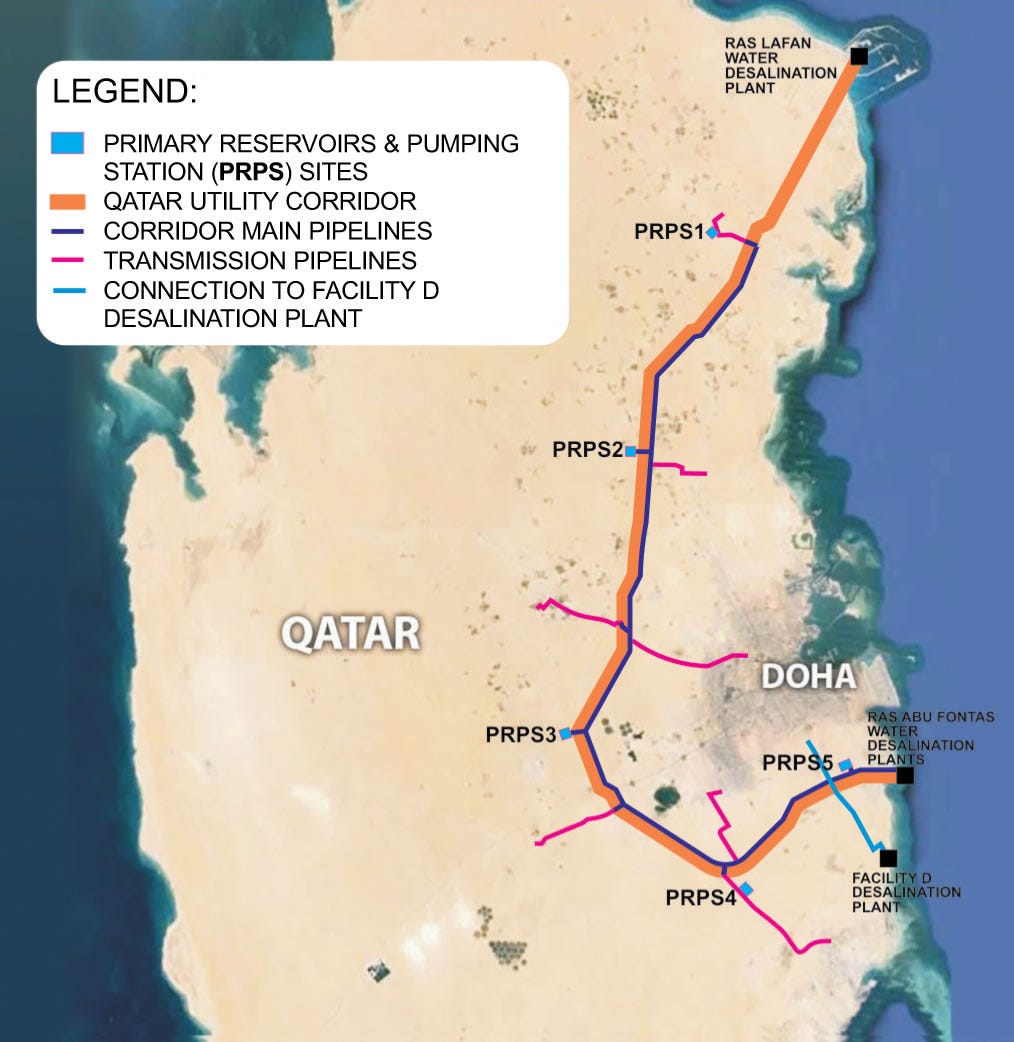
Some nations maintain reserves that can last 30, 60, or even 90 days.
That buys a lot of time in an emergency.
2. Groundwater reserves
Another interesting strategy is artificial aquifer recharge. (already published under my advisory role with farmers as mentioned a few weeks ago)
Some Gulf countries inject desalinated water into underground aquifers, creating hidden strategic reserves.
This has two advantages:
it protects the water from evaporation
it improves the water ecosystem
and curiously now it protects the reserves from surface-level attacks
Once stored underground, those reserves are extremely difficult to disrupt.
You can damage the pump well system, but actually it is much faster to construct new wells, than reconstructing a desalination plant partially.
3. System interconnection
Another key feature of modern water systems is network redundancy.
Cities are rarely dependent on a single plant.
Pipelines connect multiple production sources, allowing operators to redirect supply if one facility goes offline.
Saudi Arabia, for example, operates extensive transmission systems that connect coastal desalination plants to inland cities, and these systems are often designed with redundancy to ensure supply continuity.
4. Alternative sources
In extreme scenarios, countries can activate temporary solutions:
groundwater extraction
water imports by tanker
mobile treatment plants
We’ve seen similar emergency measures even in places like southern Spain during severe droughts.
They’re not ideal, but they buy time.
5. Demand prioritization
Finally, in crisis situations, water allocation follows clear priority rules.
Typically the order is something like:
hospitals and emergency services
domestic consumption
energy infrastructure
essential industry
agriculture
We’ve seen similar demand management measures during droughts in Spain, including reductions in irrigation allocations.
The energy-water connection
There’s another dimension that often goes unnoticed.
Desalination is not only about drinking water.
It’s also deeply connected to energy systems.
Many desalination plants are integrated with power plants. Thermal desalination systems, in particular, often share infrastructure with electricity generation.
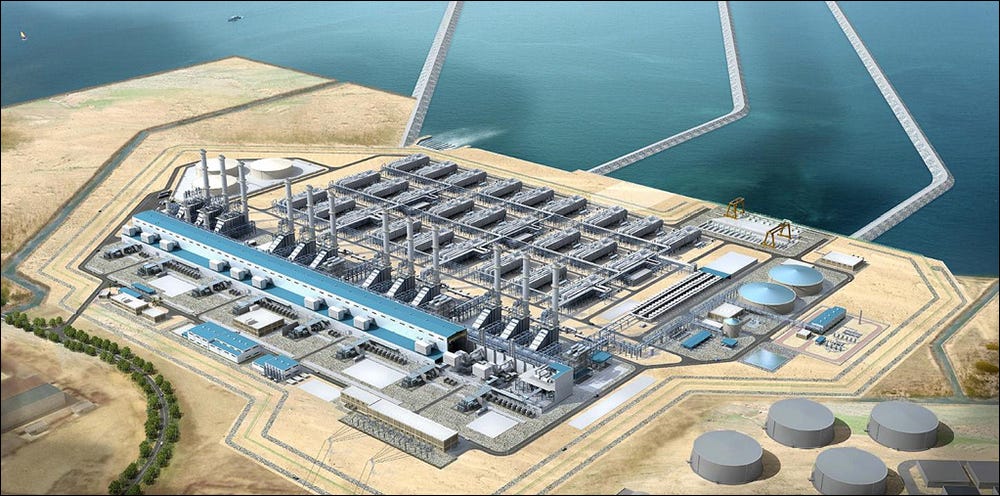
Water is needed for:
cooling systems
steam cycles
industrial processes
If a desalination system integrated with a power plant were disrupted, the consequences could affect both electricity and water supply.
This is why industrial desalination plants often have even stricter redundancy requirements than municipal water facilities.
Security is already extremely serious
One thing I can say from experience working in this sector since 2012:
Security protocols around desalination plants in the Middle East are extremely strict.
Before construction, projects typically undergo detailed risk classification assessments.
Independent security consultants analyze each component of the plant to determine:
which elements are critical
which failures would disrupt supply
which areas require additional protection
Based on that analysis, operators implement measures such as:
surveillance systems
controlled access zones
redundant equipment
physical barriers
Millions of dollars can be invested purely in security measures.
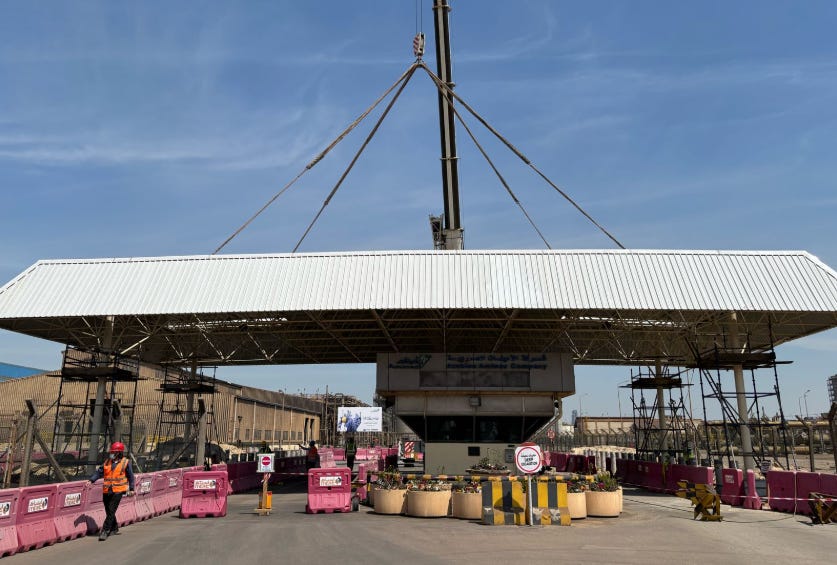
Historically, these protections focused on threats from land or sea.
The evolving role of drones and aerial attacks may push regulators to rethink some of those standards in the future. But probably this should be handled at national level, and not under each project individually.
What happens if plants actually get targeted?
The honest answer is: it depends.
If a desalination plant were destroyed tomorrow, it would not immediately cause cities to run out of water.
Strategic storage and redundancy would cushion the impact.
But if attacks became sustained and widespread over time, the situation could become much more serious.
That said, I personally find it unlikely that desalination plants will become a primary target in most scenarios.
Destroying water infrastructure creates humanitarian crises very quickly — something most actors prefer to avoid.
Still, as recent events remind us, geopolitics can change faster than infrastructure systems can adapt.
The invisible pillar of modern societies
In the Middle East, it is the foundation of modern society.
It allows cities to exist where nature alone would never sustain them.
That’s why countries invest billions into these systems even when desalinated water is expensive.
Because the alternative is simply not viable.
Without desalination, much of the region as we know it today would not function.
Water rarely makes headlines.
But when it does, it usually means something important is happening.
And sometimes, it reminds us just how fragile the systems behind everyday life really are.
Global solution is https://www.bip-it.com/project/625-cloud-power-water-airhes