

New section starting today. Every Friday I’ll share one AI approach I actually use in my daily work.
Just what I do, how I do it, and what I’ve learned along the way.
Today’s one is close to home: you can now connect your AI to The Water MBA Knowledge Hub.
That means you can talk directly to your usual assistant (ChatGPT, Claude, whichever you use) and ask it about anything stored and shared in our Hub.
Your AI reads our data and knowledge and uses it as input for its answers.
Here’s how it looks with ChatGPT and the Notion connector:

Why this matters
Many of you already have standard access to the Hub.
So open your LLM, for instance in ChatGPT, go to Plugins, select Notion, login. Connected.
Aurora Naranjo recently messaged me to discuss how we could improve navigation, given how big this universe is getting. She’s right.
The Hub has grown to the point where browsing it page by page is no longer the best way in form some cases.
The in-app search still works. But now you don’t have to search. You can ask. Have a conversation. Let your AI pull the pieces together for you.
Isn’t that a wonderfully democratic exercise?
“Yeah Ramón, but this is only for annual members, and it has a fee.”
Fair. I have bills to pay too. But the price barrier is small compared to the value this can give you. Or not, as I’ll explain below.
What you can ask
I’ll be sharing many creative ways to take advantage of this connection through future publications.
Start simple: “What has Ramón added today?”
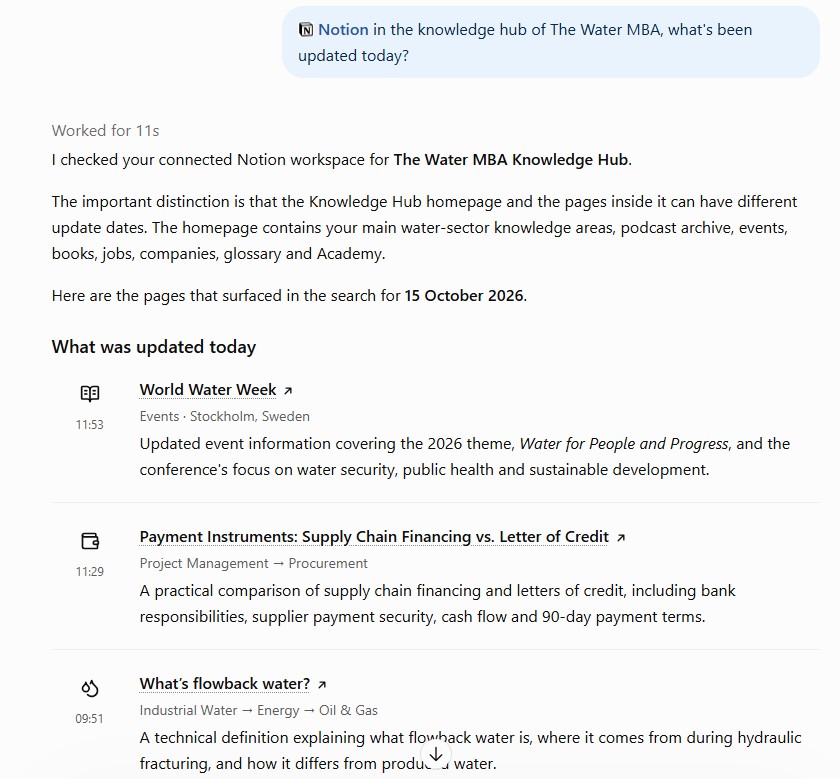
It will tell you what I learned and/or stored.
And what do I store? Every day I try to learn something new. There’s no plan, just a mindset.
Take yesterday:
LinkedIn. Ravid Levy commented on one of my posts about flowback water in oil and gas fracking. I didn’t know it well, so I looked into it and created a page explaining what it is. Stored forever in my second brain.
Email. World Water Week sent me a report with the numbers from the event. I uploaded the PDF to our Water Event Tracker under WWW 2026. Stored forever.
Corporate job. I learned a different way of paying suppliers that can avoid usual problems along the supply chain of water projects. I documented the difference between the two payment methods on the Procurement page of the Hub. Stored forever.
I’ve kept this habit for three years. I hope to keep it for the next thirty.
Do you notice how AI is changing the way we work, and how we need to reshape ourselves to keep creating value?
Try asking your AI:
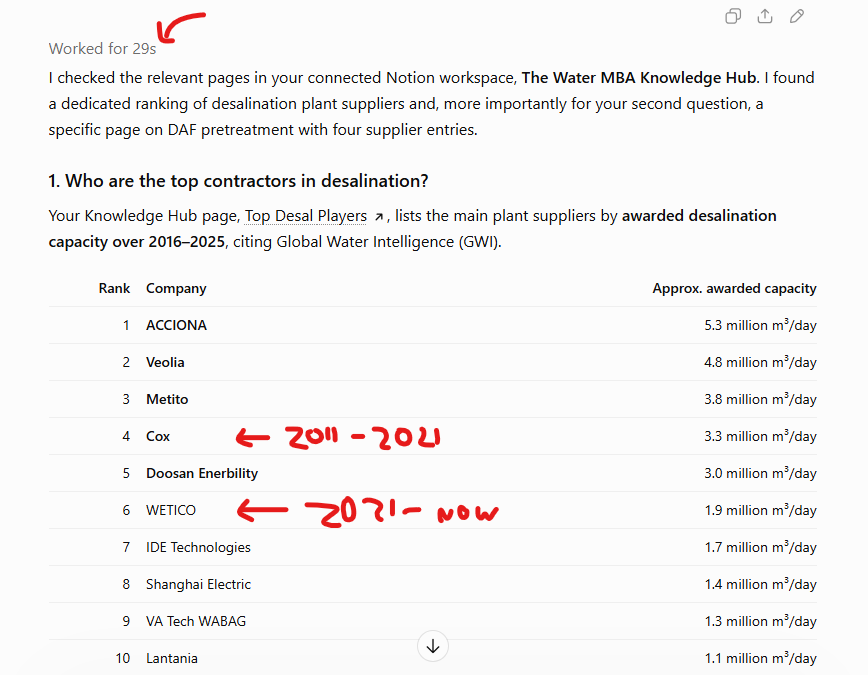
“Who are the biggest contractors in desalination?”
It will pull from the companies and projects we’ve mapped in the Hub and give you a ranked picture, with links to the relevant pages, in less than 30 seconds…
(By the way, since many of you haven’t located my current status: I spent ten years at Cox, and since 2021 I’ve been at WETICO. Just FYI.)
Or something more practical:
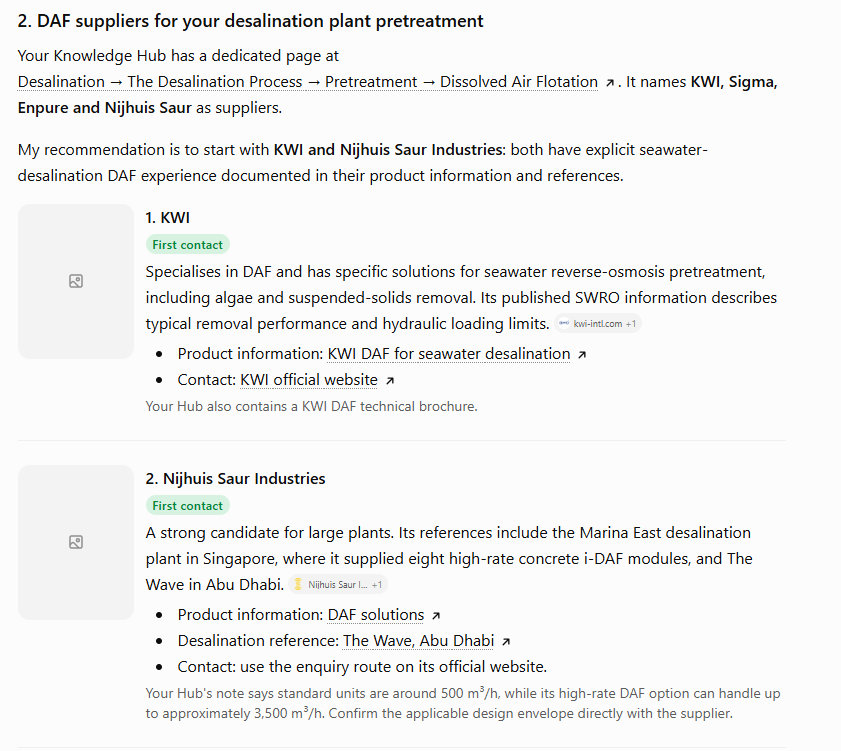
“I need a DAF system. Which suppliers does The Water MBA have stored?”
Here’s the difference from a generic web search: you’re drawing on a source you trust, built by practitioners, and permanently under update. (this is very important)
You get the answer, and links to the pages behind it, so you can check and go deeper.
The gym problem
Now your natural thought: “If I can access everything The Water MBA has built in three years in under five minutes, I’m way ahead.”
Not quite.
If I joined a gym three years ago and you sign up today, the membership card doesn’t make you as fit as me. Access to the equipment isn’t the training.
The real transformation comes from the exercise itself, the mental one.
That’s why our publications are written as essays rather than bullet-point summaries.
They’re designed to make your brain work.
Knowledge is often shades of grey. And turning the same or different knowledge into decisions and daily performance is a different story altogether.
That’s where the real value sits today: in professionals with multidisciplinary experience who can connect dots and break silos.
Is The Water MBA the only source?
Not at all.
I believe each of us will end up with our own AI, fed with our own data (our lived experience), but also with the experience of others, the sources we trust.
In the ideal scenario, your AI draws from you, from The Water MBA, and from many others.
Personally, for example, I’d love to plug into the brain of Christos for brine valorisation, or Mohamed Ateaia for emerging contaminants.
So, once access to knowledge becomes a commodity (free, or a minor fee, which amounts to the same thing), the bar goes up.
Those with curiosity and the habit of getting better every day will perform many times better.
The gap between high performers and standard performers won’t close. It will widen.
Easy access to knowledge doesn’t level the field. It rewards the people who actually do something with it.
Compounding
I hope you find this feature valuable. Our Knowledge Hub still has a long way to go, but as you can see, I add two or three consolidated learnings every day.
The habit does the rest. It compounds daily, and that’s where the transformation happens.
One last thing
AI evolution is breathless. Look at the curve below: it keeps getting steeper, and it will go vertical sooner than we think.

This is an industrial and social revolution. Catch up.
I’m doing it myself.
With our AI in Water course, every module I go through adds another step to how I understand AI is changing the way we work and live in the water business.
See you next FridAI.